"Under Martial Law, Appointed Military Commander Holds Authority, Administrative Functions Are Restricted"
"Closure of Provincial Office: Manual Procedure vs. Neglect of Responsibility"
"Beyond Political Strife, Crisis Response Manuals Need Improvement"
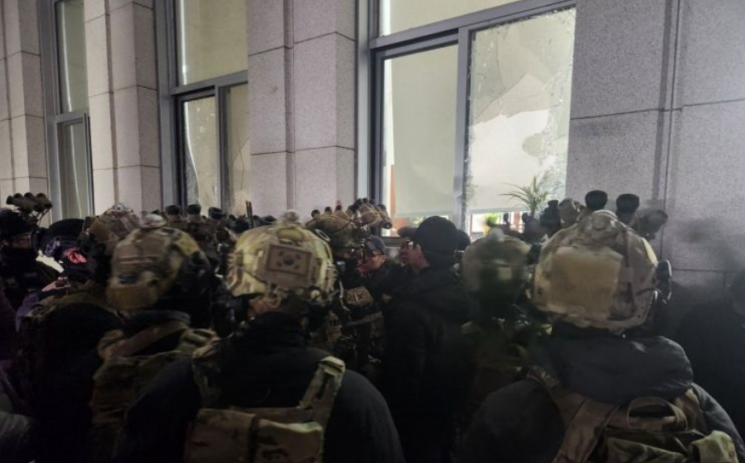
The fact that the Jeju Provincial Government Office was temporarily closed during the December 3 Martial Law declaration last year has only recently come to light, sparking controversy within the local community. Critics are focusing on the claim that the governor neglected his responsibilities over local administration, while opponents argue that, due to the legal structure of the martial law system, the issue is not fundamentally significant.
According to the current Constitution and Martial Law Act, when martial law is declared, the local military commander assumes control over all administrative, judicial, and security matters in the region. In Jeju, the commander of the 9th Marine Brigade is designated as the appointed military unit commander and serves as the martial law commander. In such cases, the functions of local governments are significantly restricted.
Military expert Mr. A explained, "When martial law is declared, the appointed military unit commander effectively holds authority above the governor," adding, "Rather than viewing the closure of the provincial office as a complete administrative paralysis, it should be interpreted as an adjusted measure under martial law."
He further stated, "In an emergency, the principle is to prioritize the defense of key facilities before fully assessing the situation," and added, "Defending garrisons, bases, and government buildings is a basic part of the manual."
An official from Jeju Province also said, "To my knowledge, the martial law manuals from the Prime Minister's Office and the Ministry of the Interior and Safety include a provision for closing government building entrances when martial law is declared," emphasizing, "This is an automatic procedure, not a special measure based on any individual's decision."
A senior official from the Jeju Integrated Defense Council interpreted, "In an emergency, various scenarios must be considered," and added, "If there was even a possibility that the military could have attempted to enter the government building due to a misjudgment, closing the building first and monitoring the movements of the military and National Assembly can be seen as a rational decision-making process for the final decision-maker."
On the other hand, fierce debates over responsibility are taking place in the local political arena. Former provincial council member Mr. B criticized, "The governor abandoned even the minimum role of protecting residents' safety and administrative continuity during a crisis." Conversely, a member of the ruling party countered, "Local government authority is inherently limited under martial law. Framing this as a matter of political responsibility is merely an attack ahead of next year's local elections."
Within the local community, there are growing calls for practical measures rather than political strife. A representative from a civic group pointed out, "The key issue is how to maintain the local safety net during a crisis. Consuming past actions solely as political controversy is not desirable."
Some in the local political scene interpret the controversy as being driven by election strategies. One political figure observed, "With Governor Oh Younghoon having secured a large number of party members and the nomination race no longer being unfavorable, some groups may be seeking political division through excessive attacks."
Ultimately, the controversy over the closure of the provincial office appears to be more about political disputes ahead of next year's local elections than about the legality of martial law procedures. However, since the authority of local administration is fundamentally limited under martial law, political arguments over responsibility have little practical value. This controversy is seen as a reminder of the need to improve crisis response systems and manuals to protect residents' safety and administrative continuity during future emergencies, beyond mere political strife.
© The Asia Business Daily(www.asiae.co.kr). All rights reserved.
![Clutching a Stolen Dior Bag, Saying "I Hate Being Poor but Real"... The Grotesque Con of a "Human Knockoff" [Slate]](https://cwcontent.asiae.co.kr/asiaresize/183/2026021902243444107_1771435474.jpg)
















