Financial Supervisory Service Employees Consider Strike Over Reorganization Plan
Union: "Difficult to Accept Separation of Financial Consumer Protection Agency, Will Undermine Consumer Protection"
First Potential Strike Since Establishment in 1999
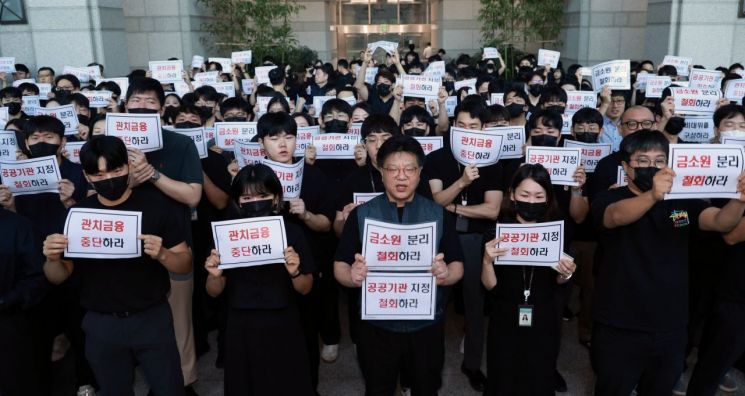 Members of the Financial Supervisory Service Labor Union and employees are condemning the government’s organizational restructuring plan to designate the Financial Supervisory Service as a public institution and to separate the Financial Consumer Protection Agency from the Financial Supervisory Service in the lobby of the Financial Supervisory Service in Yeouido, Seoul, on the 10th. Photo by Yonhap News
Employees of the Financial Supervisory Service are preparing for industrial action in protest against the government's organizational restructuring plan. If the employees of the Financial Supervisory Service proceed with a general strike, it will be the first such event since the institution was established in 1999. Should a strike occur, not only will it disrupt ongoing financial supervisory work, but it is also expected to hinder the new administration's strong push to enhance financial consumer protection.
Financial Supervisory Service Employees Consider Strike Over Organizational Restructuring
On September 10, the labor union of the Financial Supervisory Service announced that it had formed an emergency response committee to discuss future countermeasures and would launch a systematic industrial action. Jeong Boseop, acting chairman (and senior vice chairman) of the Financial Supervisory Service labor union, stated, "To discuss the direction of the struggle, we established an emergency response committee today, with Yoon Daewan, the union's vice chairman, as its head. From the 8th to today, we have convened three consecutive days of delegate meetings to discuss matters such as a strike vote," adding, "We are actively requesting that not only directors at the department head level but also executives above the deputy governor level join the emergency committee."
According to the union's internal regulations, it takes about a week to submit and table an agenda at the delegates' meeting. Therefore, the decision on whether the Financial Supervisory Service labor union will go on strike is expected as early as next week.
On this day, for the second consecutive day, hundreds of employees gathered in the first-floor lobby of the Financial Supervisory Service to hold a rally opposing the government's restructuring plan. According to the organizers, about 700 people-approximately 30% of all employees-gathered and chanted slogans against the government's plan to separate the Financial Consumer Protection Agency and designate both organizations as public institutions.
On September 7, the government announced a revision to the Government Organization Act, which includes separating the Financial Consumer Protection Agency from the Financial Supervisory Service and designating both as public institutions. The intention is to enhance financial consumer protection by making the Financial Consumer Protection Agency independent from the Financial Supervisory Service.
Despite the government's explanation, the backlash from Financial Supervisory Service employees is intense. A union official argued, "The prudential supervision of financial companies and the function of consumer protection must be organically connected. If they are mechanically separated, the functions of supervision and inspection will conflict, and the efficient provision of services related to consumer protection will collapse," adding, "Rather than strengthening consumer protection, the government's restructuring plan will seriously undermine it."
If the union decides to go on a general strike, it will be the first such case since the Financial Supervisory Service was established in 1999. The Financial Supervisory Service was created in January 1999 through the merger of the Bank Supervisory Authority, Securities Supervisory Board, Insurance Supervisory Board, and the Credit Management Fund. At that time, there was also strong opposition from employees of each organization, and the integration was achieved only after considerable difficulty.
 Lee Chanjin, Governor of the Financial Supervisory Service, is attending the "Financial Supervisory Service Governor-Insurance Company CEO Meeting" held on the 1st at the Life Insurance Education and Culture Center in Jongno-gu, Seoul. Photo by Kang Jinhyung
Concerns Over Disruption to Various Financial Supervisory Issues
Due to the union's industrial action, not only the Financial Supervisory Service's financial supervisory work but also the current administration's efforts to strengthen financial consumer protection may face setbacks. The government is currently implementing various lending regulations to stabilize the overheated real estate market in the Seoul metropolitan area. If Financial Supervisory Service employees, who are responsible for the practical execution and supervision of lending regulations in the banking sector, participate in the strike, policy implementation could be compromised. It may also become difficult to actively respond to the current administration's key policy tasks, such as strengthening the productive financial functions of the banking sector, expanding financial soundness, combating stock price manipulation, and establishing a regulatory framework for stablecoins.
There is also a possibility that more talented personnel will leave the organization due to the separation of the Financial Consumer Protection Agency. The Financial Supervisory Service has a high proportion of professionals such as lawyers, accountants, and actuaries, and if they are assigned to the Financial Consumer Protection Agency, many may seek to move to other jobs. An official from the Financial Supervisory Service stated, "Because there are many unique tasks that can only be performed at the Financial Supervisory Service, the proportion of professionals within the organization is higher than at other financial institutions," adding, "If the organization is split into two, employee unrest will intensify."
If talented personnel leave the Financial Consumer Protection Agency, there are concerns that the function of financial consumer protection will also be weakened. The government's intention to enhance financial consumer protection by establishing the Financial Consumer Protection Agency could fail from the outset. An official from the Citizens' Coalition for Economic Justice pointed out, "There are concerns about the expertise of the newly established Financial Consumer Protection Agency as a dedicated organization for financial consumer protection," adding, "It is necessary for the government to significantly strengthen its support in terms of both personnel and resources."
© The Asia Business Daily(www.asiae.co.kr). All rights reserved.
![Clutching a Stolen Dior Bag, Saying "I Hate Being Poor but Real"... The Grotesque Con of a "Human Knockoff" [Slate]](https://cwcontent.asiae.co.kr/asiaresize/183/2026021902243444107_1771435474.jpg)

















