Korea Capital Market Institute's "Innovation in AI and the Financial Investment Industry" Conference
It has been pointed out that the majority of artificial intelligence (AI) patent applications related to financial investment services are concentrated among unlisted IT companies, such as business-to-business (B2B) startups, while the share of traditional financial investment firms, including securities companies, remains minimal. In terms of content, the adoption of AI is particularly low in areas where the importance or risk of work is high, such as large-scale investment banking (IB) deals and mergers and acquisitions (M&A). To promote AI adoption and innovation across the financial investment industry, it is argued that support for pilot programs, infrastructure improvement across all areas, and clear principles for AI development and utilization to support the introduction of AI in high-risk operations are necessary.
Jinyoung Kim, a research fellow at the Korea Capital Market Institute, stated at the "Innovation in AI and Financial Investment Industry" conference held on the morning of the 10th at the Conrad Hotel in Yeouido, during a presentation titled "AI Utilization and Implications in the Financial Investment Sector through Patent Analysis," that "as AI technology evolves from statistical machine learning to deep learning and now to large language models, it is expected to transform the entire financial investment industry and generate added value."
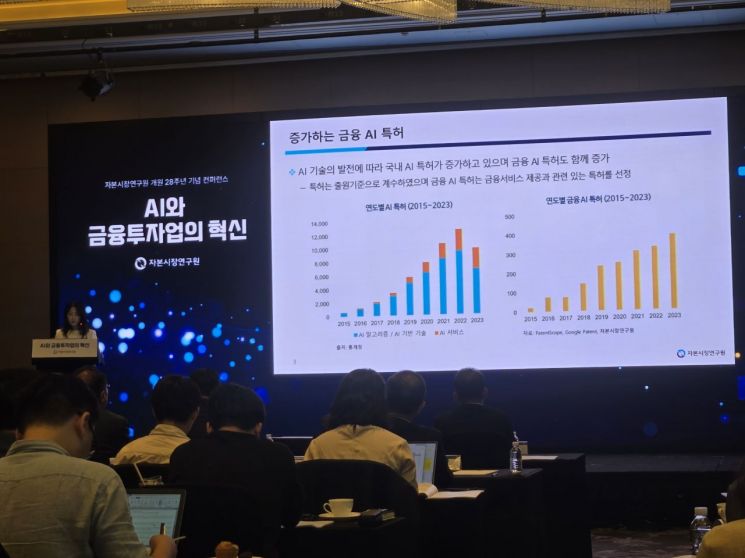 Jinyoung Kim, a research fellow at the Korea Capital Market Institute, is giving a presentation on the topic "AI Utilization and Implications in the Financial Investment Sector through Patent Analysis" at the "Innovation in AI and Financial Investment Industry" conference held on the morning of the 10th at the Conrad Hotel in Yeouido to commemorate the 28th anniversary of the institute's founding.
Kim noted, "AI technology is spreading across all areas of the financial investment industry," but also pointed out, "AI patents are being filed mainly by unlisted companies. SaaS (Software-as-a-Service) startups are leading the integration of AI into financial services."
According to research conducted by Jinyoung Kim and Seongho Noh on the distribution of companies filing AI-related financial investment patents, 67% of all applications came from unlisted SaaS companies, followed by unlisted platform companies (9%) and listed IT companies (7%). The share of patent applications by listed financial companies was only 4%. Based on the distribution of applicants, 54% were unlisted companies and 24% were individuals. Kim emphasized, "The share of traditional financial investment firms is negligible." As a result, it is anticipated that as AI utilization increases in the financial investment sector, the need for third-party risk management among financial investment firms will also grow.
From a content perspective, it was found that AI patents have been filed in most work areas performed by securities companies, asset management firms, and investment advisory firms, ranging from corporate credit evaluation to abnormal transaction detection and chatbot services. Specifically, the highest number of patents were filed in investment advisory and asset management for securities. Brokerage trading and management of public offering funds for securities also ranked high, whereas patents related to private equity funds or real estate and infrastructure funds were relatively few.
Kim assessed, "The potential for AI adoption varies greatly by business area," adding, "In the case of asset management for securities and advisory services, there is high potential for AI utilization throughout the entire value chain, whereas in other businesses, there are areas where short-term adoption is difficult at certain stages." For example, in the IB division of securities companies, many patents were identified in the corporate analysis and valuation stages, indicating high AI utilization potential, but in deal sourcing or underwriting and issuance stages, very few patents were found, suggesting virtually no potential for AI utilization.
The reasons for these disparities in AI utilization include not only the characteristics of the work (degree of standardization), but also data accessibility and the risks associated with introducing AI in high-risk work areas. Kim explained, "AI adoption tends to be more active in areas where work processes are standardized and abundant data is available for training," and added, "In areas such as M&A, where the scale is large and legal risks are high, the potential for AI errors to result in massive losses means that AI utilization is extremely limited." In such high-risk operations, a single mistake or misjudgment can often lead to significant financial losses or legal disputes.
He also highlighted overseas cases of AI utilization. When analyzing the degree of AI adoption in the global financial investment industry across three stages-stable adoption, initial adoption, and low utilization-it was found that internal document processing and code automation, market surveillance, investment research, and robo-advisors are already being operated stably. Algorithmic trading and HFT (high-frequency trading) efficiency improvement, investor communication via chatbots, and enterprise-wide LLM-based work support are in the early stages of adoption. However, fully autonomous trading, investment advisory, and alternative credit risk applications showed low levels of utilization.
Kim commented, "While there are reported cases of company-wide work support based on generative AI, this is still considered an early stage of adoption," and evaluated, "The differences in AI utilization by work area are determined by factors such as the overall maturity of the technology, including performance and stability, the gap between expected benefits and development costs, and the limitations of available computing resources."
To accelerate AI adoption and innovation in the financial investment industry, he emphasized the need to first create an experimental environment by effectively validating AI adoption through pilot programs. He also highlighted the importance of infrastructure improvement across all areas, from data import and processing to security and governance. Regarding high-risk operations with particularly low AI utilization, he added, "It is necessary to clearly establish responsibilities through principles for AI development and utilization," and stressed that "support for the introduction of AI in high-risk areas is needed."
On the same day, Minkyoung Kwon, a research fellow at the Korea Capital Market Institute who gave a presentation titled "The Future of Investment: Focusing on Transformers," analyzed the impact of the 'Transformer' architecture-central to recent AI technology advancements-on investment paradigms and compared two new investment approaches utilizing this technology: the 'LLM Agent Model' and the 'Finance-Specialized Model.' Through this, she forecasted fundamental changes in future investment methods and emphasized the need for financial companies to prepare for the future by focusing on securing 'data' as a core asset with a long-term perspective.
© The Asia Business Daily(www.asiae.co.kr). All rights reserved.
![Clutching a Stolen Dior Bag, Saying "I Hate Being Poor but Real"... The Grotesque Con of a "Human Knockoff" [Slate]](https://cwcontent.asiae.co.kr/asiaresize/183/2026021902243444107_1771435474.jpg)
















