Jeju Tourism Fully Recovers After Slowdown
Korean Overseas Travel: Fewer Trips to Japan, More to China
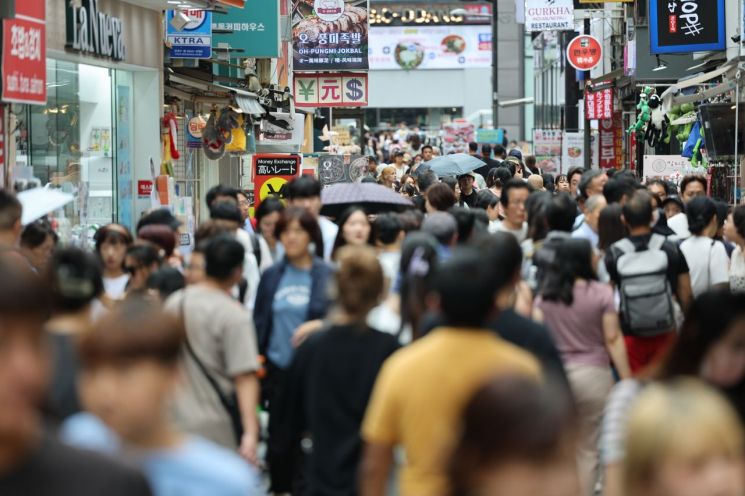
Recently, the number of foreign tourists has noticeably increased in central Seoul and major tourist destinations in Jeju Island. This appears to be due to the ongoing Korean Wave and the depreciation of the Korean won. According to travel statistics from July, before the impact of "K-Pop Demon Hunters" was reflected, the rise in foreign tourists is evident in the numbers.
According to the SK Securities report, "Returning Chinese Tourists, What Should We Watch Out For?" released on September 10, the number of foreign visitors to Korea is steadily increasing across various nationalities. In July, the most recent month for which statistics are available, the number of visitors from Japan reached 360,000. This represents a 21.6% increase compared to the same period last year and a 73.1% increase compared to January of this year. The number of visitors from China reached 500,000, up 21.0% from the same period last year and up 52.3% from January of this year.
Will Returning Chinese Tourists Spend as Much as Before?
One interesting fact is that in July, the share of total inbound visitors by point of departure was 27.8% for China and 20.0% for Japan, but by nationality, it was 35.1% for Chinese and 17.0% for Japanese. This indicates that a significant proportion of Chinese tourists visit Korea via third countries such as Japan or Southeast Asia.
There are high expectations that the number of Chinese tourists will surge when the visa-free policy for Chinese nationals is implemented on the 29th. Before 2016, when Chinese tourists flooded into Korea, the duty-free and luxury retail sectors enjoyed a boom. However, the situation is different now. Na Seungdoo, an analyst at SK Securities, stated, "We need to reconsider the current spending power of Chinese tourists," and analyzed, "Whereas foreign tourists used to be found in department stores, duty-free shops, and luxury boutiques, they are now more easily found in stores offering value-for-money products."
Koreans’ Overseas Travel Destinations Have Changed Dramatically
When comparing January and July of this year, a clear shift in overseas travel trends among Koreans can be observed. In January, 930,000 Koreans traveled to Japan, making it the most popular destination by far. During the same period, 440,000 visited Vietnam and 200,000 visited China. However, in July, the number of Koreans traveling to Japan dropped to 670,000, a 28.4% decrease from January, while the number traveling to China increased to 250,000, a 22.5% rise. Compared to the same period last year, travel to Japan decreased by 9.7%, while travel to China grew by 29.0%.

This is interpreted as a result of growing concerns about natural disasters in Japan, while China has emerged as a cost-effective travel destination. Additionally, the rapid recovery of travel routes to various Chinese cities has had a positive impact. In August, the number of passenger flights at Incheon International Airport was about 33,000, similar to January of this year, but flights to and from China surged from about 6,400 in January to 7,400 in August. In contrast, flights to and from Japan slightly decreased from about 8,500 in January to 8,400 in August.
Chinese Visitors to Jeju Island Expected to Increase Further
Due to controversies over overcharging, the number of Koreans visiting Jeju Island fell to around 700,000 in February and March this year. However, thanks to the summer peak season and improved consumer sentiment, the number of domestic visitors to Jeju in August reached 1.1 million, a slight increase of 1.1% compared to the same period last year.
During the same period, the number of foreign visitors to Jeju reached 240,000, a 14.4% increase from the same period last year. The number of Chinese visitors, which was around 70,000 in November and December last year, surpassed 100,000 in March and recovered to about 180,000 in July. In the first week of September alone, the cumulative number of foreign visitors to Jeju was about 53,000, a 26.5% increase from the same period last year.
With the visa-free policy for Chinese nationals set to take effect at the end of this month, it is only a matter of time before the number of monthly Chinese visitors to Jeju surpasses 200,000 for the first time since October 2016. Analyst Na commented, "Some argue that demand for travel to inland areas could reduce the number of visitors to Jeju, but this is likely an unfounded concern," adding, "In fact, we should consider the possibility that foreign tourists entering through inland regions may seek out alternative destinations beyond Seoul, such as Jeju Island."
© The Asia Business Daily(www.asiae.co.kr). All rights reserved.


















