NVIDIA Responds to iPhone 17 Launch
Specialized for Long-Context Computation, Excels in Video Processing
Adopts GDDR7 Memory, Signals Shift from HBM-Centric Strategy
On the same day Apple announced the iPhone 17, NVIDIA also unveiled a new product, underscoring its position as a key player in the era of artificial intelligence (AI). In particular, NVIDIA’s decision to use GDDR7 instead of high-bandwidth memory (HBM) for its new graphics processing unit (GPU) has drawn attention to the possibility of a shift in its future memory strategy.
On September 9 (local time), NVIDIA introduced its new product, the Rubin CPX, which differs from its previous GPUs.
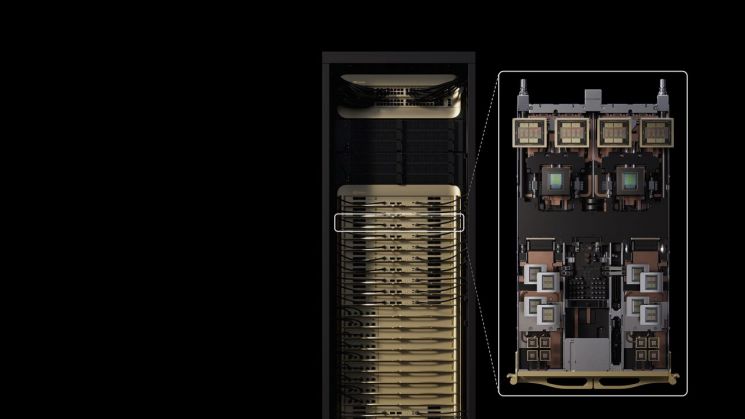
The Rubin CPX is a dedicated GPU designed to handle video encoding (compression), decoding (decompression), and AI inference all on a single chip. The Rubin CPX is specialized for efficiently processing up to one million tokens of lengthy sentences required to generate about an hour-long video. In simple terms, it is a chip optimized for generative AI models like ChatGPT to understand and respond to long-form content. The product is scheduled for release at the end of 2026, and pricing has not yet been announced.
A single NVL144 CPX system delivers a performance of 8 exaflops (ExaFLOPS, or 1018 operations per second) and 100TB of memory, which, according to NVIDIA, represents an advancement in both performance and bandwidth compared to the Blackwell-based NVL72.
The Rubin CPX adopts 128GB of GDDR7 memory instead of the more expensive HBM used in previous NVIDIA GPUs such as Hopper and Blackwell. NVIDIA emphasized that by applying this relatively affordable yet high-speed memory, it has reduced costs while improving the speed of calculating contextual word associations by more than three times compared to previous models.
While HBM is considered essential for large-scale AI training due to its fast data transfer rates and wide bandwidth, it is difficult to manufacture, expensive, and challenging to develop. In contrast, GDDR7 offers slightly lower performance but is highly cost-competitive and suitable for mass production. Through the Rubin CPX, NVIDIA has revealed its strategy to maximize cost efficiency during the AI inference stage.
NVIDIA’s choice of GDDR7 over HBM could significantly impact the global memory market. The established notion of "high performance equals HBM" may shift toward a diversified structure, with HBM and GDDR7 being used for different applications. In other words, HBM could remain the standard for high-performance AI training, while GDDR7 could dominate the inference market. Samsung Electronics, which has lagged behind in HBM, holds a competitive edge in GDDR7.
The introduction of the Rubin CPX also aligns with the current trend in the AI industry toward fiercely competitive multimodal video generation AI. Google is enhancing its video generation model through Nanobanana, while OpenAI is actively integrating video generation capabilities into ChatGPT, expanding beyond images and text. As Google increases its use of its own AI chip, the TPU, NVIDIA’s launch of the Rubin CPX is seen as a move to solidify its infrastructure advantage. By diversifying its product lineup and segmenting the market, NVIDIA is expected to intensify the challenges faced by competitors such as AMD and Intel.
© The Asia Business Daily(www.asiae.co.kr). All rights reserved.

















