"September 7 Real Estate Supply Plan Called a 'Rehash' of Previous Administration's Policies"
The People Power Party criticized the Lee Jaemyung administration's September 7 real estate supply plan, stating, "Playing with numbers while ignoring the basic principles of the market cannot solve the real estate problem." The party argued that a supply system centered on the private sector is necessary to address the housing shortage in the Seoul metropolitan area.
On September 9, the People Power Party's Real Estate Market Stabilization Response Task Force held an "Emergency Forum on the Evaluation and Prospects of the Lee Jaemyung Administration's Real Estate Supply Plan" at the National Assembly.
On September 7, the government announced its plan to commence construction on a total of 1.35 million housing units in the Seoul metropolitan area by 2030. The government also revealed that public housing sites, a key means of supply in the region, will now be developed directly by Korea Land and Housing Corporation (LH). Instead of selling the residential land developed by LH to the private sector, LH will directly supply the housing, aiming to accelerate the supply process and increase the volume.
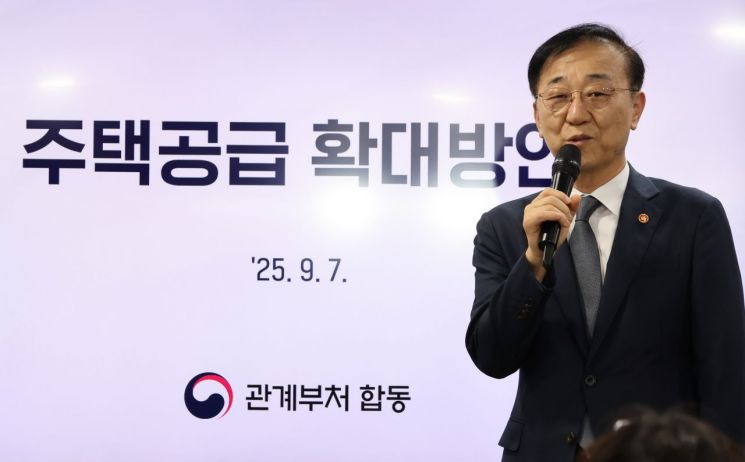
This approach has been criticized as a mere rehash of previous policies. Measures such as preventing the division of commercial spaces, allowing simultaneous applications for project implementation and management approval, and raising the acquisition price for rental housing-all announced last year-have been brought up again.
Kwon Youngjin, the People Power Party lawmaker and chair of the task force, said, "This seems to be a patchwork of policies announced by the previous administration or a superficial change of standards from housing permits to construction starts. There is an acute shortage of housing in the metropolitan area right now, yet no short-term solutions are being presented."
There was consensus that the direct implementation by LH also has clear limitations. Park Kijoo, Director of Industrial and Economic Policy at the Yeouido Institute, expressed concern, saying, "Expanding direct implementation by LH does not absolutely increase the total housing supply but merely changes the supplier for the already designated volume. This 'land swap' approach may not be well received by citizens due to concerns about the quality of supplied housing." Assemblyman Kwon also warned, "It could simply increase LH's debt burden, which already exceeds 160 trillion won, or shrink the private market."
Accordingly, there were calls for a supply plan centered on the private sector. Song Eonseok, the People Power Party's floor leader, emphasized, "Housing should be supplied where and how people want it. The Lee Jaemyung administration is stifling the construction industry, so it is important to create space for the private sector to operate by rationalizing regulations and revitalizing the construction sector."
There were also suggestions that a qualitative approach, rather than a quantitative supply plan, is needed. Lee Changmoo, professor of urban engineering at Hanyang University, pointed out, "The rental market is currently the most directly affected by the lack of new housing. It is disappointing that the focus remains solely on the sales market and quantitative supply as the solution."
© The Asia Business Daily(www.asiae.co.kr). All rights reserved.

















