Ahead of the 4th Greenhouse Gas Emissions Trading Allocation Plan Announcement
Industry: "We Must Overhaul All Plans... Reduction Targets Are Excessive"
"NDC Calls for 11%, New Government Plan Demands 30%"
As the announcement of the "4th Greenhouse Gas Emissions Trading Allocation Plan," which will be applied from 2026 to 2030, approaches, the industrial sector is mounting strong opposition. The government has proposed a plan to significantly increase its reserve quota and sharply expand the proportion of paid allocations in the power generation sector, while reducing the amount of pre-allocated quotas given to companies. This is because the burden on companies would increase substantially.
At the "4th Allocation Plan for the Greenhouse Gas Emissions Trading System Forum" held at the Korea Chamber of Commerce and Industry assembly hall on September 9, industry participants voiced concerns about the plan to be released by the Ministry of Environment. According to the government proposal, the total emissions cap will be about 640 million tons, and more than 110 million tons will be allocated as reserves. In addition, the proportion of paid allocations in the power generation sector is expected to be expanded to 50% by 2030.
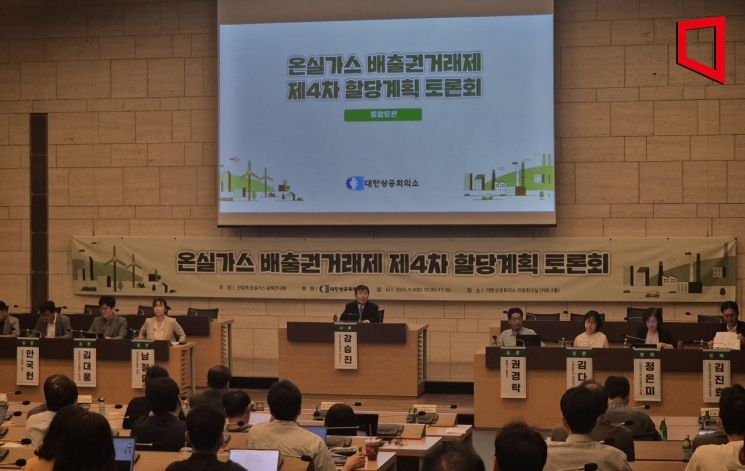
Nam Jeongim, Director of the Climate, Environment, and Safety Office at the Korea Iron & Steel Association, pointed out, "The industry has so far established facility investment and reduction plans based on the premise of an 11.4% reduction in line with the national greenhouse gas reduction target (NDC) for 2030. However, the 4th allocation plan groups industry into the 'non-power generation sector' and demands a 30.1% reduction." She added, "In effect, we are now forced to scrap all the plans we have prepared and start over." The industry believes that this would impose an additional burden of about 19 percentage points compared to the NDC, and sees the demand to triple the scale of emissions quota reductions as an "excessive burden."
The petrochemical industry pointed out the lack of realistic reduction measures. Kim Daeung, Head of the Sustainable Management Division at the Korea Chemical Industry Council, said, "Flare stacks are like 'emergency respirators' for factories. They are essential safety equipment that releases internal gas in the event of a power outage or facility malfunction. If these are targeted for reduction, it is as if companies are being told not to breathe." He also argued that the current offset quota limits should be maintained.
The refining industry also expressed concerns about the excessive reduction in the total cap and cost issues. Ahn Gukheon, Head of the Sustainable Management Division at the Korea Petroleum Association, said, "Reducing the total cap to match the nation's annual emissions of 690 million tons is unrealistic." He further noted, "Reduction measures such as carbon capture, utilization, and storage (CCUS) are extremely costly and difficult for companies to handle alone," emphasizing that "government-led support is essential."
The industry particularly criticized the government for misinterpreting the recent decrease in emissions. In the refining, petrochemical, and steel sectors, emissions have only temporarily decreased due to global oversupply and weakened demand, which led to reduced production. However, the government used this as a basis to conclude that "existing emissions quotas were overestimated" and drastically reduced the total cap. An industry official pointed out, "If production recovers as the economy normalizes, it will be impossible to achieve reduction targets within the already reduced pre-allocated quotas," and added, "Viewing figures that have decreased due to a crisis as reduction performance is a misinterpretation of industrial reality."
The government will release the final plan at a public hearing on September 12 and will accept online feedback until September 15.
The industrial sector unanimously stressed, "For companies to continue voluntary reduction efforts, a predictable system and support must be in place." Jo Youngjun, Head of the Sustainable Management Institute at the Korea Chamber of Commerce and Industry, said, "The government must balance achieving carbon neutrality targets with maintaining industrial competitiveness when improving the system."
© The Asia Business Daily(www.asiae.co.kr). All rights reserved.

















