Song Eonseok: "Will Actively Support Smooth Operation"
Two-Track Approach: Current Issues and People's Livelihoods
Contentious Bills Also Expected on the Agenda
Concerns Remain Over Potential Stalemate Amid Intensifying Partisan Standoff
With the Democratic Party of Korea and the People Power Party agreeing to promote joint pledges through the People's Livelihood Economic Council, attention is focused on whether this move will provide relief for the stagnant economy affecting people's daily lives. Issues that have been pushed aside due to ongoing conflicts between the ruling and opposition parties-such as revitalizing local real estate markets, measures for youth employment, and easing the criminal breach of trust law-are expected to be prioritized for discussion. However, there are still concerns that the council may end up in a stalemate and ultimately dissolve without results, as numerous contentious issues between the two parties remain unresolved.
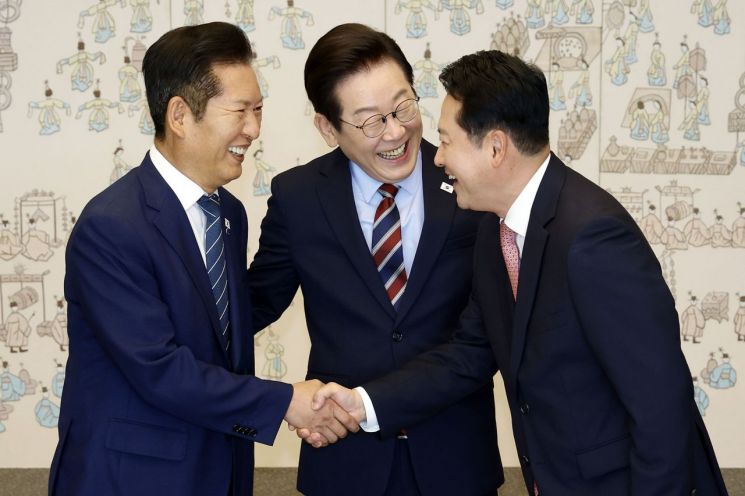 President Lee Jae-myung is watching Democratic Party leader Jeong Cheong-rae and People Power Party leader Jang Dong-hyuk shake hands during a luncheon meeting with party leaders at the Yongsan Presidential Office on the 8th. Photo by Yonhap News Agency
According to political sources on September 9, the ruling and opposition parties have begun working-level preparations to establish the People's Livelihood Economic Council, following an agreement reached the previous day between Democratic Party leader Jeong Cheongrae and People Power Party leader Jang Donghyuk. It is reported that the People Power Party is preparing for working-level consultations led by floor leader Song Eonseok. At a party strategy meeting at the National Assembly that morning, Song stated, "We will actively support the smooth formation and operation of the People's Livelihood Economic Council between the ruling and opposition parties."
The council is expected to first address joint pledges from the last presidential election and livelihood issues on which both parties have relatively few disagreements. Previously, in July, the two parties agreed to pursue common pledges, with the Democratic Party proposing to the People Power Party the passage of 11 non-controversial bills, including the Capital Markets Act and the Electronic Securities Act. This time, as the agenda will mainly focus on proposals from the opposition leader, topics of interest to the opposition-such as the Income Tax Act and real estate policies-are expected to be discussed in depth.
First, regarding the tightening of the major shareholder standard for stock transfer income tax, President Lee Jaemyung expressed his willingness to cooperate with leader Jang the previous day, suggesting that the government's stance could change. The Ministry of Economy and Finance had initially announced plans to tighten the taxation standard from 5 billion won to 1 billion won per stock, but the People Power Party has argued that the standard should be relaxed to enhance corporate value.
In addition, for real estate policy, measures to support unsold housing in local areas and expand construction investment may be discussed to boost the regional economy. In particular, the easing or abolition of the criminal breach of trust law and support measures for youth employment-issues on which there is consensus between the parties-are expected to gain momentum. Other issues, such as the Yellow Envelope Act, amendments to the Commercial Act, and the Serious Accidents Punishment Act, may also be brought to the table, but it is unlikely that the Democratic Party will reflect the opposition's views on these matters.
This council will operate separately from the current contentious issues between the ruling and opposition parties. The intention is to cooperate on people's livelihood issues, even if conflicts persist over matters such as ending the state of rebellion, special prosecutor investigations, or controversial bills. However, many believe that the council's operation will not proceed smoothly, based on past experiences. In fact, similar councils were launched or proposed during the Moon Jaein and Yoon Sukyeol administrations, but they were dissolved shortly thereafter. The decision not to hold regular meetings this time also appears to reflect concerns about potential disruptions.
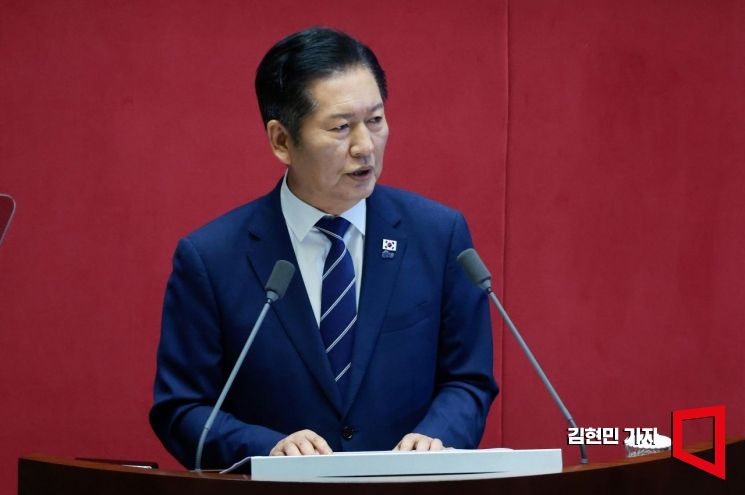 Jeong Cheongrae, leader of the Democratic Party of Korea, is delivering a speech as the representative of the negotiating group at the National Assembly plenary session on the 9th. 2025.9.9 Photo by Kim Hyunmin
Currently, cooperation between the ruling and opposition parties remains challenging. Although the party leaders shook hands for the first time during a luncheon with President Lee Jaemyung the previous day, there was a clear difference in tone. After a joint briefing on the luncheon, each party's chief spokesperson gave separate briefings: the Democratic Party emphasized the significance of communication and cooperation, while the People Power Party focused on the opinions delivered by leader Jang as the opposition.
In particular, regarding the amendment to the Special Prosecutor Act and the establishment of a special court for rebellion-which the ruling party is actively pursuing-leader Jang directly asked President Lee to "exercise the right to request reconsideration." In response, leader Jeong countered by stating, "We must thoroughly root out and punish the ringleaders and key participants of the rebellion, as well as those who aided them, and leave this as a historical lesson."
© The Asia Business Daily(www.asiae.co.kr). All rights reserved.


















