Continued Security Crisis in the Strait of Hormuz Raises Concerns
Asian Countries Move Away from Qatar as Key LNG Import Source
U.S. Share of LNG Imports Already on the Rise
U.S. Pressures Allies to Import Domestic LNG and Join Alaska Proje
The United States began its full-fledged efforts to contain China following the Obama administration's declaration of the "Pivot to Asia" strategy in 2011. In March 2023, Chinese President Xi Jinping told Russian President Vladimir Putin, "We are witnessing changes unseen in a century, and we are leading these changes." As the confrontation between the United States and its allies versus China and Russia intensifies, the security of energy supply chains has become even more critical.
On September 9, Daishin Securities released a report titled "The Beginning of the End for Qatar, Make America LNG Again," predicting that the share of Qatari LNG, a country friendly with Iran, will inevitably decrease, while exports of American LNG will rise. The report also forecasted a surge in LNG carrier orders for Korean shipyards.
Hormuz Strait Crisis and U.S. Pressure
The leading LNG exporters worldwide are the United States, Qatar, Australia, and Russia, in that order. Due to the Russia-Ukraine war, European countries have reduced their imports of Russian LNG, allowing the United States to emerge as the world's largest LNG exporter. Earlier this year, President Trump resumed LNG export permits for countries without free trade agreements, which had been suspended by the previous administration over environmental concerns.
Qatar, on which Asian countries primarily rely, is located within the Strait of Hormuz. This strait handles 20% of the world's LNG and crude oil maritime trade, and 85% of the shipments destined for Asia pass through here. The navigable section for Very Large Crude Carriers (VLCCs), with a depth of 25 to 30 meters, is only about 3 kilometers wide, and most of it falls within Iranian waters.
When there is a threat of blockade in this area, as during the Israel-Iran war, the only alternative routes are through Saudi Arabia and the United Arab Emirates (UAE). For countries like Qatar and Iraq, transportation disruptions are inevitable. For Asian nations, this presents a risk factor of a completely different magnitude compared to the Russia-Ukraine war.
The United States has openly demanded that its allies increase imports of American LNG and participate in the Alaska LNG Project. In June, Secretary of the Interior Burg Burgum stated, "The Alaska LNG Project will play a key role in the energy and supply chain security of our allied nations." In response, South Korea decided to double its imports of American LNG. Japan plans to triple its imports and participate in the Alaska LNG Project through equity investment. Taiwan has also signed a Letter of Intent (LOI) to invest in the Alaska LNG Project.
South Korea Benefits from U.S. Strategic Choices
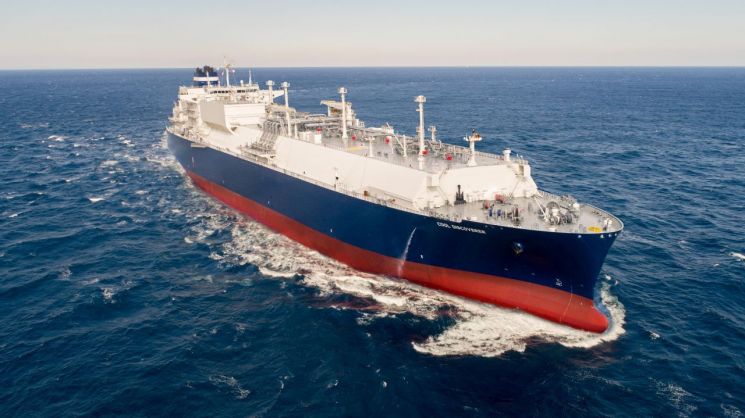
With the rapid increase in American LNG production, orders for LNG carriers are expected to flood into Korean shipyards. Daishin Securities cited the following reasons: increased operational risks for Chinese-built ships, the exclusion of strategic orders from an energy security perspective, and the limited capacity of American shipyards.
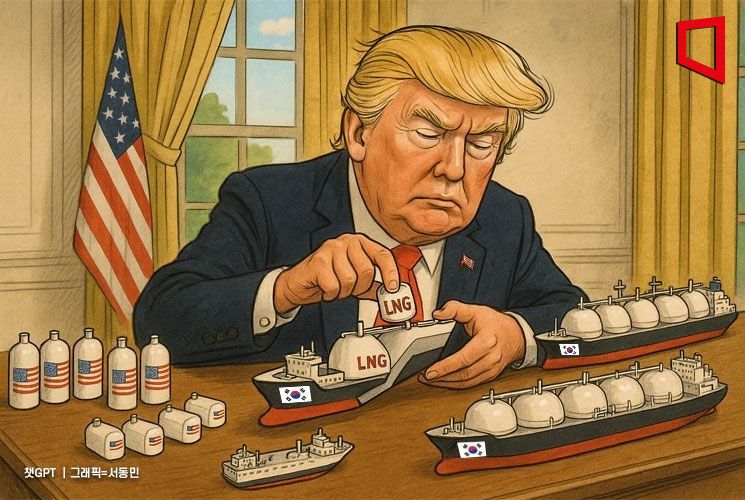
Initially, the U.S. government announced that starting in 2029, LNG producers would face fines if they failed to transport a portion of their exports using U.S.-built vessels. Although this policy was withdrawn in June, surcharges for shipping companies using Chinese-built vessels remain in place. As penalties are set to be enforced in earnest from October, companies that own or use Chinese ships will inevitably face higher long-term vessel operating costs.
The United States is concerned that the technology for building large LNG carriers could be transferred to warship construction. According to an analysis by the Center for Strategic and International Studies (CSIS), Chinese state-owned shipbuilders such as CSSC and Hudong-Zhonghua have strengthened their military capabilities based on their commercial shipbuilding expertise. As a result, an increase in the market share of Chinese shipyards for commercial vessels directly translates into a security risk for the United States. Of the 80 LNG carriers on order at Chinese shipyards, all but three are being built by subsidiaries of CSSC. Consequently, the United States and Europe are reluctant to place LNG carrier orders with Chinese shipyards.
The Trump administration has belatedly announced its intention to enhance domestic shipbuilding capabilities and is seeking technology transfers from South Korea. However, this will take time. Recently, Hanwha Philly Shipyard secured an order for one LNG carrier, but much of the construction will take place at Hanwha Ocean's dock in South Korea. Ultimately, American shipyards will not be able to independently build large LNG carriers for a considerable period.
As a result, Korean shipyards are expected to maintain a monopoly on next-generation LNG carrier orders. Choi Jin-young, an analyst at Daishin Securities, stated, "As of August, domestic shipyards have secured orders for a total of 15 LNG carriers, which falls short of market expectations. However, with the acceleration of final investment decisions (FID) for American LNG projects and the monopolization of orders by Korean shipyards, we forecast that domestic shipyards will secure orders for 57 LNG carriers in 2025, 105 in 2026, and 83 in 2027."
© The Asia Business Daily(www.asiae.co.kr). All rights reserved.