Comprehensive Analysis of This Year's Court Rulings
Cases Where Offenders Received Lenient Sentences
Judicial Authorities Must Change Their Perception
It has been confirmed that only one out of ten offenders who violated interim measures prohibiting them from approaching or contacting stalking victims received an actual prison sentence. Experts point out the need for effective protective measures and stricter punishment for violations of interim measures.

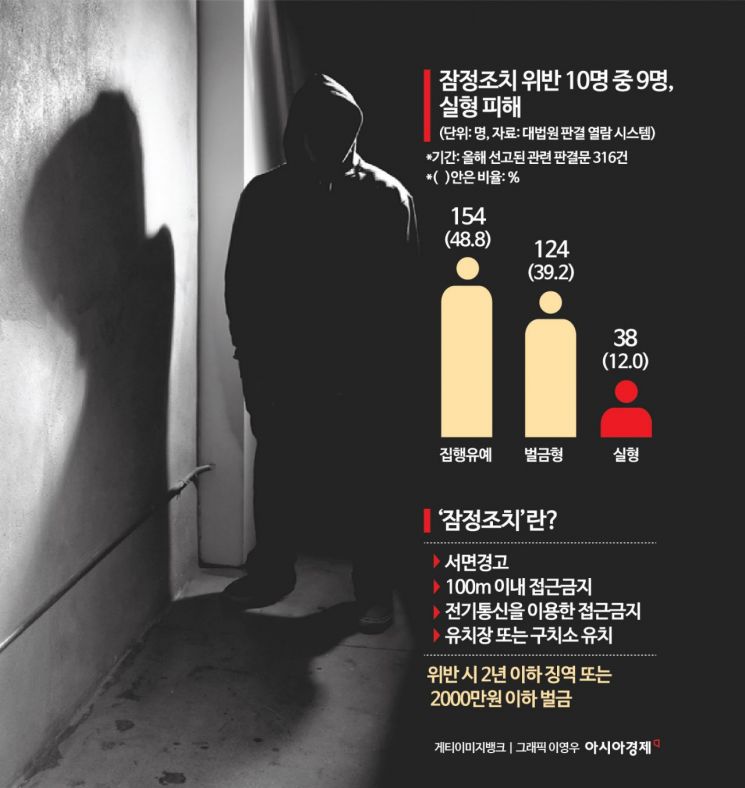
On September 9, Asia Economy conducted a comprehensive analysis of 316 court rulings on stalking crimes involving violations of interim measures that were handed down this year, using the Supreme Court's verdict viewing system. The results showed that 278 offenders (88.0%) did not receive actual prison sentences. Among them, 154 (48.8%) were given suspended sentences, while 124 (39.2%) were fined. In effect, a significant number of stalking offenders received lenient treatment from the courts.
Interim measures are issued to protect stalking victims, initiated by a police request to the prosecution and decided by the court. The main provisions include prohibiting the offender from approaching within 100 meters of the victim’s residence or workplace, and banning contact through phone calls, text messages, or social networking services (SNS) and other communication means, both online and offline. Violating these measures can result in up to two years in prison or a fine of up to 20 million won.
Violating interim measures and re-approaching the victim is considered not just a simple legal violation, but a warning sign that could escalate into a serious crime. In July this year in Ulsan, Jang Hyeongjun (33), who attempted to murder a woman he had dated by stabbing her dozens of times with a knife, had previously been subject to interim measures by the court for confining and assaulting the victim.
However, courts remain reluctant to impose actual prison sentences on offenders who violate interim measures. In October last year, despite the interim measures, Mr. A went near the victim’s workplace in Dongnae-gu, Busan, and sent multiple text messages. Nevertheless, in July this year, the Busan District Court sentenced Mr. A to four months in prison, suspended for one year. Mr. B, despite being under a restraining order from January to April this year, visited the victim’s residence and knocked on the front door several times. However, on September 7, the Seosan Branch of the Daejeon District Court sentenced Mr. B to one year in prison, suspended for two years. The main reason offenders are not given actual prison sentences is that most have no prior record of stalking.
Experts emphasize that the judiciary’s perception, which underestimates the dangers of stalking crimes, needs to change.
Attorney Lee Eunui stated, "Judges often fail to grasp the seriousness of harm in crimes they are unlikely to experience themselves, so even when interim measures are violated, cases often end with fines or suspended sentences. While actual prison sentences are handed down for property crimes or fraud, a lenient and double-standard attitude toward de facto violent crimes like stalking must be overcome in order to have a preventive effect against stalking crimes."
Song Ranhee, Executive Director of Korea Women’s Hotline, said, "The most effective way to prevent stalking is to detain offenders in detention centers or require them to wear electronic ankle bracelets. However, because courts and investigative agencies tend to downplay the risks of stalking, they remain reluctant to implement such measures."
© The Asia Business Daily(www.asiae.co.kr). All rights reserved.


















