Proactive Initiatives Spread, Leading to Tangible Results
Government Discusses Shorter Working Hours and Retirement Age Extension... Concerns Over Side Effects
Twenty-one years after the introduction of the five-day workweek, discussions on moving toward a 4.5-day workweek are gaining momentum, signaling a visible paradigm shift in the labor market. Some companies are already leading the change by implementing a four-day workweek.
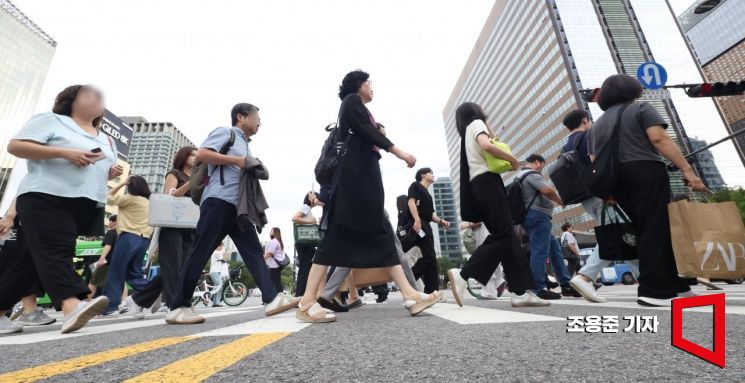 Citizens are hurrying on their way to work at the Gwanghwamun intersection. Unrelated to the article. Photo by Asia Economy DB
According to the Ministry of Employment and Labor on September 8, the average annual working hours for wage workers in South Korea in 2022 stood at 1,904 hours, which is 185 hours more than the OECD average of 1,719 hours. Among OECD member countries, only five-Colombia, Mexico, Costa Rica, Chile, and Israel-have longer working hours than South Korea. A survey by the Korea Institute for Health and Social Affairs also found that South Korea ranked near the bottom among 31 countries in terms of "time sovereignty."
As artificial intelligence (AI) becomes more widespread and productivity innovation emerges as a key factor for corporate competitiveness, there is growing criticism that long working hours not only diminish workers' quality of life but also undermine economic vitality. At the same time, with the proportion of the population aged 65 and older reaching 20.3% this year and South Korea entering a super-aged society, discussions about extending the retirement age have become unavoidable.
Proactive Initiatives Spread, Leading to Tangible Results
While labor groups and political circles advocate for the introduction of a 4.5-day workweek and retirement age extension, several companies are already experimenting with proactive changes.
SK Telecom and SK Square have introduced a 4.5-day workweek called "Happy Friday," allowing employees to take Fridays off if they complete 80 hours of work over two weeks. In July 2022, Hunet became the first in the industry to adopt a four-day workweek, resulting in a more than threefold increase in hiring competition and a 20% rise in sales. Security firm Suprema also saw sales increase by 72% and operating profit by 51% after implementing the 4.5-day workweek.
Major conglomerates such as Samsung Electronics, LG Electronics, and SK Hynix are also expanding flexible work arrangements, re-employment of older workers, and long-term utilization of specialized talent. Samsung Electronics supports work-life balance through a flexible work system, while SK Hynix encourages knowledge transfer with an engineer program that has no age or rank restrictions. LG Electronics has introduced a self-directed work hour system to boost employee satisfaction. Some local governments, including Jeju Island and Ulsan, are also operating a 4.5-day workweek using flexible work arrangements.
Government Discusses Shorter Working Hours and Retirement Age Extension... Concerns Over Side Effects
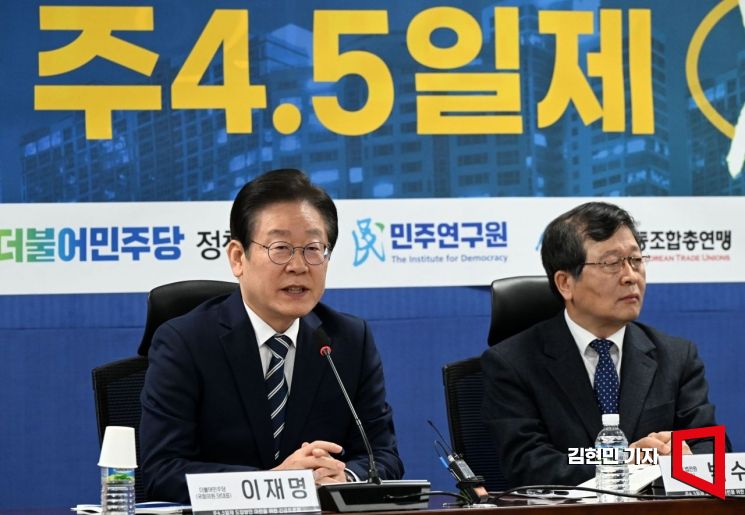 President Lee Jae Myung delivering opening remarks at an emergency forum to prepare measures for the introduction of a 4.5-day workweek during his tenure as the leader of the Democratic Party of Korea. Photo by Asia Economy DB
The government is also pursuing the 4.5-day workweek and extending the retirement age to 65 as national policy tasks. During his presidential campaign, President Lee Jaemyung pledged to "reduce South Korea's average working hours below the OECD average" and to push for the introduction of a 4.5-day workweek. He also promised to promote legislation and develop comprehensive government support measures for the phased extension of the statutory retirement age by 2025.
However, it is pointed out that issues such as reduced youth employment and increased early retirements, which occurred during previous retirement age extensions, remain challenges to be addressed. Companies emphasize that "policies should focus more on incentives rather than mandates" and argue that "the possibility of reduced wages due to shorter working hours must also be realistically discussed."
Meanwhile, some believe that fundamentally improving labor productivity and enhancing corporate competitiveness are the real solutions. Kim Daejong, professor of business administration at Sejong University, stated, "Companies should pursue efficiency through AI transformation, and workers should increase their work engagement," adding, "The government should expand such efforts through support measures like tax reductions."
© The Asia Business Daily(www.asiae.co.kr). All rights reserved.


















