The evaluation regulations for public housing construction project management services will be completely revised, with a focus on preventing poor-quality work.
On September 8, the Public Procurement Service announced that it will fully revise two regulations related to the evaluation of public housing construction project management services, with the new rules taking effect from September 10.
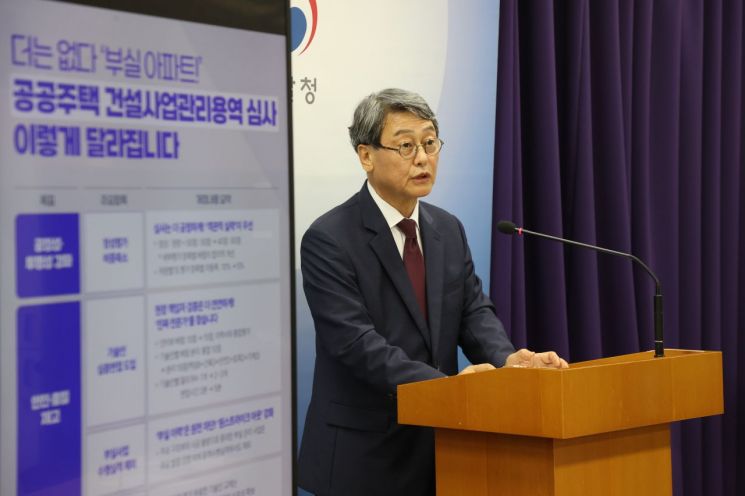 Kwon Hyukjae, Director of the Facility Project Bureau at the Public Procurement Service, is explaining the purpose and improvement directions of the "Revision of Evaluation Criteria for Public Housing Construction Project Management Service" at the Government Daejeon Complex on the 8th. Provided by the Public Procurement Service
The revised regulations are the "Detailed Evaluation Criteria for the Comprehensive Evaluation Bidding System for Public Housing Construction Project Management Services of the Public Procurement Service" and the "Detailed Evaluation Criteria for Business Performance Capability (PQ) of Public Housing Construction Project Management Service Providers of the Public Procurement Service."
The amendments will be applied to LH public housing construction project management services, focusing on expanding opportunities for companies with high technical competence and credibility. The new evaluation criteria are summarized as ensuring fairness and transparency, strengthening safety and quality, and reducing the burden on companies.
With the revision, the Public Procurement Service has reduced the weight of qualitative evaluation, which had led to excessive lobbying during bidding, by adjusting the ratio of qualitative to quantitative evaluation from the previous 50:50 to 40:60. For specific items, the scores for criteria with low technical differentiation have been reduced, and some qualitative items have been converted to quantitative evaluation to improve the indicators.
In addition, to reduce the influence of individual evaluators, the range of differential scoring by committee member and evaluation item has been lowered from 10% to 5%, thereby increasing objectivity and fairness in the evaluation process.
The verification of technical personnel capabilities has also been significantly strengthened. This includes enhanced resume verification and interview assessments for five types of construction project management engineers: those responsible for overall management, architecture, safety, civil engineering, and mechanical engineering. These engineers are stationed on-site and are responsible for managing and overseeing all stages of construction.
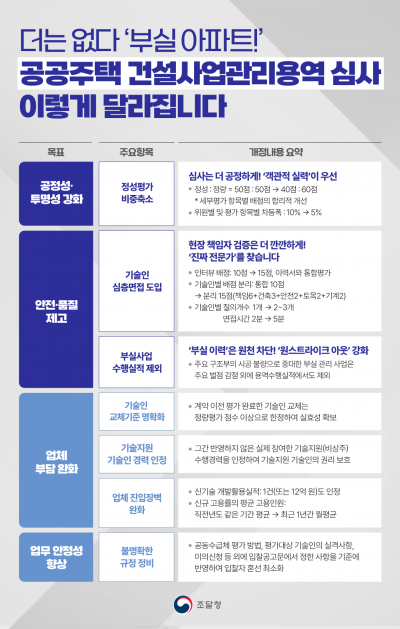
Penalties will also be strengthened. If major defects such as missing rebar or other structural deficiencies are discovered, the relevant project records will be excluded from performance evaluations. This means that companies with a history of poor performance will be fundamentally restricted from participating in new projects by excluding those records from the service performance evaluation.
The burden on newly established small and medium-sized enterprises will be reduced by improving the calculation methods for development utilization performance and the employment rate of new construction engineers. The recognition scope for development utilization performance related to new construction technologies and patents will be expanded to one case or up to 1.2 billion KRW, and the evaluation of new engineer employment rates will be changed from the "average number of employees during the same period of the previous year" to the "monthly average over the past year," allowing companies less than a year old to receive additional points in this category.
Prior to revising the regulations, the Public Procurement Service held three briefing sessions for associations and companies starting in March to gather feedback from the field. In addition, a consensus on the purpose and content of the revisions was formed with the Korea Land and Housing Corporation (LH), the client organization, through regular working-level meetings before finalizing the amendments.
Baek Seungbo, Commissioner of the Public Procurement Service, stated, "The Public Procurement Service has completely overhauled the evaluation criteria to address public concerns about public housing and to eliminate worries about bidding corruption. This institutional improvement is an important step toward establishing fair competition in public housing, and the Public Procurement Service will continue to pursue further improvements in the future."
© The Asia Business Daily(www.asiae.co.kr). All rights reserved.


















