Visiting London and Berlin’s Holzmarkt to Explore Urban Regeneration Strategies for Gimpo
Full-Scale Launch of Han River Iron Fence Removal and New Village Projects
Mayor Kim Byungsoo: "Applying Global Best Practices to Fit Gimpo’s Needs... Creating New Momentum for City Advancement"
Kim Byungsoo, Mayor of Gimpo City, visited London, a leading city in urban regeneration, and Holzmarkt in Berlin, Germany, to inspect the sites and hold meetings with relevant departments. This was part of his efforts to successfully lead the post-barrier utilization of the Han River iron fence and the Saudong New Village project. Mayor Kim expressed a strong determination to use this visit to devise the direction and strategies for Gimpo’s urban regeneration, apply global best practices tailored to Gimpo’s circumstances, and create a new momentum for the city’s advancement.
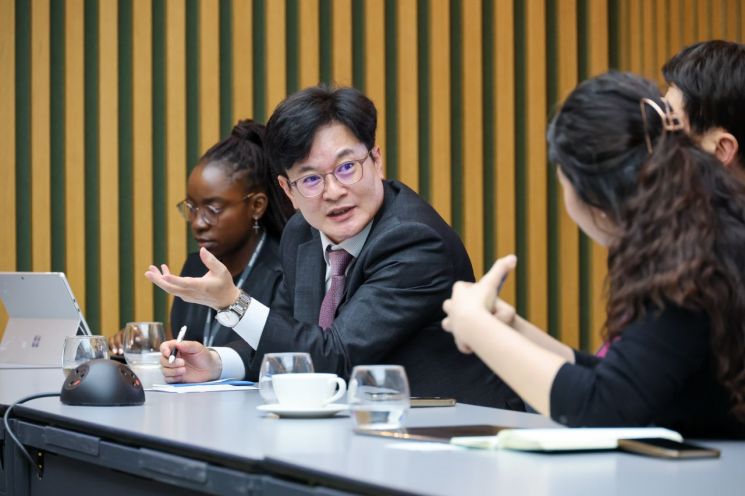 Kim Byungsoo, Mayor of Gimpo City, is visiting London City Hall and holding a meeting with the urban regeneration department. Provided by Gimpo City
Last year, Mayor Kim secured 18 billion won in national and provincial funding by being selected for the Ministry of Land, Infrastructure and Transport’s New Village project. This year, the project to remove the Han River boundary iron fence was finally selected as a new initiative in the '2026 Special Situation Area Development Project' organized by the Ministry of the Interior and Safety, marking another significant achievement.
With the New Village project and the iron fence removal project set to begin in earnest in the second half of this year, Mayor Kim’s visit to the United Kingdom and Germany is expected to further enhance Gimpo’s competitiveness by applying insights to ongoing urban regeneration and nighttime city projects.
On September 3, in his capacity as Vice President of the Council of Mayors of Major Cities in Korea, Mayor Kim visited the urban regeneration department of London City Hall to review urban regeneration policies and current conditions. He then visited the Embassy of the Republic of Korea in the UK, where he held a meeting with Acting Ambassador Han Seungho to discuss strategies for urban exchange, cooperation, and policy development for urban advancement. On September 4, he visited King’s Cross and Tate Modern, key urban regeneration areas in London, to observe the sites, compare London and Korean cases, and discuss urban regeneration strategies.
Kim Junghoo, Director of the Urban Architecture Policy Research Institute at City, University of London, who guided the site visits, emphasized, "The participation of businesses and citizens is key to the success of urban regeneration, and creative benchmarking tailored to local circumstances is crucial."
Mayor Kim stated, "By referring to London’s case, I will further develop the Saudong New Village project and Gimpo’s nighttime policies," reiterating his commitment to urban regeneration in Gimpo’s old downtown areas.
On September 7, Mayor Kim visited Holzmarkt in Germany to examine how a vacant lot was transformed into a culture-centered project, focusing on the composition and main functions of the space. He paid particular attention to the integrated space combining culture, art, and food, as well as the sustainable economic structure. Mayor Kim remarked, "By referencing the ongoing urban regeneration, structure, history, and collective efforts around the Spree River since German reunification, we will further refine plans for utilizing the waterfront after the removal of the Han River iron fence in Gimpo." He stressed, "We will transform the Han River into a space that can be used more freely and conveniently."
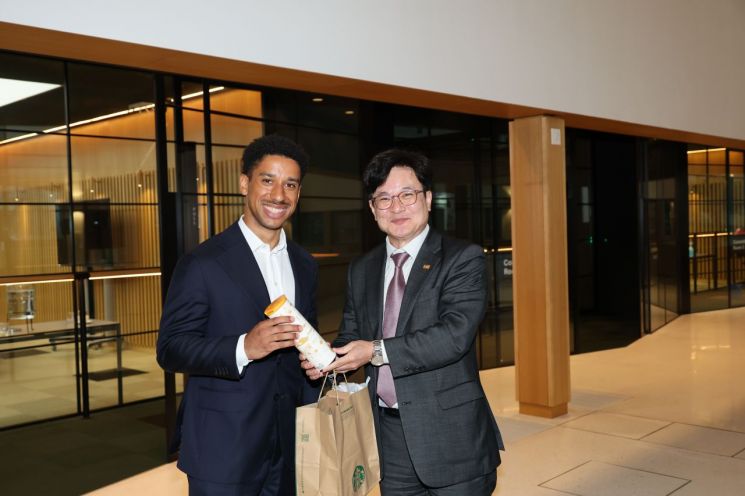 Kim Byungsoo, mayor of Gimpo City, is explaining about Gimpo while presenting the Gimpo Aegibong Starbucks tumbler to the chairman of the London City Council. Provided by Gimpo City
Meanwhile, through the Ministry of Land, Infrastructure and Transport’s New Village project, Gimpo City plans to invest approximately 25.2 billion won over five years starting this year, including 15 billion won in national funding and 3 billion won in provincial funding. The goal is to significantly improve low-rise, aging residential areas around Gimpo Jangneung, Saudong, Gimpo High School, and Gimpo Girls’ Middle School. Mayor Kim has also announced plans to appoint separate urban regeneration experts, demonstrating his strong commitment to revitalizing Gimpo’s old downtown.
In addition, the 'Han River Boundary Iron Fence Removal Project,' selected as a new initiative for the '2026 Special Situation Area Development Project' organized by the Ministry of the Interior and Safety, aims to open up the Han River waterfront, which has been restricted for decades due to military purposes, to citizens. The project plans to enhance tourism potential and utilize the area as an ecological and cultural space by creating waterfront amenities.
The removal of the Han River iron fence, which Mayor Kim has actively promoted through consultations with various organizations, is expected to serve as a turning point in transforming Gimpo’s image from a 'closed border and military area' to an 'open and friendly city' centered around the Han River, especially with the recent securing of national funding.
© The Asia Business Daily(www.asiae.co.kr). All rights reserved.
![Clutching a Stolen Dior Bag, Saying "I Hate Being Poor but Real"... The Grotesque Con of a "Human Knockoff" [Slate]](https://cwcontent.asiae.co.kr/asiaresize/183/2026021902243444107_1771435474.jpg)

















