Kiafreeze Concludes Successfully
Frieze Achieves Record Sale with 6.3 Billion Won Artwork
Kiaf Praised for Improved Viewing Environment and Artwork Quality
Kiafreeze Narrows the Gap, But Price Differences Remain Large
Frieze Features Numerous Multi-Billion Won Sales, Kiaf's Top Sales in the Hundreds of Millions
Concerns Rise Over Kiaf as "Mid- to Lower-Priced," Frieze as "High-End"
The largest art fair in Korea, "Kiafreeze" (Kiaf·Frieze), concluded successfully. The fourth year of collaboration between Kiaf Seoul, hosted by the Galleries Association of Korea, and Frieze Seoul has led to evaluations that Seoul has established itself as a new hub of the global art market, surpassing Asia. Kiaf recorded 82,000 visitors (September 3-7), with 175 galleries from over 20 countries, including 50 domestic galleries, an increase from last year. Frieze featured 121 galleries from 28 countries, attracting 70,000 visitors from 48 countries over four days (September 3-6). More than 160 representatives from leading global museums and institutions visited the exhibition. Despite uncertainties in the art market, Frieze Seoul saw record-breaking sales, confirming a recovery in consumer sentiment and the potential for market expansion.
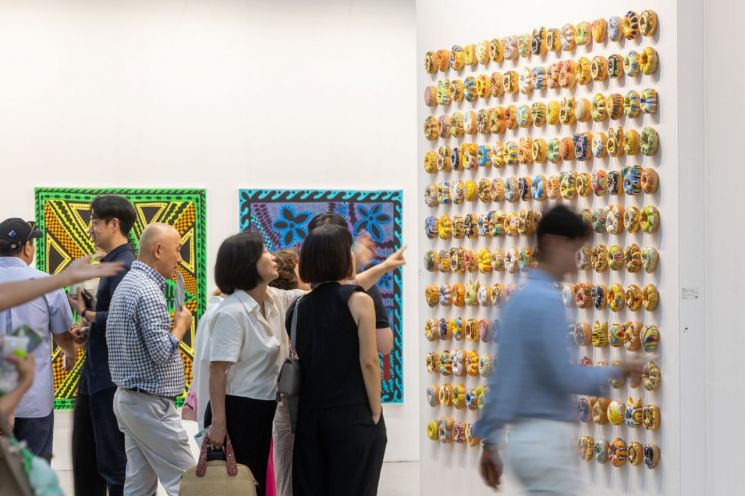
Kiaf Improves Visitor Experience, Exhibition Quality Receives Praise
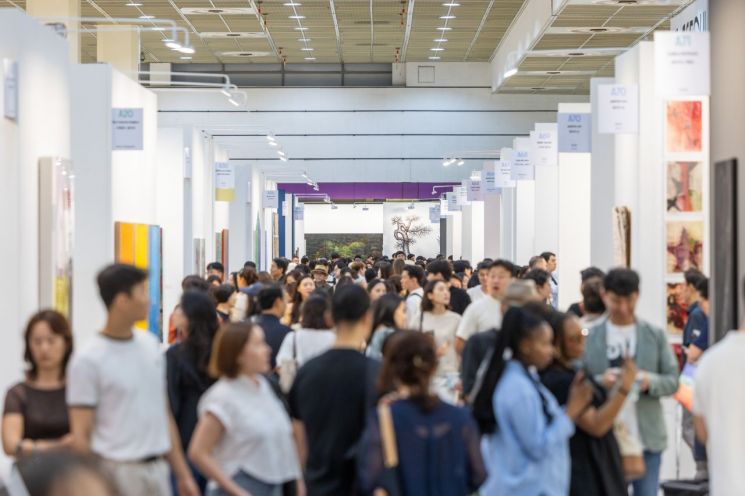
This year, Kiaf is considered to have succeeded in strengthening its core. Although the number of participating galleries dropped significantly to 175 from 206 last year, the wider aisles and more than double the convenience facilities earned high praise from visitors. The Taegukdang booth, one of the brands present, saw long lines every day and sold out its entire menu daily.
Despite the economic downturn, works by both established masters and emerging artists sold evenly at this year's fair, revealing new possibilities. J1 Gallery sold a work by Barbara Kruger for around 500 million won, while Gana Art traded a work by Chiharu Shiota for about 320 million won. Gallery Hyundai sold out works by Kim Bohie in the 140 million won range, and a Kim Changyeol piece in the 200 million won range found a new owner. Gallery Bajiwoo sold a work by Lee Ungno for 140 million won. Kukje Gallery traded Park Seobo's "Myobop" for around 400 million won and sold out the "Colormountain" sculpture series by Swiss artist Ugo Rondinone. Sun Gallery sold Lee Jungji's size 200 work for around 160 million won, Yeh Gallery sold a sculpture by Park Seokwon for 70 million won, and Hakgojae Gallery traded a large-scale work by Um Jeongsun for 60 million won.
Marking its 24th edition, Kiaf showcased a wide range of works from young to mid-career and veteran artists, securing diversity and attracting young collectors in their 20s and 30s as well as international collectors from Asia and Russia. Lee Hyemi, CEO of Artside Gallery, said, "I could clearly feel the increase in visitors compared to last year, and sales were also positive." Jang Youngho, CEO of Maek Gallery, commented, "The quality of Kiaf's exhibition and viewing environment has improved to a level comparable to Frieze. This enabled artists to expand overseas and enhance their international networks." Maximilian Egger, partner at Germany-based Kornfeld Gallery, said, "I was deeply impressed by the overall level of Kiaf this year and discovered the strong presence of Korean artists. Through Kiaf, I connected with artists Hong Sungjoon and Hwang Wonhae, and invited them to the Berlin 68 Project residency."
Frieze Achieves Record-High Sales
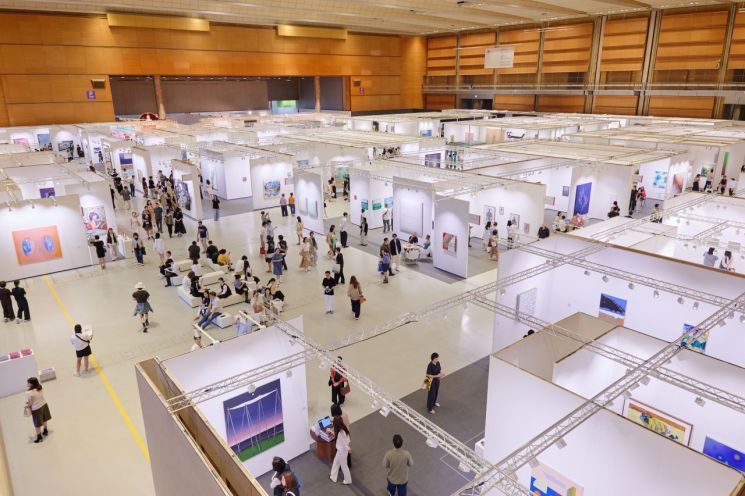
At the fourth edition of Frieze Seoul, Mark Bradford's triptych "Okay, then I apologize" (2025) sold for 6.26 billion won, attracting attention. George Condo's "Purple Sunshine" (2025) was traded for 1.67 billion won, and two drawings by Louise Bourgeois sold for 1.32 billion won and 830 million won, respectively. A painting by Rashid Johnson found a new owner for 1.04 billion won.
Overall, Frieze Seoul's sales prices were higher than those at Kiaf Seoul. White Cube sold Georg Baselitz's "Erstens, bitte sch?n" (2014) for 2.12 billion won, and two sculptures by world-renowned sculptor Antony Gormley for 800 million won and 470 million won, respectively. Spr?th Magers sold George Condo's "Thinking and Smiling" (2025) for 2.5 billion won and a felt work by Robert Morris for 830 million won. Thaddaeus Ropac traded Georg Baselitz's "Es ist dunkel, es ist" (2019) for 2.93 billion won and a painting by Alex Katz for 1.25 billion won.
Among Korean galleries, Kukje Gallery sold a mixed media canvas work by Park Seobo for 900 million won and a work by Jenny Holzer for around 670 million won. Gallery Hyundai sold a painting by Chung Sanghwa for about 830 million won, Tita Kim Gallery sold a painting by Kim Changyeol for about 490 million won, and PKM Gallery traded a work by Yun Hyongkeun for about 560 million won.
This year, participating galleries at Frieze Seoul praised the increase in sales and strengthening of international networks. Thaddaeus Ropac, founder of Thaddaeus Ropac, said, "This year, more than ever, the energy and speed of transactions among collectors clearly increased. We were able to sell to collectors from Korea, Japan, Thailand, the US, Europe, and more." Hye-ryeong Ahn, CEO of Lian Gallery, said, "There was an increase in visits from new collectors compared to last year, which led to higher sales. The number of clients newly discovering our gallery grew significantly." Atsuko Ninagawa, founder of Take Ninagawa, said, "Within 10 minutes of opening, I met major museum patrons from the United States and sold several works, some of which were acquired by American institutions." Reggie Crump, founder of the Reggie Crump Collection, praised, "I was once again reminded of how amazing Seoul is as a city. Its vibrant energy is hard to find anywhere else."
Sales Analysis: Kiaf Focuses on Mid- to Lower-Priced Works, Frieze on High-End Artworks
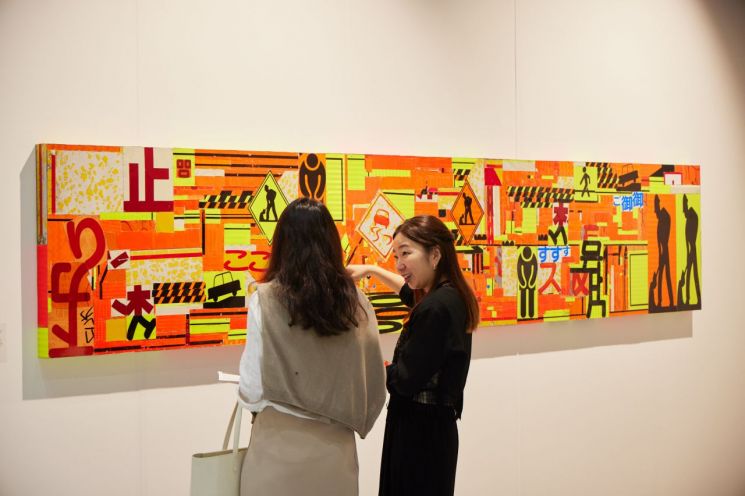
Now in its fourth year, the partnership known as "Kiafreeze" is yielding positive collaborative effects. Frieze, with its global network, has contributed to raising Korea's profile in the international market, and has compensated for areas where Kiaf's individual capabilities were lacking, enhancing the event's prominence and competitiveness. In fact, Kiaf has shifted away from its previous strategy of focusing on volume and efficiency, instead reorganizing its booth layout to prioritize visitor convenience, earning positive reviews for this step forward. However, there are concerns that Kiaf may become entrenched as a mid- to lower-priced market under the shadow of Frieze's dominance. In this year's "Kiafreeze," Frieze saw active sales of works in the tens of billions of won, including a record-high sale in the 6.3 billion won range, while most of Kiaf's sales were for works priced below 500 million won or in the tens of millions of won. For example, Kukje Gallery, which had booths at both Kiaf and Frieze, recorded a top sale of 400 million won at Kiaf and 900 million won at Frieze. Gallery Hyundai also showed a gap, with top sales of 140 million won at Kiaf and 830 million won at Frieze. While the four-year partnership of "Kiafreeze" continues to produce mutual benefits, there is a growing need for measures to prevent the image of "high-end" Frieze and "mid- to lower-priced" Kiaf from becoming fixed.
The five-year contract for the "Kiafreeze" partnership will end next year, but both parties are in discussions to continue their cooperation. During the event, Simon Fox, CEO of Frieze, told reporters, "Compared to other Asian cities, Seoul has a large number of museums and active artists, and the quality is very high. There is so much to see," adding, "Our partnership continues to strengthen. We hope and expect to build a long-term relationship."
© The Asia Business Daily(www.asiae.co.kr). All rights reserved.



















