Background of the Omission of "Denuclearization of the Korean Peninsula"
Concerns Rise Over China's Stance on North Korea's Nuclear Status
Government Reiterates Denuclearization as International Community's Unified Goal
During the North Korea-China summit held in Beijing, China, on the 4th (local time), the absence of any mention of 'denuclearization of the Korean Peninsula' has drawn attention to the reasons behind this omission. Amid concerns that China may be effectively tolerating North Korea's nuclear armament, the government reiterated that 'denuclearization' remains the unified goal of the international community.
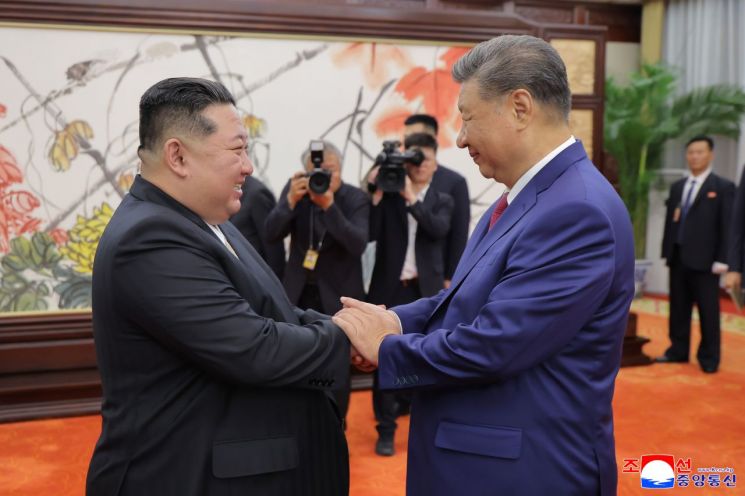 North Korean State Affairs Commission Chairman Kim Jong Un, who visited China to attend the 80th anniversary military parade of the Korean War victory, held a bilateral meeting with Chinese President Xi Jinping on the afternoon of the 4th, according to a report by the Korean Central News Agency on the 5th. 2025.9.5 Yonhap News Agency
On the 5th, an official from the Ministry of Foreign Affairs commented on the omission of the phrase 'denuclearization of the Korean Peninsula' from the North Korea-China summit statement, saying, "Denuclearization is the unified goal of the international community, and our government will continue to make efforts to achieve substantial progress in resolving the North Korean nuclear issue through a phased and pragmatic approach, in close cooperation with the United States." The official added, "While maintaining close communication and cooperation between South Korea and China, we will continue to urge China to play a constructive role in bringing North Korea to the dialogue table."
This North Korea-China summit was the first in six years and eight months since January 2019. In the statement released by China the previous day, 'denuclearization of the Korean Peninsula' was not mentioned at all. This contrasts with the previous four summits, where Chairman Kim expressed his commitment to denuclearization and President Xi Jinping voiced his support for it.
Experts have focused on the possibility that China may be accepting North Korea's nuclear status. Lim Eulchul, a professor at the Institute for Far Eastern Studies at Kyungnam University, said, "The emphasis on 'unchanging relations despite changes in the international situation' during the North Korea-China summit provides North Korea with justification to maintain its nuclear arsenal." He added, "By demonstrating support for North Korea's 'core interests,' China is interpreted as having tacitly accepted North Korea's status as a nuclear-armed state."
Until now, China has put forward the following as its 'three principles for the Korean Peninsula': ▲denuclearization of the Korean Peninsula, ▲maintenance of peace and stability on the Korean Peninsula, and ▲resolution of issues through dialogue and negotiation. Hong Min, a senior research fellow at the Korea Institute for National Unification, commented, "It is difficult to rule out the possibility that China has revised the denuclearization principle-one of the three principles for the Korean Peninsula-and is now, in effect, temporarily supporting the legitimacy of North Korea's nuclear armament." He further analyzed, "As the United States and South Korea have increased pressure on China through the Nuclear Consultative Group (NCG), modernization of the US-ROK alliance, and trilateral security cooperation with Japan, China may be indirectly supporting North Korea's nuclear status as a way to pressure the US and South Korea." However, he added, "Given the potential repercussions of revising or changing the three principles for the Korean Peninsula, China may refrain from clarifying its position for the time being and use this ambiguity as diplomatic leverage while observing the US and South Korea's response."
Regarding this, a Ministry of Foreign Affairs official stated, "China has consistently reaffirmed on various occasions, including the recent visit of the presidential special envoy to China, that there has been no change in its basic position on the Korean Peninsula issue."
Jang Yoonjung, Deputy Spokesperson for the Ministry of Unification, also responded to a related question at a regular briefing, saying, "We hope that North Korea-China relations will develop in a direction that contributes to denuclearization and peace and stability on the Korean Peninsula."
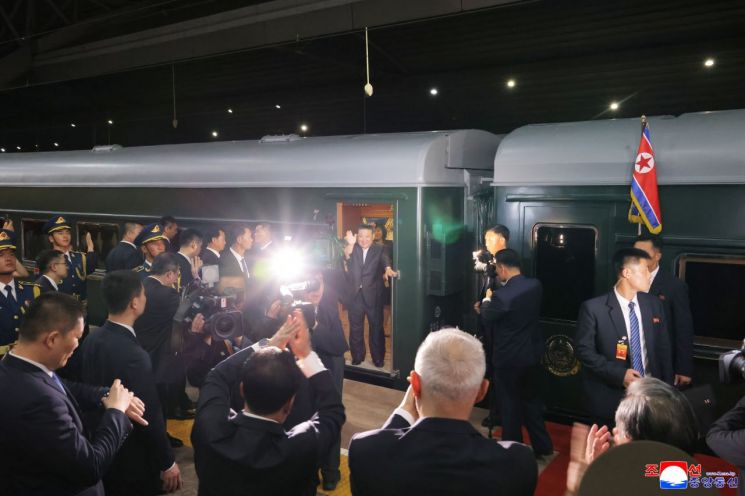 On the afternoon of the 4th, Kim Jong Un, Chairman of the State Affairs Commission of North Korea, who visited China to attend the 80th anniversary military parade of the Korean People's Army, departed Beijing by his private train after a bilateral meeting with Xi Jinping, President of China, according to the Korean Central News Agency on the 5th. 2025.9.5 Yonhap News Agency
Meanwhile, North Korean State Affairs Commission Chairman Kim Jong Un completed his fifth visit to China and returned to Pyongyang at around 10 p.m. (local time) the previous night. Excluding travel time, his actual stay in Beijing lasted about 54 hours, marking his longest visit to date. This was also the first time Chairman Kim stayed in Beijing for more than two nights.
Most observers agree that Chairman Kim's fifth visit to China carries significant symbolic meaning. For the first time in 66 years, the leaders of North Korea, China, and Russia appeared together on the Tiananmen Gate. This has been interpreted as North Korea showcasing its strategic status at the forefront of the so-called 'anti-US alliance' against South Korea, the United States, and Japan.
In particular, it is noteworthy that both China and Russia are official 'Nuclear Weapon States' under the Treaty on the Non-Proliferation of Nuclear Weapons (NPT). Throughout the military parade, Chinese President Xi Jinping was flanked by Russian President Vladimir Putin on his right and Chairman Kim on his left. By presenting North Korea alongside nuclear-armed states, they aimed to strengthen North Korea's image as a nuclear-armed country in the eyes of the international community. Some analysts suggest this was also intended to signal 'negotiation conditions' in anticipation of future talks with the United States.
© The Asia Business Daily(www.asiae.co.kr). All rights reserved.


















