No Mention of "Denuclearization of the Korean Peninsula"
in North Korea-China Summit Statement
Experts: "China Shifts to Tolerate North Korea's Nuclear Program,
Pressuring the United States and South Korea"
Kim Jong Un, Chairman of the State Affairs Commission of North Korea, completed his fifth official visit to China and returned to Pyongyang at around 10 p.m. local time on the 4th. Excluding travel time, his stay in Beijing lasted approximately 54 hours, marking the longest visit to date. This was also the first time that Chairman Kim spent more than two nights in Beijing.
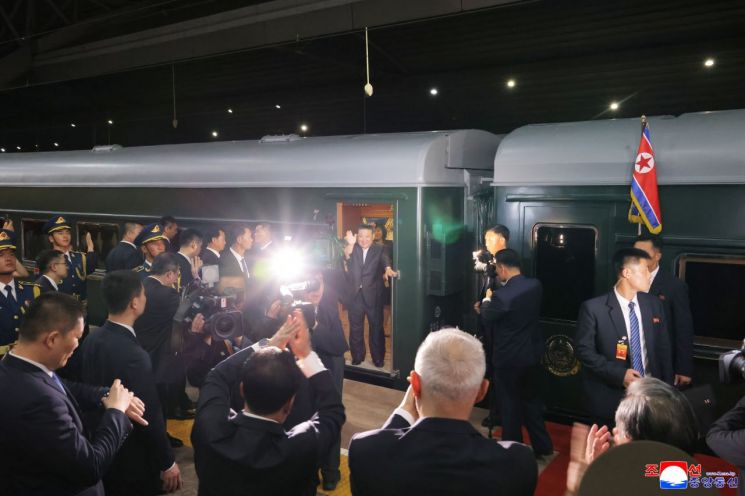 On the afternoon of the 4th, Kim Jong Un, Chairman of the State Affairs Commission of North Korea, who visited China to attend the 80th anniversary military parade of the victory day, departed Beijing by a special train after a bilateral meeting with Xi Jinping, President of China, according to the Korean Central News Agency on the 5th. 2025.9.5 Yonhap News Agency
There is a general consensus that Kim Jong Un's fifth visit to China carries several symbolic meanings. Most notably, for the first time in 66 years, the leaders of North Korea, China, and Russia stood together on the Tiananmen Gate, creating a powerful image. Analysts interpret this as North Korea demonstrating its strategic status at the forefront of the so-called "anti-U.S. alliance" that counters South Korea, the United States, and Japan.
In particular, the fact that China and Russia are official "Nuclear Weapon States" under the Treaty on the Non-Proliferation of Nuclear Weapons (NPT) adds special significance. Throughout the military parade, Chinese President Xi Jinping was flanked by Russian President Vladimir Putin on his right and Chairman Kim on his left. By presenting an image of North Korea standing alongside nuclear-armed states, they aimed to reinforce North Korea's image as a nuclear weapons state. Some analysts suggest that this was also intended to signal North Korea's "negotiating conditions" for future talks with the United States.
In fact, the joint statement from the North Korea-China summit released by China the previous day did not mention "denuclearization of the Korean Peninsula" at all. This stands in contrast to the previous four summits, where Chairman Kim expressed his commitment to denuclearization and President Xi voiced his support for it.
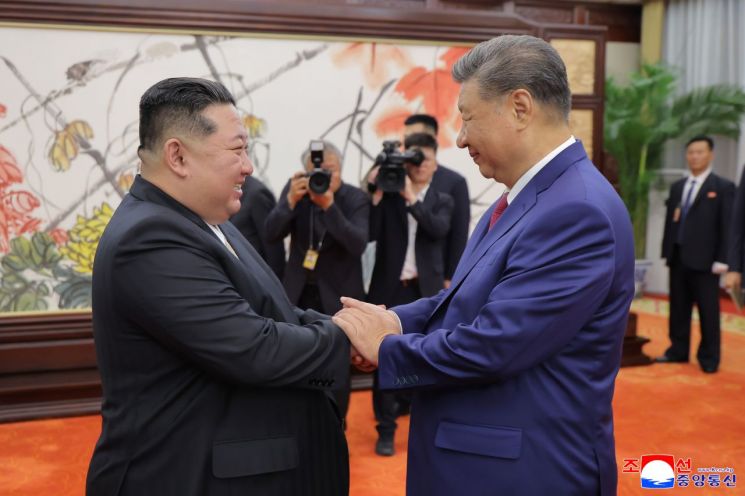 North Korean State Affairs Commission Chairman Kim Jong Un, who visited China to attend the 80th anniversary military parade of the Korean War victory, held a bilateral meeting with Chinese President Xi Jinping on the afternoon of the 4th, according to a report by the Korean Central News Agency on the 5th. 2025.9.5 Yonhap News Agency
Im Eulchul, a professor at the Institute for Far Eastern Studies at Kyungnam University, stated, "By emphasizing the 'unchanging relationship despite changes in the international situation' during the North Korea-China summit, North Korea has gained justification for maintaining its nuclear arsenal." He added, "With China showing support for North Korea's 'core interests,' it can be interpreted that China has in effect tacitly accepted North Korea's status as a nuclear weapons state."
Hong Min, a senior research fellow at the Korea Institute for National Unification, also commented, "It cannot be ruled out that China has effectively revised its stance on the denuclearization principle-one of the three core principles regarding the Korean Peninsula-and is now temporarily supporting the legitimacy of North Korea's nuclear possession." He further analyzed, "With the increasing pressure on China from the Nuclear Consultative Group between South Korea and the United States, the modernization of the South Korea-U.S. alliance, and enhanced security cooperation among South Korea, the United States, and Japan, China may be seeking to pressure the United States and South Korea by indirectly supporting North Korea's nuclear status." However, he added, "Given the potential repercussions of modifying or changing the three core principles regarding the Korean Peninsula, China may refrain from making any clear statements on this matter for the time being and instead use it as diplomatic leverage while observing the positions of the United States and South Korea."
© The Asia Business Daily(www.asiae.co.kr). All rights reserved.


















