Academic Conference in Naju on September 11-12
Reviewing Results of a Three-Year Joint Research Project by Four Institutions
The National Naju Institute of Cultural Heritage announced on September 5 that it will hold an academic conference titled "Social Structure and Culture of Mahan" in collaboration with the National Naju Museum, the Korean Archaeological Society, and the Korean Ancient History Society. The conference will take place in the main conference room over two days, starting from September 11.
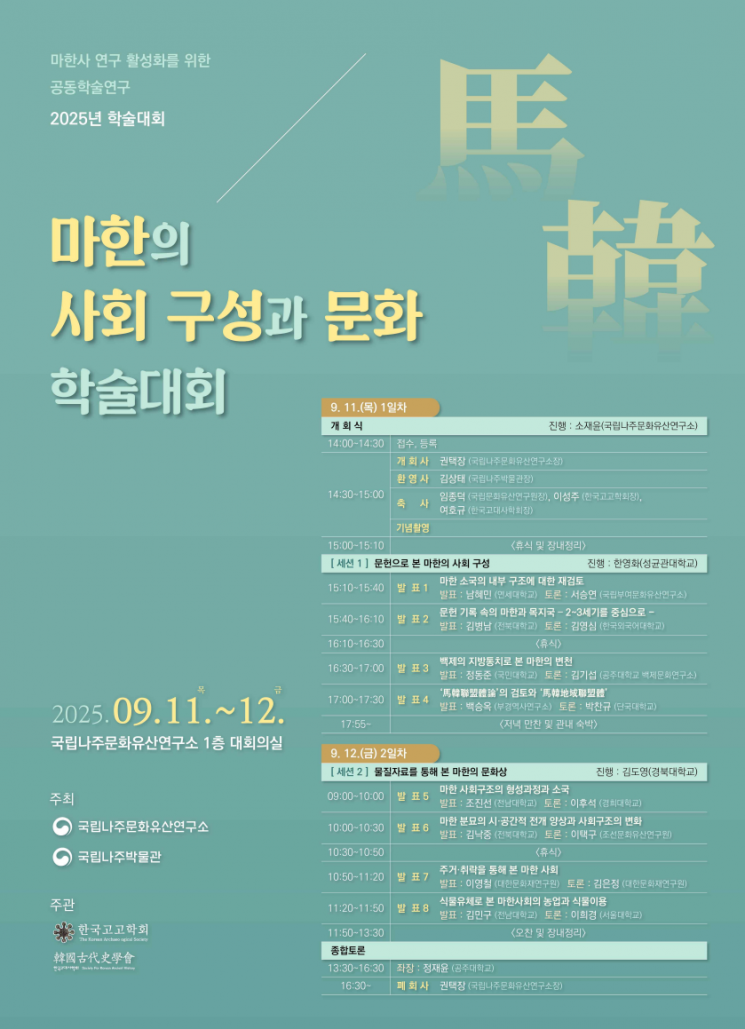
This event is part of a three-year joint research project promoted by the four organizations. Last year, the project identified research topics through the conference "Current Status and Issues in Mahan Studies." This year, the focus will shift to a detailed examination of social structure and culture.
On the first day, the conference will shed light on the characteristics of Mahan society, mainly through historical records. Nam Hyemin, a researcher at Yonsei University, will examine the internal structure and political control of small states by analyzing the relationship between Guk-eup and Byeol-eup. Kim Byungnam, a professor at Jeonbuk National University, will discuss the relationship between Mahan and Mokjiguk as described in historical documents. Jung Dongjun, a professor at Kookmin University, will address the process of Baekje's local governance and the merger with Mahan, while Baek Seungok, director of the Pukyong History Research Institute, will revisit the "Mahan Confederacy Theory."
The second day will focus on archaeological materials. Jo Jinsun, a professor at Chonnam National University, will estimate the formation of Mahan and the location of small states based on prehistoric culture and population changes. Kim Nakjung, a professor at Jeonbuk National University, will analyze tomb structures and grave goods to reveal social changes. Lee Youngcheol, a research fellow at the Korean Cultural Heritage Research Institute, will examine internal landscapes and social structures through residential sites and settlements. Kim Mingu, a professor at Chonnam National University, will discuss agriculture and plant utilization based on plant remains analysis. After the presentations, a comprehensive discussion encompassing both historical and archaeological perspectives will be led by Jung Jaeyoon, a professor at Kongju National University.
The academic conference is open to anyone who registers on-site. The results will be published as an academic series at the end of this year. A representative from the National Naju Institute of Cultural Heritage stated, "Through these discussions, we aim to strengthen the academic foundation of Mahan studies, which has been relatively under-researched compared to Baekje, Gaya, and Silla. We also plan to continue joint research and strengthen cooperation between academia and research institutes through next year."
© The Asia Business Daily(www.asiae.co.kr). All rights reserved.

















