"Next Year’s Interest Payments Are Fully Manageable,
No Major Tax Revenue Shortfall Expected"
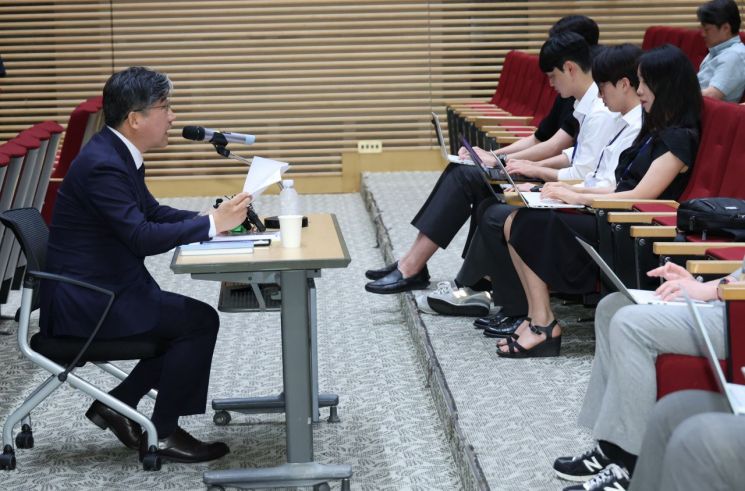 Ryu Deokhyun, Financial Planning Advisor, is holding a press briefing at the Yongsan Presidential Office on the 4th. Photo by Yonhap News Agency
The Presidential Office has commented on the recently released national debt forecast, stating that "there is no reason for it to rise that much." The latest projection from the Ministry of Economy and Finance suggested that national debt could more than triple in 40 years. However, the Presidential Office explained that with restructuring and economic growth, the debt will not actually surge to such severe levels. The office also emphasized that the interest payments resulting from national debt are manageable.
Ryu Deokhyun, Financial Planning Advisor at the Presidential Office, held a press briefing at the Yongsan Presidential Office on the 4th and shared his position on the Ministry of Economy and Finance’s long-term fiscal outlook. On the 3rd, the Ministry announced that South Korea’s national debt could rise to as much as 173.4% of GDP by 2065. In response, Advisor Ryu said, "That scenario assumes we do nothing in the future, but do you really think that will happen? If we achieve higher growth, there is no reason for national debt to rise that much," he stated firmly.
Advisor Ryu explained, "According to the National Finance Act, the government is required to conduct a long-term fiscal outlook for the next 40 years every five years and submit it to the National Assembly along with the budget bill." He added, "However, the long-term fiscal outlook does not precisely predict the national debt 40 years from now." He continued, "The long-term fiscal outlook is a mechanical projection based on the assumption that the current system and economic conditions remain unchanged. Its main purpose is to highlight the need for fiscal reform in the absence of structural reform."
Advisor Ryu stated, "The Lee Jaemyung administration will enhance sustainability through an AI-driven transformation, advanced industry investment, boosting economic growth rates, tax exemptions and reductions, and bold expenditure restructuring." He analyzed, "We expect the long-term fiscal outlook for 2030, at the end of the term, to improve significantly." Addressing some concerns about the fiscal outlook, Advisor Ryu added, "It seems people were overly surprised."
"Next Year’s Interest Payments Are Fully Manageable, No Major Tax Revenue Shortfall Expected"
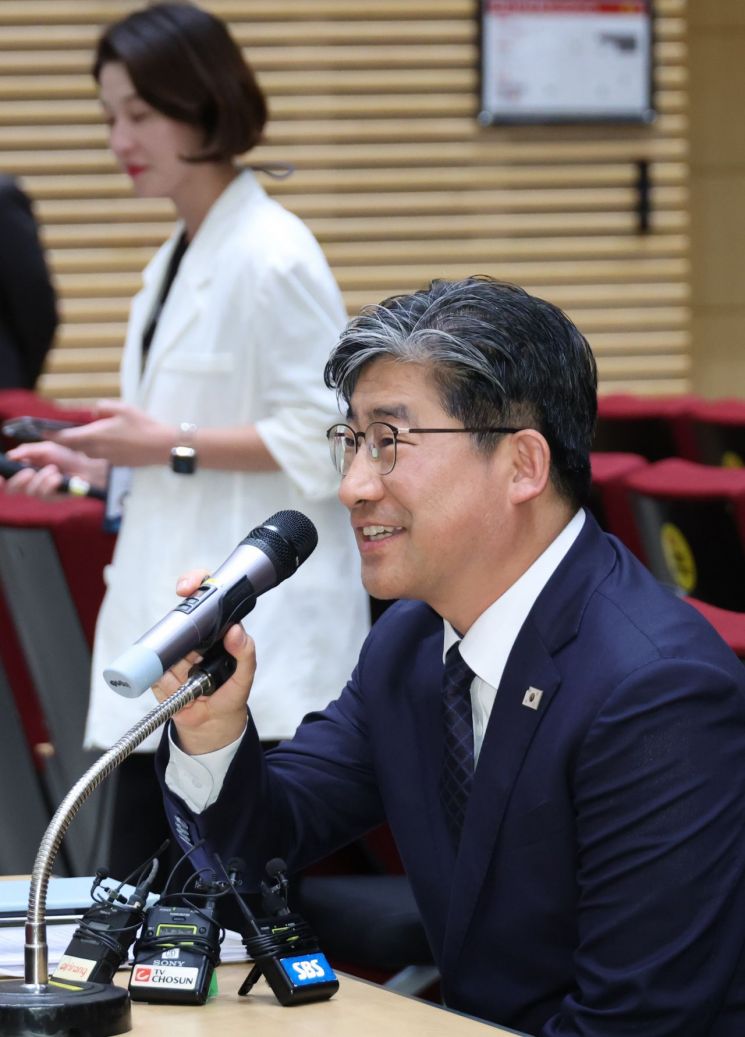 Ryu Deokhyun, Financial Planning Advisor, is holding a press briefing at the Yongsan Presidential Office on the 4th. Photo by Yonhap News Agency
Regarding the current active fiscal policy, Advisor Ryu said, "Will we continue to spend at this rate in the future? I don’t think so." However, he added, "If active fiscal policy helps the economy recover and this recovery leads to a virtuous cycle of increased tax revenue, I believe sustainable fiscal management is possible."
Advisor Ryu also stated, "It is not necessary to allow the national debt ratio to keep rising." He further explained, "Next year’s interest payments are projected at 3.64 trillion won, which is 1.4% of GDP." He added, "This is fully manageable, both compared to other countries and in terms of our fiscal capacity."
Regarding this year’s tax revenue, Advisor Ryu said, "I don’t think the actual shortfall will be as large as some expect." He continued, "We revised the revenue estimate by 1.03 trillion won in early June. Judging by the progress rate, I expect it will reach 99% by year-end, or at least over 90%." The progress rate is an indicator of how much tax revenue has been collected compared to the planned national tax in the budget; the closer to 100%, the more accurate the forecast was.
Meanwhile, Advisor Ryu said, "We set next year’s growth target at 1.8% when allocating the budget," but also pointed out, "Even if the growth rate reaches 2% or 3%, it is difficult to say whether the polarized structure of our economy will improve."
He continued, "Looking at the structure of growth rates, our economy is highly dependent on external trade. When exports perform well, the growth rate rises, but this does not necessarily improve the livelihoods of ordinary people or households." He added, "If the growth rate declines, it is like an ailing body getting even sicker. For this reason, we plan to fully support efforts to boost next year’s growth rate with fiscal policy."
© The Asia Business Daily(www.asiae.co.kr). All rights reserved.
![User Who Sold Erroneously Deposited Bitcoins to Repay Debt and Fund Entertainment... What Did the Supreme Court Decide in 2021? [Legal Issue Check]](https://cwcontent.asiae.co.kr/asiaresize/183/2026020910431234020_1770601391.png)
















