Job Openings Hit 10-Month Low in July
95% Probability for September Rate Cut
U.S. Treasury Yields Reverse and Decline
Alphabet Surges After Google Chrome Ruling
The three major indices on the New York Stock Exchange showed mixed movements on the 3rd (local time). The Nasdaq index continued its upward trend, buoyed by strong performances in technology stocks following a surge in Alphabet shares and growing expectations for a September rate cut due to weakening employment indicators. The S&P 500 index was also attempting a modest rebound. In addition, bond yields, which had soared after a U.S. court ruling on reciprocal tariffs, declined rapidly, supporting investor sentiment.
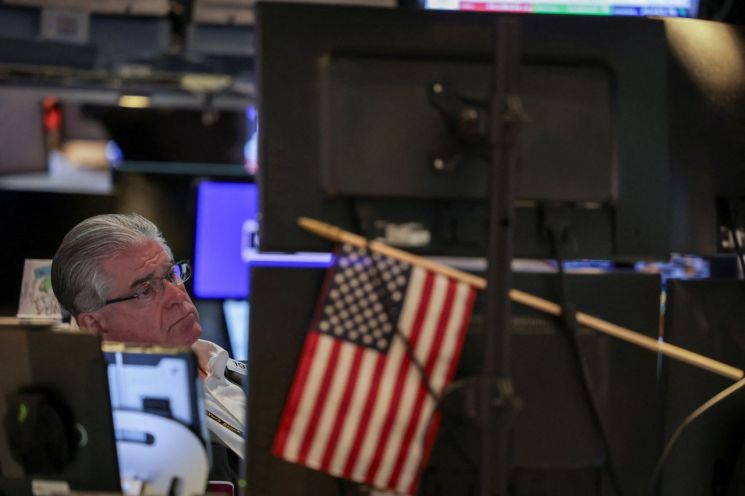
As of 2:24 p.m. on the same day at the New York Stock Exchange, the Dow Jones Industrial Average, which focuses on blue-chip stocks, was down 229.99 points (0.51%) from the previous trading day at 45,065.82. The S&P 500 index, centered on large-cap stocks, was up 5.66 points (0.09%) at 6,421.2, while the technology-heavy Nasdaq index was trading at 21,396.392, up 116.762 points (0.55%).
By stock, Alphabet surged 8.29%. Buying momentum increased after its subsidiary, Google, avoided having to sell its Chrome browser due to a court ruling the previous day. The court also allowed Google to pay third parties, including Apple, to have its services pre-installed as the default browser, which sent Apple’s share price soaring by 3.11%. Tesla was up 2.25%. Optimism that big tech companies can overcome regulatory threats led to gains in some technology stocks.
Mark Mahaney, head of internet research at Evercore ISI, analyzed in a CNBC interview that “the confusion is now over” for Google, adding, “We can focus on fundamentals, and we still think the valuation is very attractive.”
Expectations for a rate cut increased as employment indicators weakened, further supporting investor sentiment. According to the July Job Openings and Labor Turnover Survey (JOLTs) released by the U.S. Department of Labor on the same day, the number of job openings was 7,181,000. This was a decrease of 176,000 from June’s 7,357,000, and fell well short of the market expectation of 7,380,000. Experts analyzed that companies are delaying new hires as they assess the economic impact of President Donald Trump’s aggressive tariff policies.
Christopher Waller, a Federal Reserve Governor considered a candidate for the next Fed Chair, said in a CNBC interview that “when the labor market starts to deteriorate, it worsens quickly,” and emphasized, “We need to begin cutting rates at the next meeting.” He added, “The current rate is 1.0 to 1.5 percentage points above the neutral level,” and predicted, “There could be several rate cuts over the next three to six months.”
Signs of a slowdown in the labor market have further heightened expectations for a rate cut this month. According to the Chicago Mercantile Exchange (CME) FedWatch, the federal funds futures market on this day reflected a more than 95% probability that the Fed will cut the current annual rate of 4.25-4.5% by 0.25 percentage points at the upcoming Federal Open Market Committee (FOMC) meeting on the 17th.
Yields on U.S. Treasury bonds, which had surged following the court’s ruling on reciprocal tariffs, are now stabilizing rapidly due to weakening employment indicators. Currently, the yield on the 30-year U.S. Treasury bond is at 4.89%, down 7 basis points (1bp = 0.01 percentage points) from the previous trading day. The 10-year bond yield has fallen by 6 basis points to 4.2%, while the 2-year bond yield is down 4 basis points at 3.61%. Treasury yields had been rising before the market opened due to concerns over fiscal instability stemming from the Trump administration’s possible tariff rebates.
Bryot Kenwell, a U.S. investment analyst at eToro, said that while the employment data released today “is not a warning signal, it reaffirmed that the U.S. labor market is easing.” He noted, “This suggests the Fed will pivot toward rate cuts, but in the long run, the benefit of lower rates should not be welcomed if it comes with a marked slowdown in the labor market.”
The more important indicator for gauging labor market trends will be the August employment report to be released on the 5th. The market expects nonfarm payrolls to increase slightly to 75,000 in August from 73,000 in July. However, with increases remaining below 100,000 for four consecutive months, the labor market is expected to show its weakest trend since the COVID-19 pandemic in 2020. The unemployment rate is projected to rise from 4.2% in July to 4.3% in August.
© The Asia Business Daily(www.asiae.co.kr). All rights reserved.
![Clutching a Stolen Dior Bag, Saying "I Hate Being Poor but Real"... The Grotesque Con of a "Human Knockoff" [Slate]](https://cwcontent.asiae.co.kr/asiaresize/183/2026021902243444107_1771435474.jpg)
















