Strengthening Resource Recycling Through U.S. Subsidiary
Germanium MOU Signed With Lockheed Martin
Chairman Yunbeom Choi: "Confirmed U.S. Commitment"
Antimony Exports to the U.S. Also Accelerating
Korea Zinc is accelerating its efforts to build a "de-China supply chain" by expanding its supply of strategic minerals and resource recycling business with a base in the United States.
On September 3, Korea Zinc announced that it is strengthening its resource recycling business by collecting waste resources such as electronic waste (e-waste), copper scrap, and discarded solar panels through its U.S. subsidiary Pedal Point and others, and expanding the domestic production of strategic minerals and base metals. The company plans to increase production not only of base metals, but also of rare strategic minerals such as germanium and antimony. Yunbeom Choi, Chairman of Korea Zinc, stated in a past interview with Bloomberg that "the United States, where industrial waste is continuously generated, is the optimal location to develop an urban mining business," and revealed a goal to nearly quintuple copper production by 2028.
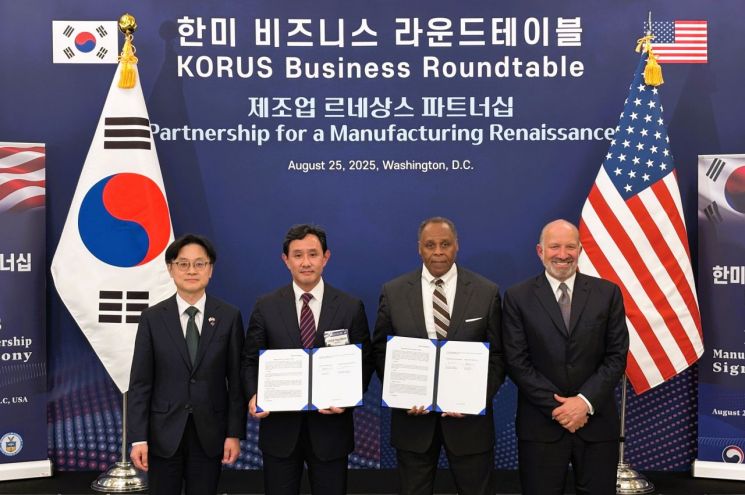 Korea Zinc and Lockheed Martin signed a memorandum of understanding (MOU) on the 25th local time in the United States to cooperate on the supply and purchase of germanium and the supply chain of critical minerals. From left to right: Jungkwan Kim, Minister of Trade, Industry and Energy; Yunbeom Choi, Chairman of Korea Zinc; Michael Williamson, President of Lockheed Martin International; Howard Lutnick, United States Secretary of Commerce. Provided by Korea Zinc
Previously, in August, Korea Zinc signed a memorandum of understanding (MOU) with Lockheed Martin to cooperate on the supply and purchase of germanium and the supply chain of critical minerals. The signing ceremony was attended by Chairman Choi and Michael Williamson, President of Lockheed Martin International. In conjunction with the MOU, Korea Zinc decided to establish a new germanium production plant at its Onsan Smelter in Ulsan. The company plans to produce high-purity germanium dioxide (approximately 10 tons of germanium metal) with trial operations in 2027 and commercial operation targeted for the first half of 2028.
Germanium is an advanced core material used in semiconductors and optical communications. In 2023, China designated germanium, along with gallium, as its first export-restricted items. Chairman Choi, who visited the United States as part of the economic delegation for the Korea-U.S. summit, said, "We have confirmed the U.S. government's determination to strengthen the core mineral supply chain away from China as a matter of national security."
In June, Korea Zinc also exported antimony, a strategic mineral, to the United States for the first time. Previously, the United States relied on China for 60% of its antimony imports. This mineral is used in a wide range of industries, including semiconductors, defense products, flame retardants, and batteries. Korea Zinc plans to increase its antimony exports to the United States to over 100 tons this year and more than 240 tons annually next year.
Korea Zinc's recent actions are expected to support the efforts of the United States and other economic allies to establish resource supply chains independent of China. Its role is also likely to grow further in the future. Korea Zinc is the only company in Korea that produces antimony, indium, and bismuth. It is also the largest domestic producer of sulfuric acid, including sulfuric acid for semiconductors. The company stated, "Our resource recycling business and copper expansion plans are also being pursued as part of efforts to establish a stable supply chain for critical minerals."
© The Asia Business Daily(www.asiae.co.kr). All rights reserved.

















