Total Liabilities Reached 100.4 Billion Won Last Year; Net Loss at 135 Billion Won
Accumulated Deficits Since 2022 Opening
Geographic Disadvantages and Lack of Adult Attractions
New Attractions and Enhanced Marketing as Key Strategies
Legoland Korea Resort (Legoland), which operates a theme park and hotel in Chuncheon, Gangwon Province, has fallen into a state of capital erosion just three years after opening, unable to withstand continued losses. The park's remote location, far from the Seoul metropolitan area, and a lack of attractions beyond those for young children have been cited as major limitations, resulting in visitor numbers falling short of expectations.
Although it drew attention as the first global theme park in Korea, its association with the so-called "Legoland Incident"-a real estate project financing (PF) default in Gangwon Province-also had a negative impact. Legoland has stated its intention to increase visitors and improve profitability through additional facility investments, but as visitor numbers continue to decline and performance worsens, many predict that improving its financial structure will not be easy.
According to last year's audit report submitted by Legoland to the Financial Supervisory Service's electronic disclosure system on September 4, the company's total equity for the period was negative 100.4 billion won, indicating capital erosion. Accumulated losses reached 191.5 billion won, surpassing its paid-in capital of 90.5 billion won. This figure includes a net loss of 135 billion won for last year and 56.5 billion won in unappropriated losses carried over from the previous year.
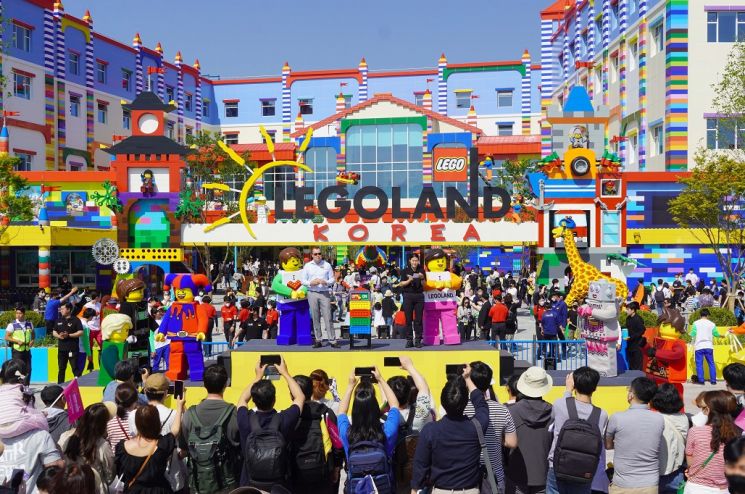 In May 2022, in line with the opening of Legoland, Legoland Korea officials held a welcoming event for customers visiting the theme park. Photo by Legoland
Operated by Merlin Entertainments of the United Kingdom, Legoland opened in May 2022 on Hajungdo (Jungdo), an island in the middle of Uiam Lake in Chuncheon, with a total area of 280,000 square meters (about 85,000 pyeong). It was the tenth Legoland in the world and, at the time, the largest in Asia. As the first global theme park attracted to Korea, its chances of success drew significant attention.
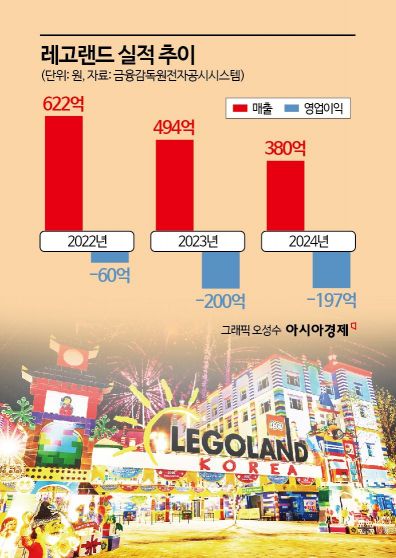
However, the park has struggled, failing to turn a profit since opening. Revenue dropped from 62.2 billion won in its first year to 49.4 billion won the following year, and then to 38 billion won last year. Operating losses continued over the same period at 6 billion won, 20 billion won, and 19.7 billion won, respectively. Net losses also ballooned from 11.1 billion won and 28.9 billion won to over 100 billion won.
The total project cost for Legoland was 300 billion won, with Merlin providing 220 billion won. Legoland Korea financed the project by selling park assets-including attractions and real estate within the resort-worth 80 billion won to Gangwon Jungdo Development Corporation, then immediately leasing them back. According to the agreement, if Legoland's annual revenue exceeds 40 billion won, Gangwon Jungdo Development Corporation receives 3% of the rental income as dividends. In addition, Gangwon Province agreed to lease the Legoland site free of charge until May 4, 2072, with the possibility of renegotiating for up to 50 more years afterward.
At opening, Legoland set an annual visitor target of 2 million people. However, actual visitor numbers have fallen far short. According to data released in February by Chuncheon City Council member Yoon Minseop of the Justice Party, Legoland recorded 653,991 visitors from its May 2022 opening through December of that year, 632,871 visitors in 2023, and 494,618 visitors in 2024, showing a downward trend.
Legoland, however, has not disclosed specific visitor numbers, except for an announcement that 1 million people visited in the first year after opening, which it said was in line with global operator policy.
Legoland's business struggles were exacerbated when, in September 2022, Gangwon Province Governor Kim Jin-tae mentioned plans for Gangwon Jungdo Development Corporation, which was in charge of Legoland's development, to enter corporate rehabilitation proceedings. The resulting real estate PF issue, which became known as the "Legoland Incident," brought negative publicity and contributed to the park's unfavorable image.
Other limitations include its unfavorable location far from Seoul, a lack of attractions appealing to adults, and the park's outdoor facilities, which are limited by rainy seasons, heat waves, and winter operation constraints-all of which undermine its competitiveness as a theme park. In fact, online communities and social networking services are filled with visitor reviews such as, "It's not close to the Seoul metropolitan area, so a day trip is costly and time-consuming," and "There aren't enough attractions for families compared to the price."
It appears unlikely that Legoland will abandon its domestic business in the near future. According to the agreement, if Merlin ceases commercial operations within five years of Legoland's opening, Gangwon Jungdo Development Corporation can require Legoland to repurchase the resort assets it acquired at a predetermined price.
Legoland stated, "To continue as a going concern, we are aiming for a turnaround by diversifying content, expanding ticket sales channels, and enhancing external marketing. We are also working to improve operating profit and loss through monthly and quarterly performance management and cost structure improvements, and have established plans to raise additional funds through further borrowing." As part of these efforts, in April, Legoland introduced the world's first Ninjago-themed roller coaster, "Spinjitzu Master," at a cost of 20 billion won, and is expanding its infrastructure with amenities such as an all-season heated pool and the "Summer Pass," which allows unlimited entry during the summer season (August 2 to September 7). Since last month, Lee Seongho, CEO of Coex Aquarium, which was acquired by Merlin, has also taken on the role of Legoland CEO as the company prepares for a new phase.
A Legoland representative said, "Theme parks are characterized by high initial facility investment costs, and overseas Legoland parks that opened earlier only began to show results after five years. While we cannot disclose specific numbers, the introduction of new attractions and events has led to an upward trend in visitor numbers and revenue indicators this year." The representative added, "We plan to fulfill our initial promise to invest an additional 100 billion won in the theme park and hotel by 2027, aiming to establish Legoland as a landmark of Chuncheon while seeking ways to improve profitability."
© The Asia Business Daily(www.asiae.co.kr). All rights reserved.


















