Emphasizing the Need for Export Diversification
A Strategic Choice Amid Agricultural Opposition and Domestic Procedural Debate
The government has decided to revisit the possibility of joining the Comprehensive and Progressive Agreement for Trans-Pacific Partnership (CPTPP). Officials explained that this is a strategic move to respond to the ongoing trade friction between the United States and China, the rise of protectionism, and to lay the groundwork for diversifying export markets.
An official from the Ministry of Trade, Industry and Energy told reporters on September 3, shortly after the joint announcement of countermeasures to U.S. tariffs by relevant ministries, "We have included the issue of joining the CPTPP as a subject for review." The official added, "This is not a mere mention, but a matter that has been agreed upon through consultations with related ministries," and explained, "We will make a decision on whether to proceed after comprehensively considering domestic conditions and the international situation."
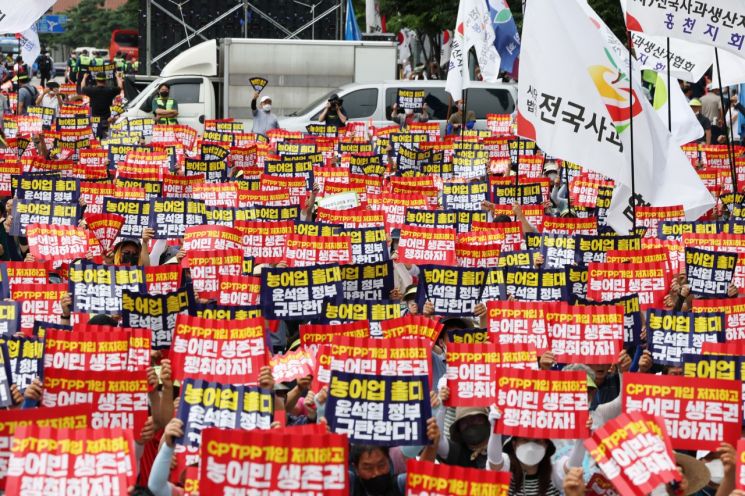
The CPTPP includes major agricultural countries such as Australia, Canada, and New Zealand, so if Korea joins, the burden of opening up its agricultural and livestock markets will be inevitable. The Korea Rural Economic Institute previously estimated that abolishing tariffs on agricultural and livestock products under the CPTPP could result in annual losses of up to 440 billion won. As a result, opposition from the agricultural sector and the need to achieve social consensus are seen as the biggest challenges.
On the other hand, the manufacturing, service, and content industries are expected to benefit from the elimination of tariffs and expanded market access through CPTPP membership. The official explained, "It will be possible to expand tariff-free exports and strengthen our capacity to respond to international trade rules in sectors such as automobiles, electronics, and services."
The domestic process of joining the CPTPP also presents challenges. The previous Moon Jae-in administration had completed most of the procedures, with only a report to the National Assembly remaining, but the current administration says that circumstances have changed since then. The Ministry official stated, "Before moving forward with accession, it is necessary to persuade domestic stakeholders and achieve social consensus," adding, "Creating the right conditions is the top priority."
There is also a need for clarity regarding the timing and figures of the economic impact analysis. Some studies have projected that joining the CPTPP could raise Korea's gross domestic product (GDP) by 0.38 percentage points, but the specific basis and timing of application require further review.
The government has expressed its intention to proactively respond to the restructuring of global supply chains by reviewing CPTPP membership. The Ministry official said, "As international trade rules are evolving rapidly, the longer we delay joining, the more likely Korea will remain in the position of a rule-taker," adding, "Strategic review is necessary to ensure supply chain stability and diversify exports."
The following is a Q&A with a Ministry of Trade, Industry and Energy official regarding the CPTPP:
- Why was CPTPP specified as 'under review' in this measure?
▲As a result of consultations between relevant ministries, the issue of joining the CPTPP was included as a subject for strategic review. It is not at the stage of active pursuit, but it needs to be managed as an option.
- How was the economic impact analysis conducted?
▲Some studies have suggested a 0.38 percentage point increase in GDP, but further verification is needed regarding the timing of the analysis and the institutions involved.
- What is the estimated scale of damage to the agricultural sector?
▲There is an analysis that abolishing tariffs on agricultural and livestock products could result in annual losses of up to 440 billion won. Achieving social consensus is essential.
- How far has the domestic process progressed?
▲The previous administration had completed much of the process, but under current circumstances, a reassessment is needed in light of domestic and international conditions. Securing social acceptance must come first.
- What is the necessity of pursuing CPTPP membership?
▲Amid U.S.-China tensions and the spread of protectionism, diversifying exports and stabilizing supply chains are key. The CPTPP also covers digital, intellectual property, and environmental standards, making it important for responding to the evolving international trade order.
© The Asia Business Daily(www.asiae.co.kr). All rights reserved.

















