"Final Decision on Serious Crimes Investigation Agency Affiliation to Be Made After Policy Meeting, Legislative Hearing, and Discussion"
"All Pros and Cons of Placement Under Justice or Interior Ministries Will Be Considered"
Assemblyman Lee Yongwoo, who serves as the secretary of the Special Committee on Prosecutor Normalization of the Democratic Party of Korea, commented on the issue of abolishing the prosecution's supplementary investigation authority, stating, "There are various debates, but we will take sufficient time and examine the matter thoroughly."
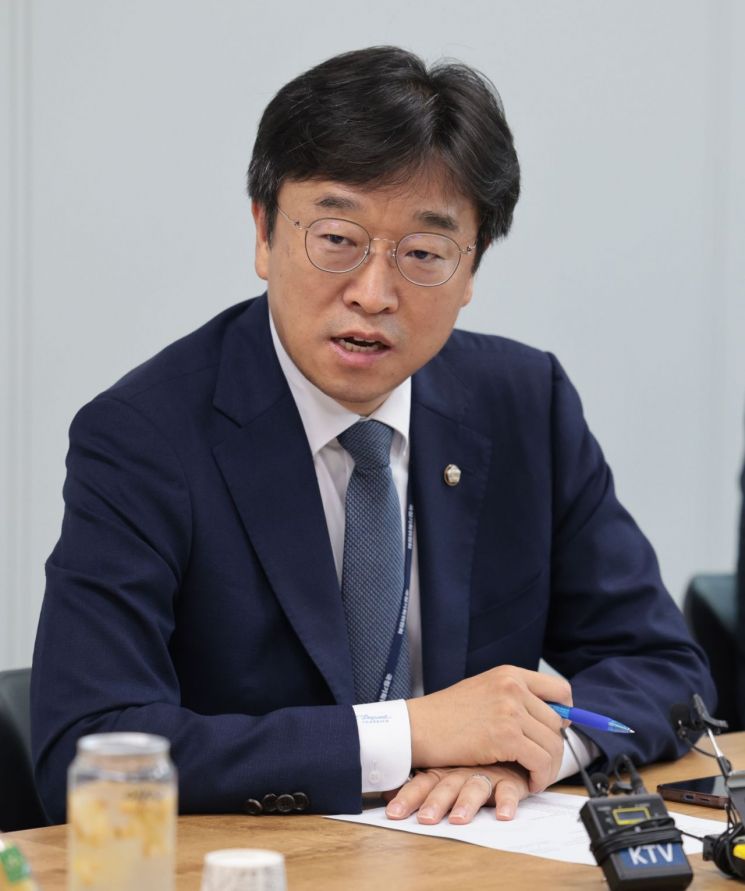 Lee Yongwoo, the secretary of the Special Committee on Prosecutorial Normalization of the Democratic Party of Korea. Photo by Yonhap News
On the morning of September 3, during an appearance on SBS Radio's "Kim Taehyun's Political Show," Assemblyman Lee responded to the question, "In the process of prosecution reform, is the supplementary investigation authority of the prosecution heading toward abolition or retention?" with the above statement.
He explained, "At the National Assembly plenary session scheduled for September 25, discussions will focus on the amendment of the Government Organization Act. However, the issue of abolishing the supplementary investigation authority is not directly addressed in that content. I understand that even within the prosecution, there are various opinions regarding the supplementary investigation authority."
He added, "In any case, within the prosecution, there are not many strong opinions or stances confirmed about which ministry the Serious Crimes Investigation Agency will be placed under. What the prosecution considers most important is whether they retain the direct investigative authority, which is the supplementary investigation authority."
He continued, "There seems to be a public perspective questioning whether 'the supplementary investigation authority still existing' aligns with the fundamental principle of separating investigation and indictment. Conversely, there are also concerns that completely stripping this authority could cause problems in the process from investigation to indictment. We are discussing what countermeasures would be necessary if it were truly abolished, among other issues."
When asked what control mechanisms are being prepared in response to concerns that police power could become excessively concentrated due to prosecution reform, he stated, "Institutional design must be based on the fundamental principle that power concentrated in any agency carries a high risk of abuse. We will maintain checks and balances through a tripartite system, prohibit personnel exchanges between agencies, and ensure that each can operate independently."
Regarding the Democratic Party policy general meeting to be held at the National Assembly in Yeouido, Seoul, on the afternoon of the same day, he said, "We need to listen to the overall opinions of the assembly members," and added, "Afterward, we will finalize the plan through a series of processes including public hearings and legislative hearings to gather opinions."
© The Asia Business Daily(www.asiae.co.kr). All rights reserved.

















