Government Continues 'Local University Development' Policy
Low Regional University Enrollment and Local Employment Rates
RISE Initiative Launched This Year, Led by Local Governments and Universities
"Need to Build an Ecosystem for Employmen
The number of young people leaving their regions for university admission and employment is on the rise. Although the government has introduced various support measures to prevent the outflow of local talent, critics point out that there is still a lack of a comprehensive system that connects university admission, quality jobs, and favorable living conditions.
According to the National Assembly Budget Office's report, "Evaluation of Local University Development Policies," released on September 4, the rate of students entering universities in the same region as their high school is declining in non-metropolitan areas. In Daegu and North Gyeongsang Province, the rate dropped from 66.9% in 2016 to 62.2% in 2023, while in Jeju, it fell from 74.8% to 68.3%. Although the rate in the Chungcheong region rose from 34.6% to 38.5%, it has consistently remained lower than the non-metropolitan average of around 58%. In contrast, the metropolitan area-including Seoul, Incheon, and Gyeonggi Province-has maintained a steady rate of 75-76%.
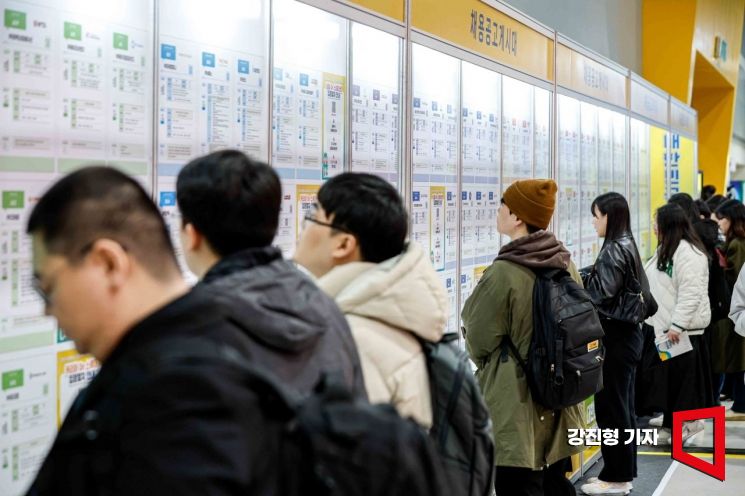 Job seekers participating in the '2025 Korea Job Fair' held at the aT Center in Seocho-gu, Seoul, are looking at the recruitment board. March 19, 2025. Photo by Kang Jinhyung
The proportion of university students who find employment in the region where their university is located after graduation is also decreasing in non-metropolitan areas. In Seoul, this rate increased from 63.0% in 2017 to 63.8% in 2023, but in non-metropolitan areas, it declined from 43.1% to 41.8%. Notably, in Jeju, the rate dropped from 62.5% to 53.3% during the same period, marking a decrease of 9.2 percentage points.
Despite the government's ongoing policies to foster local universities and recruit regional talent, the outflow of young people from these areas continues. Policies to strengthen the capabilities of local universities have been continuously promoted in line with government initiatives since the "Local University Development Plan" was introduced in 2003. Even after the enactment of the Local University Development Act in 2014, which increased admission opportunities for local talent and gave preference to local candidates in hiring at public institutions, these measures have not been enough to stem the tide of young people leaving their regions.
Recently, a notable change is that local governments and universities, rather than the central government, have taken the lead in policy initiatives. This year, the Ministry of Education officially launched the Regional Innovation System for Education (RISE). RISE is a system in which local governments take the initiative to support universities, aiming for the joint growth of both the region and its universities. The goal is for universities to nurture local talent, who then find employment and settle in the region.
The report stated, "If the concentration of students and jobs in the metropolitan area continues both at the time of university admission and after graduation, the resulting outflow of young people will accelerate the decline of the productive population and further impact the local economy." It also recommended, "There is a need to organically link the RISE project with local talent development strategies and make strategic efforts to build an ecosystem for 'local talent development, employment and entrepreneurship, and settlement.'"
© The Asia Business Daily(www.asiae.co.kr). All rights reserved.

















