71 Days of Growth Captured by Cameras at Taehwagang Samho Migratory Bird Park
Fourth Breeding Record After Grey Heron, Great Egret, and Cattle Egret
The growth process of the Intermediate Egret, from egg laying to fledging in the Taehwagang bamboo forest, was recorded for the first time since observation cameras were installed in 2016, spanning a period of 71 days.
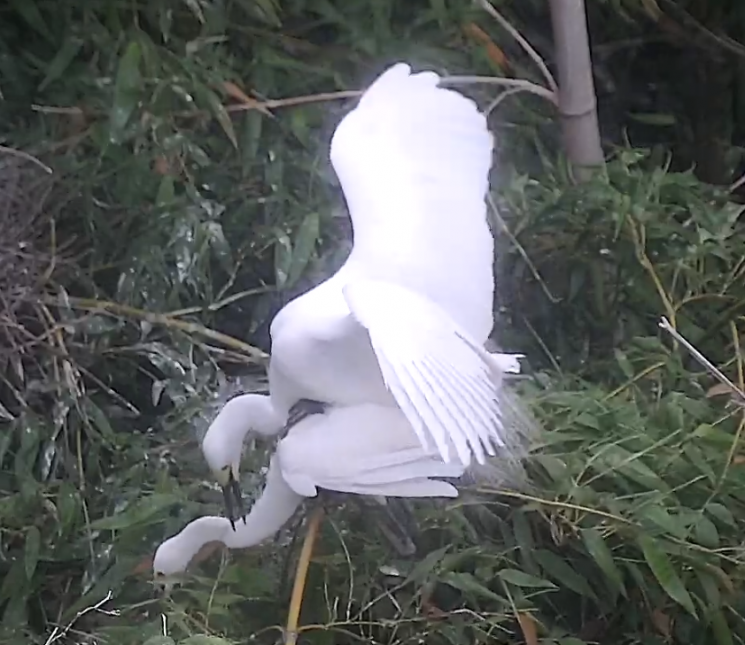
The Ulsan City government reported that it documented the breeding process of the Intermediate Egret, from egg laying and hatching to fledging (when the chicks leave the nest), using observation cameras installed at Samho Migratory Bird Park from June 2 to August 11.
This observation marks the fourth time that breeding has been recorded among egret species nesting in the Taehwagang bamboo forest, following the Grey Heron in 2020 and this year, the Great Egret in 2021, and the Cattle Egret in 2022.
While many egrets have been observed in large numbers, making them easy to spot, the Intermediate Egret, which visits in small numbers and infrequently, has proven difficult to locate each year.
However, on June 2, for the first time, cameras captured an Intermediate Egret incubating two eggs.
On June 3, the next day, the bird was seen laying a third egg, and on June 4, footage of a mating pair was recorded. The male and female then took turns incubating the eggs, and on June 10, a fourth egg was laid.
After the male and female Intermediate Egrets began taking turns incubating the eggs, the first chick hatched on June 26, and the mother was observed feeding it.
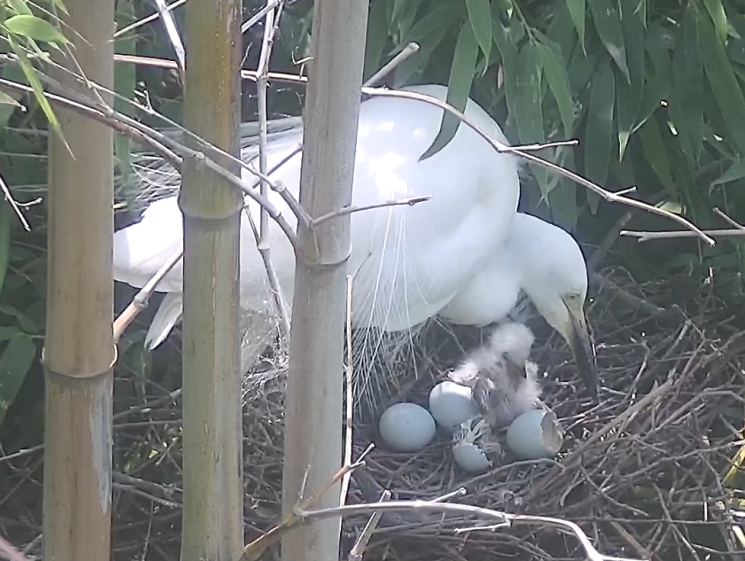
On June 27, the mother bird discarded the eggshell of the second chick outside the nest and fed the newly hatched chick partially digested food. The third chick hatched on June 30, followed by the fourth on July 1.
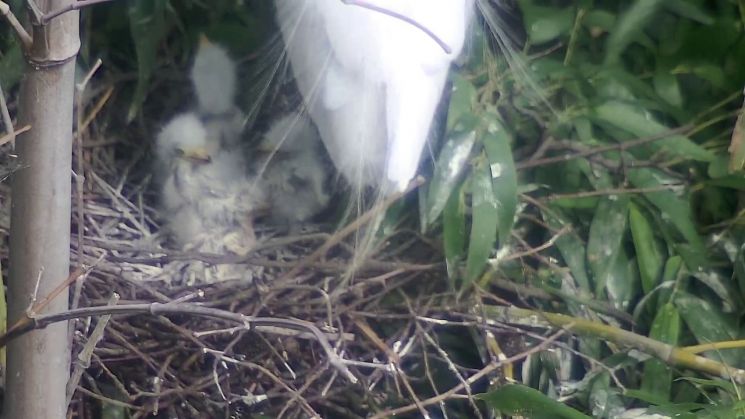
Intermediate Egrets are known to incubate their eggs for about 24 to 27 days (an average of 26 days) before hatching. It is estimated that the first egg was laid on May 31, with the third and fourth eggs laid on June 3 and June 10, respectively, confirming an average incubation period of 26 days for the observed Intermediate Egret.
On July 14, the 14th day after hatching, the mother bird began leaving the nest, returning only every 8 to 10 hours to feed the chicks. From July 25, the chicks were seen hopping along branches next to the nest, practicing for fledging.
On July 31, the 35th day after hatching, the first chick flew out of the nest. The second chick fledged on August 8, and on August 10, two days later, the third and fourth chicks flapped their wings and left the nest.
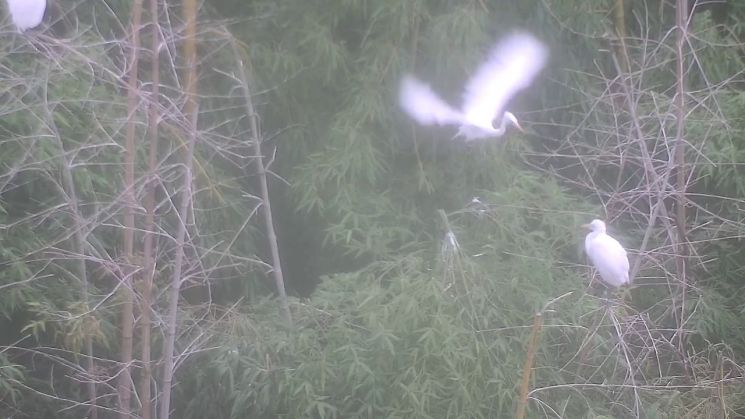
An Ulsan City official stated, "While Great Egrets and other species have many nests and individuals, the nests of Intermediate Egrets, which visit in small numbers, are rarely observed. The video footage documenting the successful breeding of four eggs laid at roughly one-week intervals will be used as educational material on the Ulsan Migratory Bird Tour Bus and the Bird Safari website."
The Intermediate Egret (Ardea intermedia) is a summer migratory bird that spends the winter in Southeast Asia, arrives at Taehwagang in April to breed, and departs in late September.
Among the egret species that breed in the Taehwagang bamboo forest, the Intermediate Egret is smaller than the Grey Heron and Great Egret, but larger than the Little Egret. Unlike the Great Egret, whose bill base extends behind the eye, the Intermediate Egret's bill base reaches only to the middle of the eye. During the summer breeding season, it has filamentous plumes on its back and chest, which disappear in winter.
© The Asia Business Daily(www.asiae.co.kr). All rights reserved.
![Clutching a Stolen Dior Bag, Saying "I Hate Being Poor but Real"... The Grotesque Con of a "Human Knockoff" [Slate]](https://cwcontent.asiae.co.kr/asiaresize/183/2026021902243444107_1771435474.jpg)


















