Police Refer 12 for Violation of Resident Registration Act
Consent Rate Falls Below Standard Without Falsely Registered Residents
Opposition Committee Demands "Site Selection Must Be Invalidated"
Gwangju City Maintains Cautious Stance, Awaiting Legal Judgment
The process of selecting the site for the waste incineration plant (metropolitan resource recovery facility) in Samdo-dong, Gwangsan-gu, Gwangju, has inevitably faced setbacks after it was revealed that some residents had falsely registered their addresses.
According to Gwangju City and the Gwangsan Police Station on September 3, it was confirmed the previous day that 12 people had changed their registered addresses to the area near the planned incinerator site without actually living there. These individuals were found to have influenced the resident consent procedure.
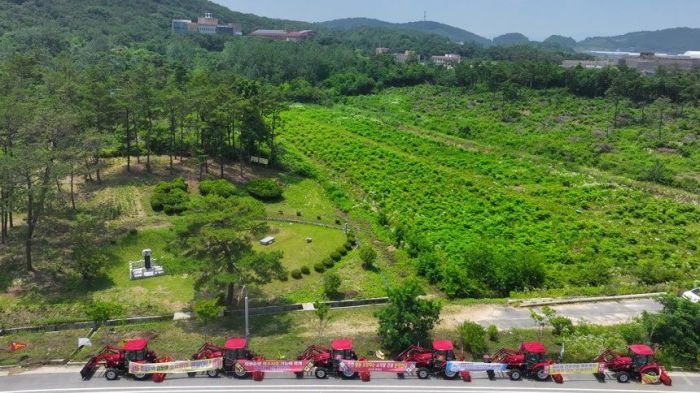 Gwangju City is promoting the installation of a resource recovery facility (incinerator) with a daily processing capacity of 650 tons in preparation for the ban on direct landfill of combustible household waste starting in 2030. The photo shows the area around San 77-9, Samgeo-dong, Gwangsan-gu, selected as the optimal candidate site by the Gwangju City Resource Recovery Facility Site Selection Committee. Photo by Yonhap News Agency
For the incinerator site selection, more than 50% of the heads of households living within a 300-meter radius of the site must give their consent. In the case of Samdo-dong, 48 out of a total of 88 households (54%) agreed, thus meeting the requirement. However, if the 12 households with false registrations are excluded, the consent rate falls short of the standard.
As a result, opponents are protesting, claiming that "the site selection is completely invalid." Kook Kanghyun, a member of the Gwangsan District Council from the Progressive Party, pointed out, "The false registrations were centered around the city-run nursing hospital, which is an agency commissioned by Gwangju City," and added, "It has been confirmed that this was organized to meet the resident consent rate." He further argued, "It is unacceptable to push forward a public facility worth several hundred billion won in such a non-transparent and unethical manner," and insisted, "Gwangju City should immediately cancel the project and apologize to the residents."
The emergency committee, which has already seen two resident briefings fail, is expected to intensify its opposition in light of these findings.
Gwangju City is in a difficult position. In order to comply with the ban on direct landfill of household waste in 2030, the site must be finalized within this year. The city plans to select the site this year, conduct a basic plan and feasibility study next year, begin construction in 2027, and complete the project in 2030.
Despite the investigation into the false address registrations, Gwangju City maintains its intention to proceed with the project. Since the resident briefings have failed, the city is considering replacing them with a public inspection process. A city official stated, "We believed there was no legal problem as long as people commuted to work from the registered address, even if they did not sleep there," adding, "However, since the prosecution and the court have yet to make a final decision, we must wait for the final outcome."
© The Asia Business Daily(www.asiae.co.kr). All rights reserved.

















