Washington D.C. Federal Court Ruling
"Exclusive Contracts and Search Data Monopolization Prohibited"
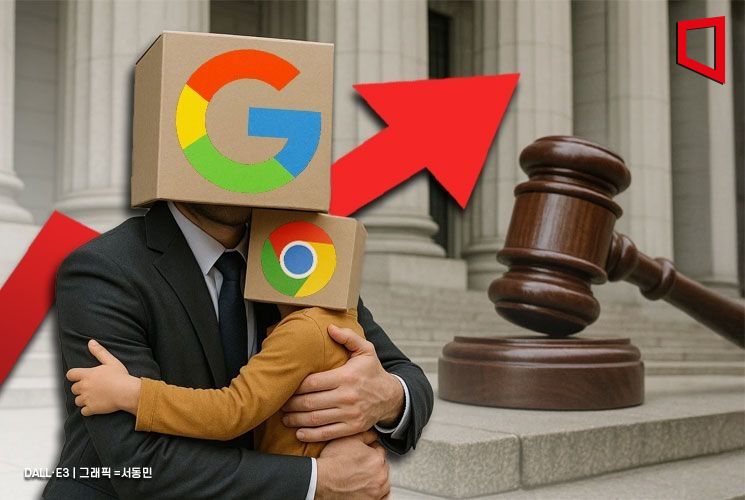
On September 2 (local time), a U.S. court ruled that Google, which has been deemed a monopoly in the search market, does not have to sell its Chrome browser (internet access program).
The U.S. District Court for the District of Columbia announced that Google may continue to operate the Chrome browser, but exclusive contracts and monopolization of search data are prohibited.
Judge Amit Mehta stated, "Forcing the sale of such a core asset, which Google has not used to impose illegal restrictions, is an excessive measure."
The court also allowed Google to pay third parties, including Apple, to have its services pre-installed as the default browser.
However, Judge Mehta ruled that, in order to promote competition in the online search market, Google must share data with its competitors. He also prohibited Google from entering into exclusive agreements with device manufacturers, such as smartphone makers, that would prevent the pre-installation of competitors' products on new devices.
The U.S. Department of Justice had previously proposed to the court measures to restore competition in the online search market, including requiring Google to sell its Chrome browser, banning large payments to Apple and others, and mandating the sharing of Google's data with competitors. The court did not accept the Department of Justice's requests to force the sale of Chrome or to ban payments to Apple and others, but did order Google to share its data with competitors.
In response, Google argued that the Department of Justice's claims were excessively extreme, and that splitting up Chrome would threaten not only American consumers and the economy, but also Google's position as a global leader in technology. Google has also rejected the demand to share search data with competitors, stating, "Data sharing is essentially the same as selling our intellectual property (IP)," and "It would allow competitors to completely copy our technology."
Previously, in October 2020, the U.S. Department of Justice filed a lawsuit alleging that Google violated antitrust laws by paying smartphone manufacturers such as Apple and Samsung Electronics tens of billions of dollars each year to establish a monopoly in the search engine market. In August last year, the court determined that Google was a monopoly in the search market.
After winning last year's presidential election, President Trump commented on the potential breakup of Google, stating, "It is a very dangerous move that could destroy Google," and "China fears Google. We do not want China to have companies like this."
With this ruling, Google has avoided the worst-case scenario of being forced to break up Chrome. However, Google announced that it plans to appeal the decision. The Department of Justice is also expected to appeal, so it may take several more years before a final ruling is reached.
Meanwhile, as a result of this decision, the stock price of Alphabet, Google's parent company, surged by 7.55% in after-hours trading as of 5:41 p.m. Eastern Time. Apple shares are up by 3.46%.
© The Asia Business Daily(www.asiae.co.kr). All rights reserved.

![Clutching a Stolen Dior Bag, Saying "I Hate Being Poor but Real"... The Grotesque Con of a "Human Knockoff" [Slate]](https://cwcontent.asiae.co.kr/asiaresize/183/2026021902243444107_1771435474.jpg)
















