Millions of Tourists Flock to Gangneung Despite Drought Emergency
Water Shortage Worsens as Residents Face Inconvenience
Government Declares Disaster Situation for the First Time Due to Drought
Despite an extreme drought that recently led to a disaster declaration in Gangneung, Gangwon Province, more than 3.06 million vacationers flocked to the city this summer.
According to statistics released by Gangwon Province on September 2, a total of 8,650,208 people visited 83 beaches along the East Coast of Gangwon this summer. This figure represents an 11.3% increase from last year and is the highest since the COVID-19 endemic. In particular, Gangneung recorded the largest number of visitors among the six cities and counties along the East Coast, with 3,066,872 people.
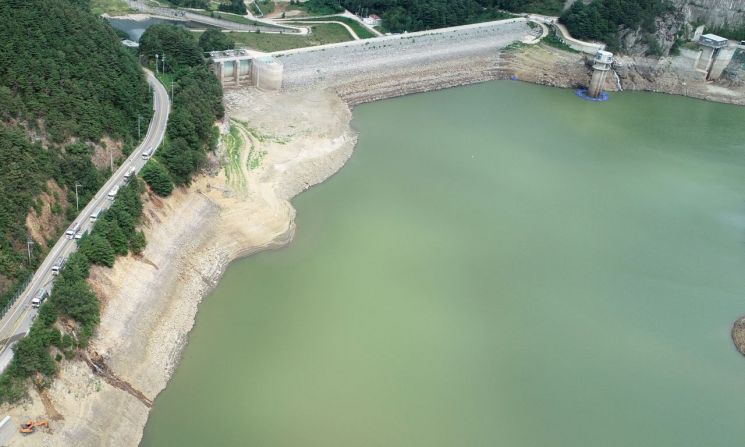 On the afternoon of the 1st, water spraying trucks lined up and poured water into Obong Reservoir, the water source in Gangneung City, Gangwon Province, where the water storage rate dropped to 14.4%. Starting from this day, Gangneung City is supplying water not only to Hongchae Water Purification Plant but also to Obong Reservoir to prevent a complete water outage. Photo by Yonhap News
While this is welcome news for the tourism industry, the local community is not entirely pleased. With millions of tourists pouring in as the worst drought has put the region on the brink of a domestic water crisis, the inconvenience for residents has only intensified.
This summer, Gangneung experienced 40 days of heat waves and 43 tropical nights, while precipitation totaled only 187.9 mm, making it the second lowest in 108 years since 1917 (187.4 mm). The water storage rate at Obong Reservoir, the main water source for Gangneung, fell to 14.2% on this day, setting a new record low.
On September 1 alone, 85,497 cubic meters of domestic water were supplied, with daily supply hovering around 85,000 cubic meters since late August. Previously, when the water storage rate dropped below 20% and 50% of water meters were locked starting August 20, the domestic water supply reached 94,118 cubic meters.
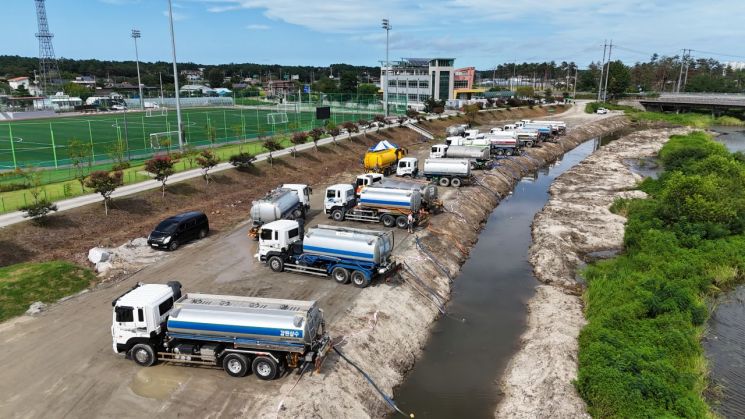 On the afternoon of the 2nd, water spraying trucks that came from all over the country to provide support are drawing water from a stream on the outskirts of Gangneung City, Gangwon Province, to be supplied to Obong Reservoir. Photo by Yonhap News Agency
In materials from a drought emergency response press conference held on August 19, Gangneung City estimated that, with the water storage rate below 20% and 50% of meters restricted, daily domestic water supply would be about 57,000 cubic meters. If stricter restrictions were implemented with the storage rate below 15%, supply was projected to drop to about 38,000 cubic meters. The city expected a 40% water-saving effect with 50% meter locking, and a 60% reduction with the stronger 75% restriction.
However, the results were not as expected. Despite the closure of beaches, a decrease in tourists, scaled-back operations at large accommodations, the shutdown of sports facilities and public restrooms, and a widespread water-saving campaign among residents, water usage has not noticeably decreased.
President Lee Jaemyung, who visited Obong Reservoir on August 30, also commented on Gangneung City's water meter restriction method, saying, "It will not lead to a dramatic reduction in water usage," and suggested that "time-based water rationing should be considered."
Meanwhile, on August 30, the government declared a disaster situation in Gangneung. This is the first time a disaster declaration has been issued for a natural disaster such as a drought.
© The Asia Business Daily(www.asiae.co.kr). All rights reserved.
![Clutching a Stolen Dior Bag, Saying "I Hate Being Poor but Real"... The Grotesque Con of a "Human Knockoff" [Slate]](https://cwcontent.asiae.co.kr/asiaresize/183/2026021902243444107_1771435474.jpg)

















