Six Out of Eleven Juvenile Detention Centers Over Capacity
Recidivism Rate for Juvenile Offenders More Than Double That of Adults
The suspect who posted a threat last month to bomb the main branch of Shinsegae Department Store in Myeong-dong, Seoul, was a first-year middle school student, referred to as Student A, who is under the age of criminal responsibility. Due to Student A's prank post, Shinsegae Department Store is estimated to have suffered damages amounting to approximately 600 million won. Over the past five years, crimes committed by juveniles aged 10 to under 14, who are exempt from criminal punishment like Student A, have more than doubled. This has led to calls for not only stronger punishment but also enhanced crime prevention and rehabilitation systems to address the issue of juvenile delinquency.
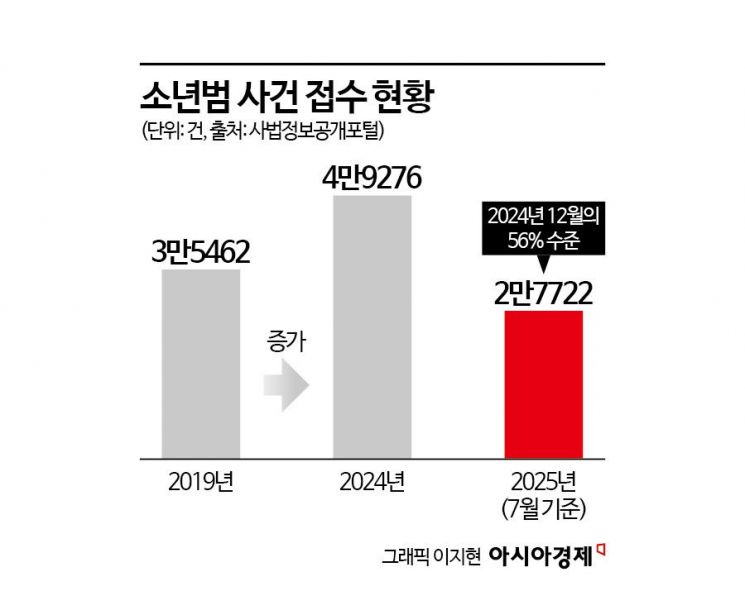
According to the Judicial Information Disclosure Portal on September 5, the number of juvenile cases filed with the courts increased by 39%, from 35,462 in 2019 to 49,276 last year. As of July this year, the figure stood at 27,722.
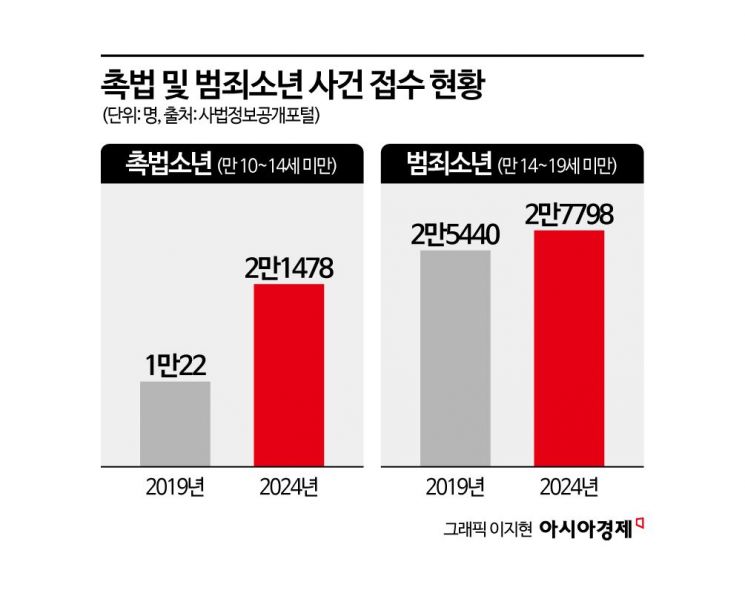
The increase was particularly pronounced among juveniles aged 10 to under 14 who are exempt from criminal liability. The number of such juveniles rose sharply by 114%, from 10,022 in 2019 to 21,478 last year. While the number of juvenile offenders aged 14 to under 19 also increased, the gap was much smaller, rising from 25,440 in 2019 to 27,798 last year. In other words, the majority of the increase in juvenile crime was accounted for by those under the age of criminal responsibility.

Some analysts argue that the apparent rise in youth crime is actually due to the government's tough-on-crime policies, which have led to the criminalization of behaviors that were previously overlooked. However, the actual number of cases involving juveniles exempt from criminal liability that were processed by the police has also steadily increased. According to National Police Agency statistics from the past five years, crimes committed by such juveniles rose by 117%, from 9,606 in 2020 to 20,814 last year.
Not only has the quantity of offenses increased, but the severity of the crimes has also worsened. When a family court deems it necessary, it can issue one of ten types of protective measures for juvenile offenders, intended to give them a chance to reintegrate into society. Among these, the number of cases involving short-term or long-term commitment to juvenile detention centers-classified as the 9th and 10th measures-nearly doubled, from 1,050 in 2019 to 2,098 last year.
As more juvenile offenders are being sent to detention centers, there is now a shortage of space in these facilities. According to the Ministry of Justice, six out of the eleven juvenile detention centers nationwide (including pretrial facilities) are currently over capacity.
Experts point out that environmental factors exposing youth to crime have increased, and advise that the focus should be not only on punishment but also on prevention, rehabilitation, and re-education.
Kwon Ilnam, a professor at Myongji University’s Department of Youth Guidance, stated, "In addition to the traditional causes that could lead youth to commit crimes, new types of offenses have emerged, resulting in an increase in juvenile crime. While crime has increased, our response remains outdated. We need systems that prevent youth from engaging in crime in the first place and help those who have offended to reintegrate into society." Lee Yunho, a distinguished professor at Korea Cyber University’s Department of Police Studies, added, "Rather than imposing lenient measures simply because of age, the system should be improved to assess the individual’s characteristics and the severity of the crime when determining the level of punishment."
The high recidivism rate among juveniles under probation supervision is also a concern. According to probation statistics, over the past ten years, the average recidivism rate for juveniles under probation was 12.5%, more than twice as high as the approximately 5% rate for adults. Lee Soojung, a professor at Kyonggi University’s Department of Criminal Correctional Psychology, commented, "Juveniles under probation often live as usual and may not recognize that their actions constitute a crime, which increases the risk of reoffending. We need to increase the number of probation officers to reduce the number of juveniles each officer supervises, and at the same time, raise awareness of juvenile crime among probation office staff."
© The Asia Business Daily(www.asiae.co.kr). All rights reserved.



















