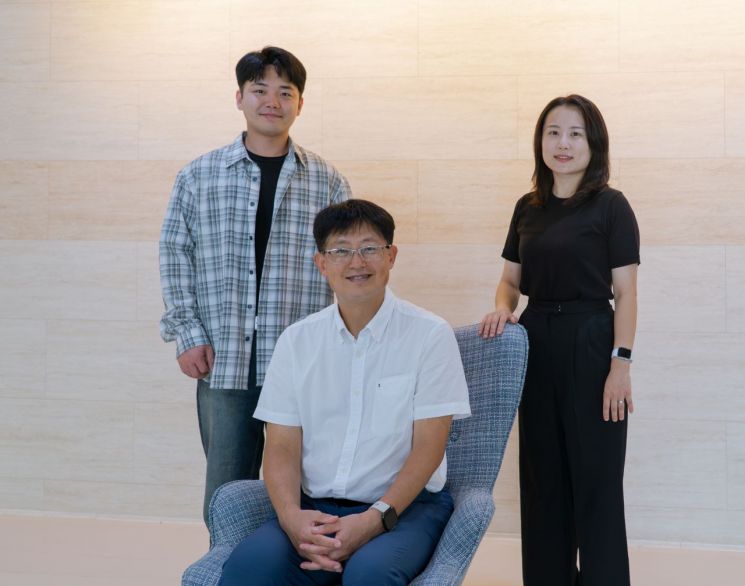
 (From left) Jaehoon Lee, PhD in Materials Science and Engineering, Inchang Kwon, Professor, Nahyun Kwon, Doctoral Student.
Gwangju Institute of Science and Technology (GIST) announced on September 2 that a research team led by Professor Inchang Kwon from the Department of Materials Science and Engineering, in collaboration with researchers from the University of Virginia School of Medicine, has developed a new anticancer therapeutic platform called "Albubody" that can overcome the limitations of conventional antibody-drug conjugates (ADCs).
This achievement is academically and industrially significant as it addresses the biggest obstacle in developing anticancer drugs based on small antibody fragments: their short half-life in the body.
Antibody-drug conjugates (ADCs) are targeted therapies that selectively and precisely attack only cancer cells, minimizing damage to normal cells while maximizing anticancer effects. As such, they have attracted attention as "personalized anticancer drugs." To date, 15 types have received approval from the U.S. Food and Drug Administration (FDA), and over 100 are in clinical trials.
However, most of the commercially available antibody-drug conjugates so far are based on large antibodies (IgG), which are too large to penetrate tumors uniformly, resulting in unstable therapeutic effects.
In contrast, antibody fragments (scFv) are small enough to deeply penetrate tumor tissues, but their clinical application has been limited due to their short half-life in the bloodstream-only about one hour-which causes them to be rapidly eliminated from the body.
An antibody fragment is a lightweight and simple form of antibody, created by isolating only the antigen-recognition region and connecting two variable domains (VH and VL) with a short peptide. While its small molecular size allows for rapid and uniform penetration into tumor tissues, its short half-life in the bloodstream leads to quick elimination from the body, prompting various research efforts to address this limitation.
To solve this problem, the research team devised a new antibody fragment platform called Albubody, which combines the advantages of small antibody fragments (rapid tumor penetration) and albumin (long half-life in the body).
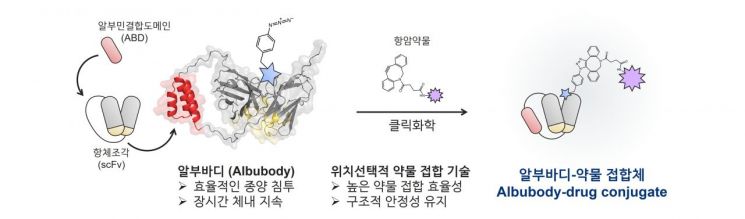
Albubody is a recombinant protein designed to bind to albumin in the body by inserting an albumin-binding domain (ABD) into the antibody fragment. This enables Albubody to circulate in the bloodstream for extended periods by leveraging albumin’s persistence mechanism in the body.
In fact, Albubody demonstrated a residence time in the body more than 200 times longer than conventional antibody fragments, and it exhibited superior tumor penetration compared to the large antibody immunoglobulin G (IgG), proving its potential as a next-generation anticancer drug platform.
The research team applied a click chemistry-based site-specific drug conjugation technology to develop an Albubody-drug conjugate that targets HER2, a protein receptor excessively expressed in breast and gastric cancers that promotes cancer cell growth and metastasis.
This approach enabled the drug to bind precisely to a specific site on the antibody fragment, thereby improving both the synthesis efficiency and stability of the antibody-drug conjugate.
In in vivo distribution experiments, Albubody accumulated in tumor tissues for extended periods, unlike conventional antibody fragments, resulting in efficient anticancer effects. No toxicity was observed in normal tissues, confirming its safety.
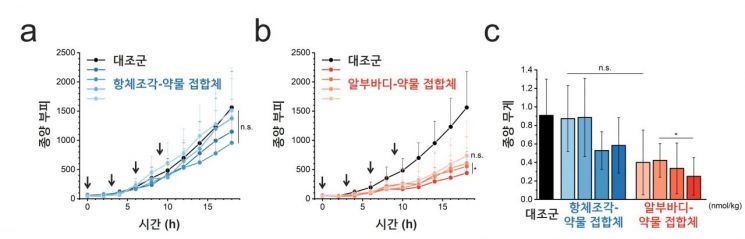 AlbudAb-Drug Conjugates Showing Superior Anticancer Effects Compared to Conventional Antibody Fragment-Drug Conjugates.
The synthesized Albubody-drug conjugate demonstrated superior persistence in the body and deep penetration into tumor tissues in a mouse model implanted with HER2-positive breast cancer cells, showing outstanding anticancer efficacy compared to conventional antibody fragment-drug conjugates. This technology can be applied to other target antigens and drugs, making it highly promising as a universal anticancer treatment platform.
Professor Inchang Kwon stated, "It is highly meaningful that we overcame the biggest weakness of antibody fragment-based anticancer drugs-their short half-life-through albumin-binding technology. If combined with various anticancer drugs and applied clinically in the future, it could enable more effective and safer cancer treatments."
This research, supervised by Professor Inchang Kwon of the Department of Materials Science and Engineering at GIST and conducted by doctoral student Nahyun Kwon and Dr. Jaehoon Lee, was supported by the Individual Basic Research Program (Mid-Career Researcher Program) of the Ministry of Science and ICT and the National Research Foundation of Korea. The results were published online on August 22 in the international journal Journal of Controlled Release.
© The Asia Business Daily(www.asiae.co.kr). All rights reserved.



















