70,000 KRW for a Plate of Sea Cucumber...
Refunded 5,000 KRW After Complaint
Recurring Overcharging Controversies...
What Is the Solution?
Recently, major tourist destinations in South Korea have been drawing public criticism for excessive overcharging, and now controversy has erupted over a plate of sea cucumber being sold for 70,000 KRW at Jagalchi Market in Busan.
70,000 KRW for a Plate of Sea Cucumber... Refunded 5,000 KRW After Complaint
 Sea cucumbers that Mr. A received. Mr. A claimed that the amount of sea cucumbers was "only enough for 2 to 3 pieces." Screenshot from an online community
On August 29, a post titled "I was charged 70,000 KRW for a plate of sea cucumber at a sashimi restaurant in Jagalchi, Busan. Is this normal?" appeared on an online community. The author, identified as Mr. A, shared a receipt and a photo of the packaged sea cucumber, expressing that it was "an absurd and unpleasant experience."
Mr. A visited a well-known sashimi restaurant in Busan and ordered a sashimi set meal for 43,000 KRW per person, then additionally ordered "market price sea cucumber," only to be charged an unexpectedly high amount. According to Mr. A, the sea cucumber in question "was lukewarm, had a poor texture, and only a few pieces were served in a container about the size of a palm."
Mr. A requested, "Please pack the remaining pieces," but found that the receipt included a 70,000 KRW item labeled as "sashimi" in addition to the sashimi set price. When Mr. A asked, "What is this sashimi charge?" the restaurant replied, "It's for the sea cucumber." Mr. A expressed dissatisfaction, saying, "They charged 70,000 KRW for sea cucumber that amounts to only 2 to 3 pieces. There were just a few pieces in a palm-sized container. In many cases, this amount is even given as a complimentary side dish."
In response to Mr. A's complaint, the restaurant handed back 5,000 KRW. Mr. A stated, "It wasn't about the 5,000 KRW," and added, "What upset me more was their attitude-overcharging under the name of 'market price' without any explanation, then trying to appease me by returning a few thousand won."
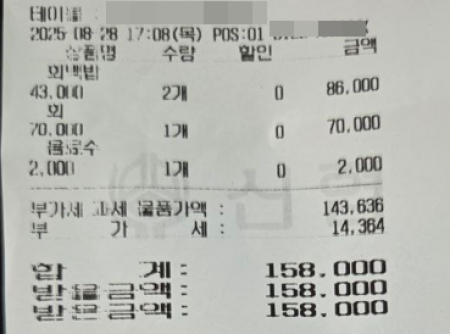 Receipt paid by A. In addition to 86,000 won for two servings of sashimi set, 70,000 won for sashimi was charged separately. Screenshot from an online community
Mr. A continued, "I've lived in Busan for about a year and frequently visit local markets and sashimi centers, so I'm well aware of seafood prices. I can only think that this sea cucumber was grossly overpriced, and it's disappointing that such practices still persist openly in Busan. If this kind of overcharging continues in a tourist city like Busan, the ones who ultimately suffer are both the visitors and those of us who live here."
Netizens who read the story criticized, "That amount is worth only 5,000 KRW," "You can get twice as much at the market for 10,000 KRW," "It's more than double the price of other sashimi restaurants," "Since when was sea cucumber sold at market price?" and "It would be better to buy it at a large supermarket." However, some pointed out, "For market price menu items, you should check the price before ordering."
Recurring Overcharging Controversies... What Is the Solution?
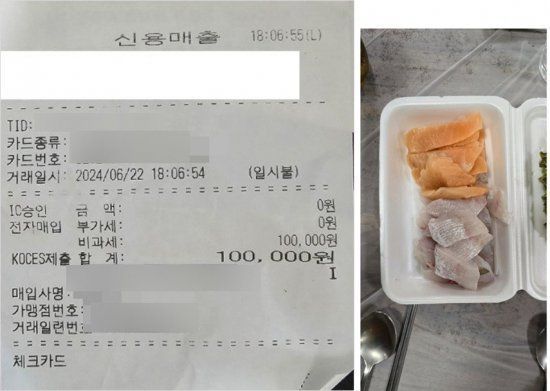 Purchase receipts and amount of sashimi from Mr. B, who visited Jagalchi Market. Mr. B bought 50,000 KRW worth of salmon and 50,000 KRW worth of white fish. Screenshot from an online community
This is not the first time Jagalchi Market has faced overcharging controversies. Last year, a tourist identified as Mr. B, who visited Busan, claimed that after ordering 50,000 KRW worth of salmon and 50,000 KRW worth of white fish, the portions served were unreasonably small. When Mr. B asked, "Is this price correct?" the owner reportedly replied, "I'm not sure." Mr. B expressed dissatisfaction, saying, "It was an enjoyable trip, but I was upset at the end."
Experts warn that repeated overcharging incidents could undermine trust in the entire domestic tourism industry. They point out, "For tourists, a single trip can shape their entire impression of a city," and "The attitude of some merchants focusing solely on short-term profits threatens the overall regional tourism industry." Experts advise that the government and local authorities need to take structural measures such as strengthening crackdowns, expanding voluntary reporting systems, and launching consumer protection campaigns.
© The Asia Business Daily(www.asiae.co.kr). All rights reserved.



















