DS Investment & Securities has assessed that, as pessimism emerges in the U.S. stock market and market volatility increases, short-term corrections could present buying opportunities. The surge in profit-taking triggered by concerns over a so-called "artificial intelligence (AI) bubble" is also viewed as a buying opportunity at lower prices from a long-term perspective.
On September 2, Woo Jiyeon, a researcher at DS Investment & Securities, stated in the report "Global Strategy - A Review of Pessimism in the U.S. Stock Market" that "persistent pessimism may increase short-term market volatility, but the likelihood of these pessimistic scenarios materializing appears low," maintaining a positive outlook on the U.S. stock market.
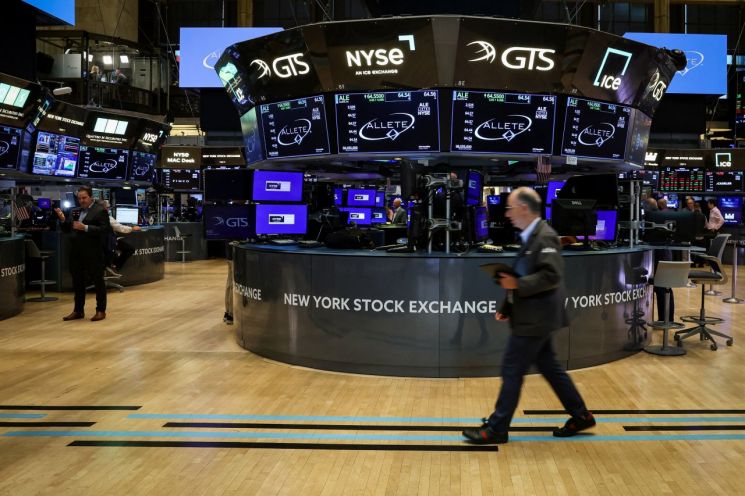
Recent pessimism surrounding the New York stock market can largely be divided into two categories. The first is concerns over the market peaking and the potential bursting of the AI technology stock bubble. Regarding this, Woo pointed out, "The S&P 500's 12-month forward multiple remains at 22 times, its historical peak," but added, "It is difficult to declare a market peak in the U.S. solely based on the multiple level. Rather than focusing on absolute numbers, attention should be paid to the structural improvements within the market."
She argued that the upper bound for multiples should be raised, stating, "As AI investments have begun to be fully reflected in the earnings of big tech companies, margin improvements are becoming prominent, especially in the Tech, Media, and Telecom (TMT) sector." She also noted, "The situation is markedly different from July and August of last year, and the beginning of this year, when skepticism about the sustainability of U.S. AI companies' growth was prominent." She added that both qualitative and quantitative growth are now occurring together.
The second wave of pessimism involves concerns over an overheated FOMO (Fear of Missing Out) rally. Woo explained, "Some pessimists claim that the recent U.S. stock rally is driven by FOMO and has entered overbought territory," but she questioned, "Looking at the market trends over the past few months, it is difficult to conclude that a full-fledged risk-on phase has begun. Can the current U.S. stock market truly be described as FOMO?"
She pointed out that the current risk appetite index for the U.S. stock market is only around 0.3, arguing, "This suggests that the market is not in an overheated phase caused by FOMO." The risk appetite index, which diagnoses overheating in the U.S. stock market based on 10 indicators such as sentiment and price, is typically considered overbought at 1 or above, and oversold at -1 or below.
Additionally, the recent concentration in AI mega-cap stocks such as Nvidia and Microsoft is also seen as a natural market phenomenon. Woo explained, "While the successful monetization of AI by mega-cap companies has already proven the utility of the technology itself, other industries remain in a transitional phase in terms of technology adoption. In this environment, investment opportunities are inevitably concentrated among a small number of leading companies that can directly link AI technology to financial results." She expects this concentration trend to continue for the time being.
Woo also expects the AI bubble debate to persist. She said, "Rather than searching for new market leaders, it is important to focus on stocks among the existing leaders that have become more attractive in terms of price." Among the so-called Magnificent 7 (M7) companies, she named Nvidia, Microsoft, Meta, and Broadcom-companies with a strong business-to-business (B2B) orientation-as her top picks. From the perspective of the AI value chain theme, she also suggested paying attention to energy, utility, and server-related companies. She noted, "Recently, profit-taking has occurred due to AI skepticism and policy risks," but added, "Considering the long-term trend of AI, this should be seen as a buying opportunity at lower prices."
Specifically, she recommended companies with a diverse energy portfolio rather than those dependent on a single business model. Constellation Energy (CEG), Vistra Energy (VST), and NextEra Energy (NEE) were cited as representative examples. As for recommended ETFs, she mentioned GRID US and ARTY US, which are power infrastructure and related value chain ETFs expected to benefit directly and indirectly from the expansion of AI-driven power demand.
© The Asia Business Daily(www.asiae.co.kr). All rights reserved.

















