Applicable to a Wide Range of Cases, Including Metastatic and Recurrent Cancers
Kyung Hee University Hospital announced on September 1 that it has ushered in a new era of precision radiation therapy by introducing the state-of-the-art customized radiation cancer treatment device, Radixact X9.
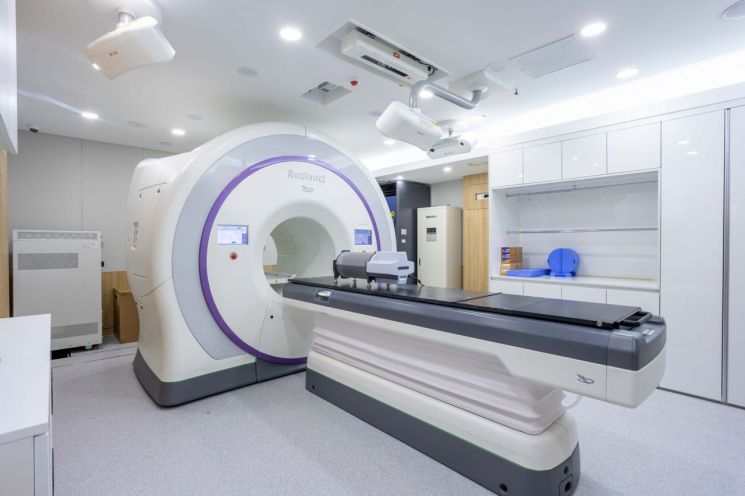 State-of-the-art customized radiation cancer treatment device 'Radixact X9'. Kyung Hee University Hospital
The Radixact X9 is the highest-performing radiation therapy device currently available. It enables fast and precise simultaneous treatment regardless of the size, shape, or number of tumors. In particular, it can be broadly applied to metastatic and recurrent cancers, which were difficult to treat with previous equipment, greatly expanding the range of treatable cases.
The device is equipped with a low-dose, high-resolution CT scanner that allows for accurate assessment of tumor status before and after treatment. The rotation angle of the radiation beam can be controlled precisely in 0.1-degree increments, significantly improving treatment accuracy. Treatment plans can be established and implemented five times faster than before, reducing patient wait times and shortening treatment duration by 20% compared to previous methods.
Alongside the introduction of the Radixact X9, Kyung Hee University Hospital is also operating a markerless real-time surface-guided radiation therapy system (SGRT) to maximize the effectiveness of radiation therapy, enhance patient convenience, and ensure safety.
SGRT uses high-resolution sensor cameras installed on the treatment room ceiling to create a three-dimensional image of the patient’s body surface. It guides the treatment area in real time, accurately tracking changes due to posture and breathing, and automatically detects and corrects any movement.
Previously, the treatment area was marked on the skin with ink, which imposed significant restrictions on daily activities such as showering, exercising, or going out. Now, with laser-based visual confirmation of the treatment position, there is no need for skin markings, greatly improving patient convenience.
Gong Moonkyu, Professor and Chair of Radiation Oncology at Kyung Hee University Hospital, stated, "The combination of our highly skilled medical staff, extensive clinical experience, and cutting-edge infrastructure ensures the safety of treatments while further enhancing their accuracy and reliability. We will do our utmost to set a new standard for precision radiation therapy not only in northeastern Seoul but throughout Korea."
Kim Jongwoo, Director of Kyung Hee University Hospital, added, "We will continue to strive to improve both the precision of cancer treatment and patients’ quality of life by building a patient-centered treatment environment and introducing advanced medical technologies."
Meanwhile, since its opening in January 2008, the Tomotherapy Center at Kyung Hee University Hospital has been recognized for successfully establishing the concept of radiation surgery for the first time in Korea. In 2022, it attracted international attention by presenting the world’s first ‘continuous lung cancer radiation surgery method’ to the academic community.
© The Asia Business Daily(www.asiae.co.kr). All rights reserved.

















