Leeum Museum's "Lee Bul: After 1998" Exhibition
Opens on the 4th, Runs Until January 4 Next Year
Showcasing Lee Bul's Artistic World Since 1998
"I Don't Define My Identity... I Follow My Curiosity"
History repeats itself. Topics that were discussed 10 or 20 years ago may feel like issues of the past that have already been resolved, but just as history repeats, the messages conveyed by art also cycle through the times. In this sense, the survey exhibition "Lee Bul: After 1998" by Lee Bul, a leading installation artist in Korean contemporary art, holds significant meaning.
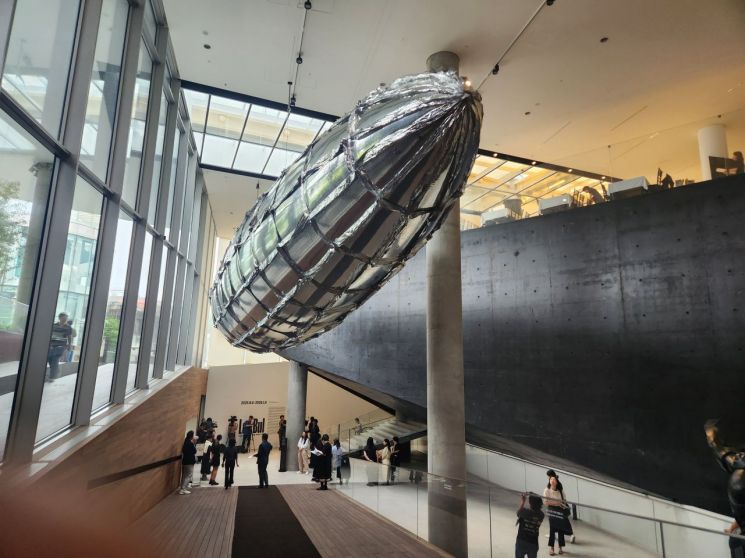 Interior view of the survey exhibition "Lee Bul: After 1998" by artist Lee Bul held at the Leeum Museum of Art. At the entrance of the exhibition hall, the 17-meter-long silver airship-shaped work "Willingness to Be Vulnerable - Metallized Balloon" (2020) catches the eye. Photo by Seo Mideum
Opening on September 4 at the Leeum Museum of Art in Hannam-dong, Seoul, this exhibition provides a comprehensive overview of Lee Bul's artistic world since the late 1990s. It features more than 150 works, including sculptures, large-scale installations, two-dimensional pieces, drawings, and models.
One of the central themes running through the exhibition is "the lessons of history." As visitors enter the exhibition, their attention is immediately drawn to a 17-meter-long silver airship suspended from the ceiling. This work, "Willingness to Be Vulnerable - Metallized Balloon" (2020), is an installation modeled after the Zeppelin airship that exploded over New Jersey in 1937, resulting in 36 deaths. Addressing both technological advancement and human destruction, the piece highlights the artist's social perspective, offering questions through art as she contemplates a turbulent era. The Zeppelin airship, introduced in the early 20th century, disappeared from history after the Hindenburg disaster in 1937. Curator Kwak Junyoung, who organized the exhibition, explained, "The core of this exhibition is the question, 'What should we do after the failure of grand narratives?'."
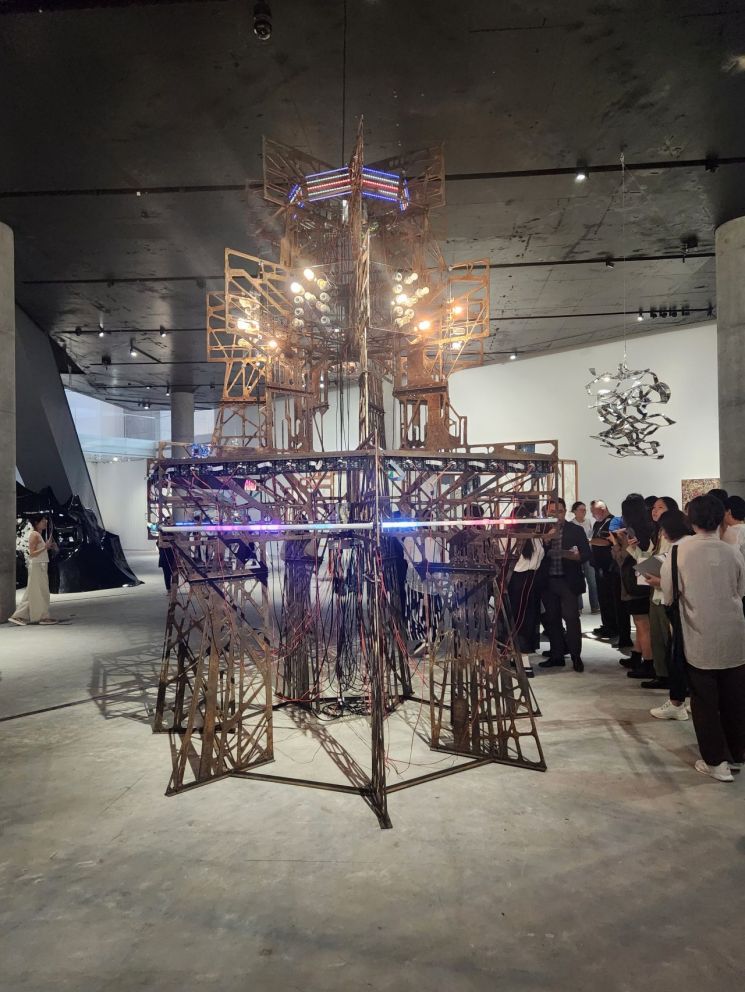 The artwork "Obad V" (2019). This piece was created using materials from a guard post dismantled in the Demilitarized Zone in 2018. At the time, some felt it was inappropriate due to the atmosphere of inter-Korean reconciliation, but it is now gaining renewed attention amid the current era of escalating confrontation. Photo by Seo Mideum
The artwork "Obad V" (2019) was created using materials from guard posts dismantled in the Demilitarized Zone during a period of inter-Korean summits and a prevailing mood of peace. At the time, producing an ideologically charged artwork felt awkward amid the atmosphere of reconciliation. However, the artist thought differently. She said, "When people suggested discussing ideology as a new paradigm, I disagreed," adding, "Even if its form changes, ideology has never truly been overcome, so it cannot be said that it has been left behind."
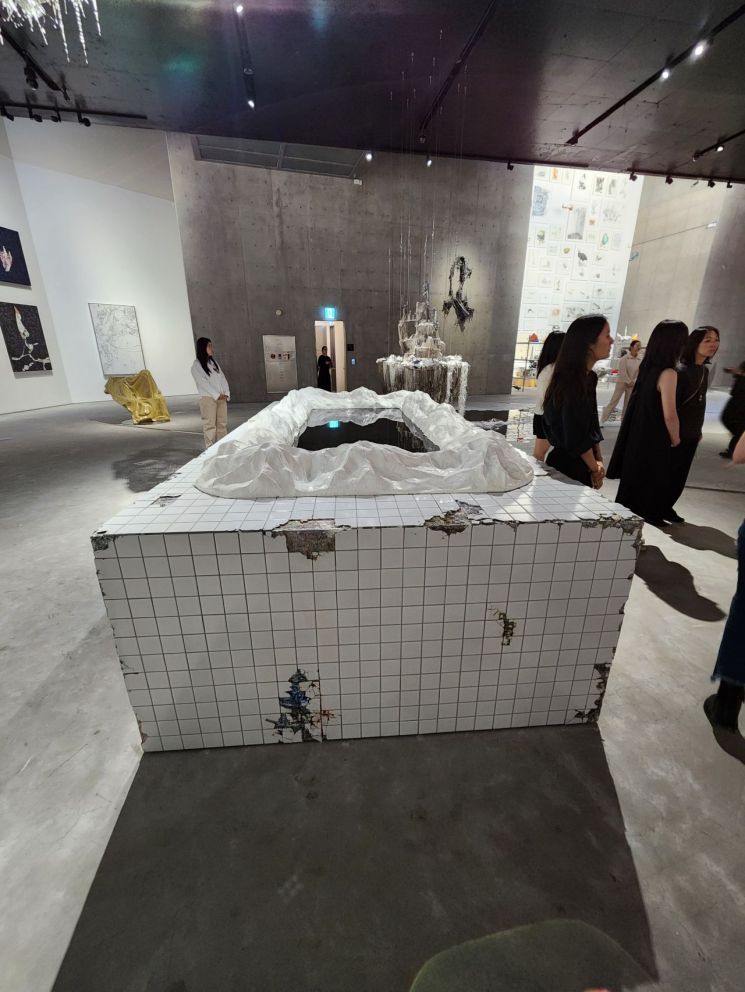
A bathtub-shaped piece reminiscent of the death by torture of Park Jongchul evokes memories of a time when torture was possible in the past, as well as recent domestic circumstances that have hinted at such possibilities. Regarding this, the artist refrained from making direct comments but said, "From the initial conception, the material aspects of the work and the social questions arise simultaneously. The challenge is how to realize that," and added, "I approached it with the breath of 'modern history.' The things I saw and learned growing up are wrapped into my work in various ways."
"Bunker (M. Bakhtin)" (2012) is rooted in her teenage experiences living in a border area. As a child, her parents, who were politically persecuted by the military regime, stayed in the border region and had to move frequently. During that time, she encountered military facilities such as bunkers, which she paradoxically perceived as utopian spaces. The artist said, "My childhood memories are simply of playing with other kids there. When I revisited those memories as an adult, they felt like a shelter," and added, "Perhaps the sense of freedom came from the comfort provided by the solid (concrete) material."
After graduating from the College of Fine Arts at Hongik University, Lee Bul began her career in 1987 and has since gained attention for her provocative exhibitions. She performed an "Abortion" piece, hanging upside down from the ceiling while nude, and walked through the streets of Tokyo wearing a costume with multiple tentacles. In 1997, she presented the installation "Majestic Splendor" at the Museum of Modern Art in New York, placing raw fish in a glass case to display its decay, but the piece was removed midway due to the smell. Since the late 1990s, her work has focused on the relationships between humans and technology, nature and civilization, and the body and society.
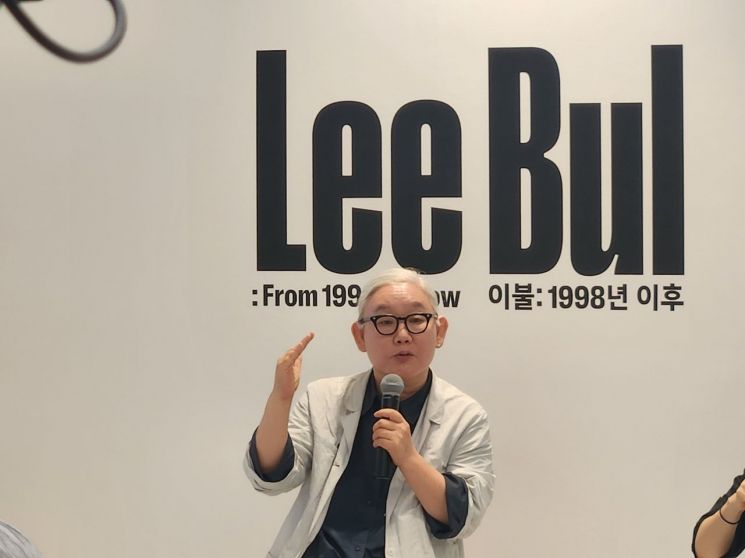 Artist Lee Bul is speaking at the press conference for the survey exhibition "Lee Bul: After 1998" held at the Leeum Museum of Art. Photo by Seo Mideum
By highlighting the continued relevance of her past works in today's era, the exhibition serves as a survey that goes beyond a mere retrospective. The artist said, "This exhibition is not arranged chronologically, but rather unfolds the works in ways that reflect both the past and the future. I hope visitors will feel free to interpret them," adding, "If viewers feel that the meaning of the works is relevant to the present, I will feel fulfilled. But if they see them as things of the past, I believe that is better for humanity."
The exhibition runs until January 4 next year. In March, it will be shown at the M+ Museum in Hong Kong, followed by a tour in Europe and Canada.
© The Asia Business Daily(www.asiae.co.kr). All rights reserved.



















