Discussion on Government Budget and Three Major Reform Bills
Interpellations, Confirmation Hearings, and Parliamentary Audits to Follow
Motion to Arrest Kweon Seongdong Not Reported to Plenary Session Today
The first regular session of the National Assembly under the Lee Jaemyung administration opened on September 1. The ruling and opposition parties are set to discuss the government budget and various reform legislative agendas during the 100-day regular session, which will continue until December 9.
The National Assembly began its schedule with an opening ceremony held at 2 p.m. in the main conference hall of the main building on this day.
On September 9 and 10, the Democratic Party of Korea and the People Power Party will each deliver speeches as the representatives of their respective negotiation groups. From September 15 to 18, interpellations to the government on overall state affairs will take place. The schedule for these interpellations is as follows: September 15 for politics, September 16 for diplomacy, unification, and security, September 17 for the economy, and September 18 for education, society, and culture.
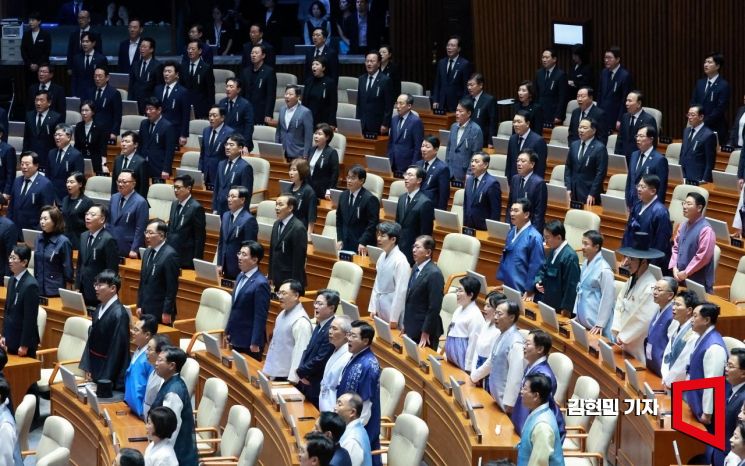 On September 1, 2025, at the regular session opening ceremony held at the National Assembly, ruling and opposition party lawmakers dressed in hanbok and mourning attire salute the national flag. Photo by Kim Hyunmin
Confirmation hearings will also be held. Starting on September 2, hearings will be conducted for Choi Gyojin, nominee for Minister of Education, and Lee Eokwon, nominee for Chairman of the Financial Services Commission. On September 3, a hearing for Won Minkyeong, nominee for Minister of Gender Equality and Family, will take place, followed by a hearing for Joo Byeonggi, nominee for Chairman of the Fair Trade Commission, on September 5. The schedule for the parliamentary audit is expected to be set around the Chuseok holiday.
The Democratic Party plans to focus on pushing forward 224 bills during this regular session. The amendment to the Government Organization Act, which stipulates the separation of investigative and prosecutorial powers, is targeted for passage at the plenary session on September 25. The party is also pursuing media reform, which includes the introduction of punitive damages for the press, as well as judicial reform, which involves increasing the number of Supreme Court justices. Democratic Party leader Jung Chungrae emphasized at the party's Supreme Council meeting on this day, "As this is the first regular session under the Lee Jaemyung administration, the role of the National Assembly is more important than ever," adding, "We will fulfill the historic tasks of the three major reforms without fail."
The People Power Party is considering the use of a filibuster (unlimited debate) or a boycott of the National Assembly schedule to block the passage of controversial bills. Before the opening ceremony of the regular session, the party held a general assembly of lawmakers and resolved to fight against the ruling party. Song Eonseok, floor leader of the People Power Party, stated at the assembly, "For the Lee Jaemyung administration, which wields the power of the majority party in one hand and the sword of a special prosecutor in the other, the word 'dictatorship' is not just political rhetoric but the essence of this government."
The handling of the government budget bill is also a major point of interest. The government has passed a budget bill for next year featuring expansionary fiscal policy amounting to 728 trillion won. While the Democratic Party maintains that such expansionary spending is necessary, the People Power Party has criticized, "It is becoming increasingly difficult for companies to do business and for taxes to be collected, yet government spending is surging."
Another flashpoint in this regular session is the motion to arrest Kweon Seongdong, a lawmaker from the People Power Party, which was not reported to the plenary session of the National Assembly on this day. On August 28, the special prosecutor requested an arrest warrant for Kweon on charges of receiving illegal political funds from the Unification Church.
Sitting lawmakers are protected by parliamentary immunity from arrest, so a motion to arrest must be passed by the plenary session of the National Assembly before a substantive warrant review can be held. When the Speaker of the National Assembly receives a request for consent to arrest, it must be reported at the plenary session and put to a vote within 72 hours. If the deadline is missed, the motion is put to a vote at the next plenary session.
As the motion to arrest was not submitted to the plenary session on this day, the related procedures are expected to proceed next week. While Kweon has stated that he will waive his immunity and attend the warrant review, the People Power Party is protesting, questioning the legitimacy of the special prosecutor's investigation itself. However, since the Democratic Party holds a majority of seats, the motion is highly likely to pass if put to a vote.
© The Asia Business Daily(www.asiae.co.kr). All rights reserved.
![Clutching a Stolen Dior Bag, Saying "I Hate Being Poor but Real"... The Grotesque Con of a "Human Knockoff" [Slate]](https://cwcontent.asiae.co.kr/asiaresize/183/2026021902243444107_1771435474.jpg)
















