Enhancing Food Security, Innovating Distribution Structures, and Strengthening National Food Care
Strengthening National Responsibility for Farm Income and Management Stability, and Promoting Agricultural Generational Change
Supporting Growth of the Agri-Food Industry through AI-Based Smart Agriculture and K-Food+ Export Expansion
Rural Areas Leading Balanced Growth
A Society Where People and Animals Live Happily Together
For the first time ever, next year's agricultural budget has surpassed 20 trillion won. The government plans to focus its budget investments on strengthening national responsibility for responding to the climate crisis and disasters, proactive supply and demand management, ensuring food security for vulnerable groups, fostering a new generation of young farmers, promoting balanced regional growth, and expanding the foundation for artificial intelligence transformation (AX).
On September 1, the Ministry of Agriculture, Food and Rural Affairs announced that it has set the 2026 budget proposal at 20.035 trillion won, an increase of 6.9% (1.2934 trillion won) from the previous year.
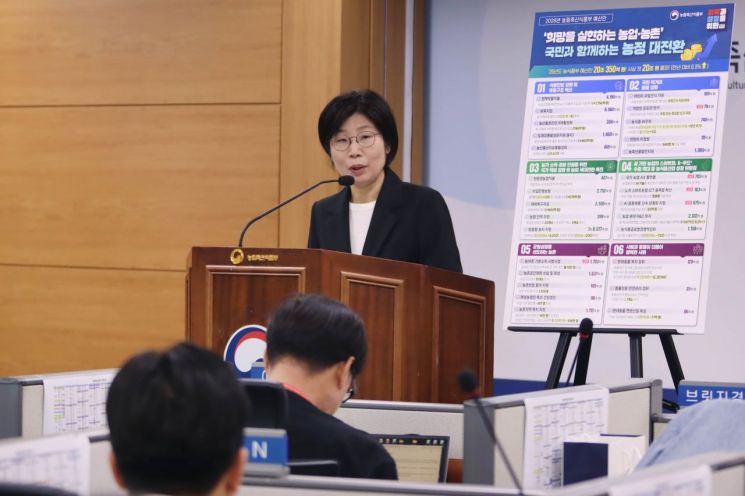 Soojin Park, Director General of the Planning and Coordination Office at the Ministry of Agriculture, Food and Rural Affairs, is explaining the "2026 Ministry of Agriculture, Food and Rural Affairs Budget Proposal" at the Government Complex Sejong. (Photo by Ministry of Agriculture, Food and Rural Affairs)
Enhancing Food Security, Innovating Distribution Structures, and Strengthening National Food Care
First, the government will focus on food security, innovating distribution structures, and strengthening national food care. To stabilize the rice supply and increase food self-sufficiency, strategic crop direct payments will be significantly expanded from 244 billion won in 2025 to 419.6 billion won in 2026. The area supported will increase from 176,000 hectares to 205,000 hectares, the payment rate will be raised, and five additional items, including rice for supply adjustment, will be added.
To expand the consumption base, a new rice self-help fund (2.9 billion won) will be introduced. In line with the expansion of production of strategic crops such as wheat and soybeans, support for boosting consumption will be strengthened (from 53.3 billion won to 56.4 billion won for strategic crop industrialization), and soybean reserves will also be expanded (from 30,000 tons to 60,000 tons, from 153.2 billion won to 315 billion won).
To revitalize online wholesale markets, a new customized voucher program will be provided to participants for direct delivery from production areas and marketing (18.6 billion won), and support for shipping and settlement funds will be expanded (from 60 billion won to 100 billion won). In addition, the government plans to expand smart agricultural product processing centers (APC) in major production areas (cumulative 60 to 115 locations, from 22.3 billion won to 38.7 billion won) to establish a consistent shipping system from production to distribution.
Food support for nutritionally vulnerable groups will also be strengthened. The agricultural and food voucher program will expand its target from pregnant women, infants, and children in households receiving basic living benefits to include young people (from 87,000 to 161,000 households, from 38.1 billion won to 74 billion won).
To ease the meal cost burden for office workers, a new program called "A Hearty Meal for Office Workers" will be introduced (7.9 billion won), providing 40,000 won per month for meal expenses to industrial complex workers and employees of small and medium-sized enterprises. The fruit snack support program for first and second grade students at Neulbom schools will also resume (600,000 students, 16.9 billion won).
Strengthening National Responsibility for Farm Income and Management Stability, and Promoting Agricultural Generational Change
Next year, the basic direct payment, which is the foundation of the farm income safety net, will be enhanced by refining compliance requirements and reflecting feasible execution levels, while the optional direct payment will be significantly expanded (from 320.1 billion won to 516.4 billion won).
To strengthen national responsibility for farm income safety nets and disasters, income stabilization insurance (from 15 to 20 items, from 207.8 billion won to 275.2 billion won), crop disaster insurance (from 76 to 78 items, from 484.2 billion won to 501.7 billion won), and disaster response funds (from 160 billion won to 250 billion won) will be significantly expanded.
A new program (6 locations, 2.6 billion won) will be introduced to support the spread of joint farming, which is being proposed as an alternative to overcome productivity constraints due to aging. Through this, comprehensive support will be provided to agricultural corporations promoting land consolidation and scale-up through farmland leasing, including infrastructure improvement, facilities and equipment, marketing, and sales channels.
To help young farmers secure farmland stably, public rental farmland purchases will be expanded (from 2,500 to 4,200 hectares, from 962.5 billion won to 1.617 trillion won). The supply of farmland using a pre-lease, post-purchase method, which allows young farmers to rent their desired farmland at the start-up stage and purchase it later, will also be expanded (from 50 to 200 hectares, from 19.3 billion won to 77 billion won).
Supporting Growth of the Agri-Food Industry through AI-Based Smart Agriculture and K-Food+ Export Expansion
To build an AI ecosystem in agriculture, a national agricultural AX platform will be created through a public-private joint investment model (establishment of a special purpose corporation, 70.5 billion won). This will focus investments on leading smart agriculture and livestock industries, as well as upstream and downstream sectors, utilizing AI and digital technologies. To spread smart agriculture to open fields and small farms, smart solutions will be distributed to major open-field crop production areas (5 locations, 1,400 farms, 10.3 billion won), and a new support program for small farm K-Smart Farm models will be introduced (2.1 billion won).
The agri-food research and development (R&D) budget will be expanded, focusing on artificial intelligence (AI), climate crisis response, and biotechnology (from 226.7 billion won to 261.2 billion won, up 15.2%). Separately, as part of "AX-Sprint 300," a new program will support the rapid commercialization of agricultural products using AI technology (30 companies, 67.5 billion won). A 100 billion won fund will also be created to support smart agriculture innovation.
To expand K-Food exports in connection with K-initiatives such as culture, beauty, and tourism, K-Food overseas hubs will be designated, and new support will be provided for discovering and fostering export strategy items by region (6 billion won) and pioneering traditional liquor export markets (1 billion won). Support for operating and facility funds for export companies (from 458.2 billion won to 510 billion won) and export vouchers (from 36 billion won to 72 billion won) will also be expanded.
Rural Areas Leading Balanced Growth
To guarantee the basic livelihood of rural residents, a pilot project for basic income in rural and fishing villages (170.3 billion won) will be introduced. Among the 69 counties experiencing rural population decline, six counties with a strong will to overcome the risk of extinction will be selected through a public contest, and about 240,000 people will receive 150,000 won per month in local currency.
To enable rural areas to lead national balanced growth and energy transition, rural space improvement projects will be expanded (from 122 to 137 locations, from 104.5 billion won to 151.9 billion won), and a new rural clean-up project (6.8 billion won) will be launched to collect agricultural waste left in rural and fishing villages and create a more pleasant environment. In addition, with the transfer of responsibility for rural vacant house demolition from the Ministry of the Interior and Safety to the Ministry of Agriculture, Food and Rural Affairs (10.5 billion won), the demolition and regeneration of vacant houses will be streamlined and accelerated.
The number of women farmers eligible for special health checkups will be significantly increased (from 50,000 to 80,000, from 6.5 billion won to 9.6 billion won), and the standard income amount for supporting farmers' pension insurance premiums will be raised (from 1.03 million won to 1.06 million won per month).
A Society Where People and Animals Live Happily Together
The Ministry of Agriculture, Food and Rural Affairs will support awareness improvement and future generation education in connection with "Animal Protection Day" (2.6 billion won) to raise awareness of animal welfare, and will continue to improve the environment of animal protection facilities (1.2 billion won) to enhance the welfare of protected animals.
To foster a healthy culture of pet adoption, the ministry will support the adoption of retired animals that have served society, such as military and police dogs (new, 100 million won), and will continue to manage stray and abandoned animals by expanding support for neutering surgeries to control the stray cat population (from 7.9 billion won to 8.1 billion won).
To promote the development of high-value-added new products in companion animal-related industries such as pet food and pet tech, support will be provided for the creation of "One-Welfare Valley" (to be completed in 2027, 7.1 billion won). Support will also be provided for market development, including overseas certification, consulting, and participation in exhibitions, to help companies enter promising markets such as Thailand and the Middle East (1.5 billion won).
© The Asia Business Daily(www.asiae.co.kr). All rights reserved.


















