Omission of "Special Medical Examination" for Musculoskeletal Disorders
Exclusion of "Epidemiological Investigation" for Lung Cancer and Leukemia
19 Billion Won Allocated for Public Industrial Accident Representatives
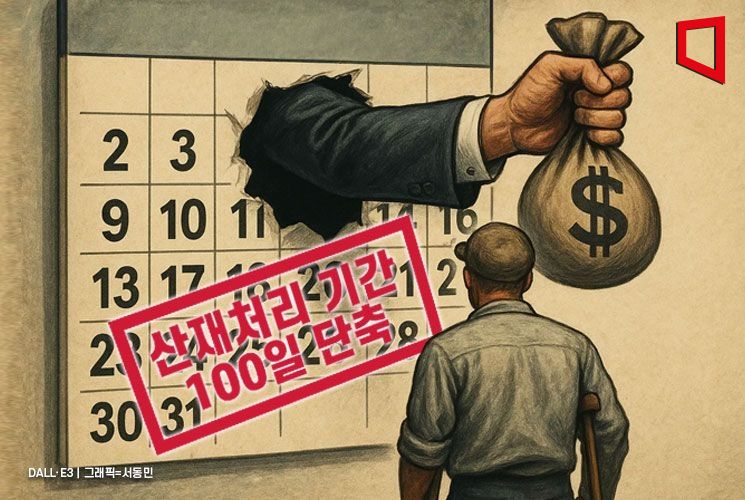
The government will significantly reduce the processing period for industrial accident compensation claims filed by workers with occupational diseases to within 120 days by 2027. The current average decision process, which takes 228 days, will be shortened by more than 100 days to promptly guarantee workers' rights. For musculoskeletal disorders, which account for a significant portion of occupational diseases, the 'special medical examination' process will be omitted, and for diseases such as lung cancer and leukemia, where the correlation between work and illness is sufficiently established, epidemiological investigations will be excluded.
On September 1, Kim Younghoon, Minister of Employment and Labor, held a briefing at the Government Sejong Complex and announced the 'Plan to Reduce the Processing Period for Occupational Disease Industrial Accident Claims.' Minister Kim stated, "For accidental injuries, a decision on industrial accident compensation can be made in an average of 17 days, but for occupational diseases, it takes an average of 228 days, and in some cases, up to four years," adding, "We have prepared related measures to reduce workers' suffering and ensure that industrial accident insurance fulfills its original purpose."
Minister Kim emphasized the need to improve the processing period for industrial accident claims by citing real cases. He said, "A worker who had been tunneling in an underground coal mine for six years applied for industrial accident compensation after developing lung cancer, but it took as long as 974 days to prove the causal relationship between the work and the disease," adding, "This problem of prolonged processing can no longer be neglected."
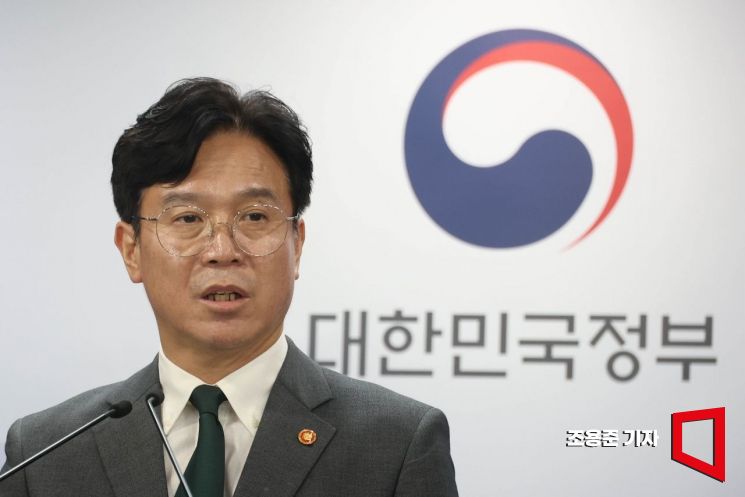 Kim Younghun, Minister of Employment and Labor, is answering reporters' questions during a briefing on the amendment to the Labor Union and Labor Relations Adjustment Act (Yellow Envelope Act) at the Government Seoul Office in Jongno-gu, Seoul on July 29, 2025. Photo by Jo Yongjun
Special Medical Examinations Omitted for 32 Musculoskeletal Disorder Occupations
The government will first simplify the decision process for occupational diseases. It will start by reducing the processing period for musculoskeletal disorders, which account for more than half (51%) of all occupational diseases. For additional occupations proposed on-site in the construction industry, such as system scaffolding workers and waterproofers, the scope will be expanded by gathering input from labor, management, and experts.
Minister Kim explained, "When workers in 32 occupations, including construction rebar workers, pipefitters, stonemasons, food service workers, cleaners, and automobile mechanics, apply for industrial accident compensation due to musculoskeletal disorders, the 'special medical examination' will be omitted, taking into account the accumulation of numerous cases, and the decision will be made promptly through only the review by the decision committee."
For cases where the correlation between hazardous substances and diseases is sufficiently established, such as primary lung cancer in mining workers or leukemia in semiconductor workers, the epidemiological investigation process will be excluded. Minister Kim stated, "If sufficient research has accumulated to confirm a significant causal relationship between work and disease, the case will be processed through only an accident investigation and review by the decision committee." In addition, for diseases that are strongly assessed as work-related, the 'presumption principle' will be applied, allowing for prompt decisions through accident investigation without additional procedures.
Strengthening Expertise... Establishment of Dedicated Occupational Disease Teams
While reducing procedures, the expertise of accident investigations and the decision committee will be strengthened. Each of the 64 affiliated institutions of the Korea Workers' Compensation and Welfare Service will establish a 'dedicated occupational disease team' to conduct specialized investigations. Accident investigators will be required to complete mandatory training as 'industrial accident insurance accident investigation specialists' to ensure expertise.
The government also plans to introduce an 'AI-based disease processing system' to utilize accumulated decision data, enabling more precise reviews. The decision committee will adjust the number of cases to an appropriate level and share major cases between committees to strengthen the substance of deliberations. In particular, for diseases with high litigation loss rates, the committee will supplement its review direction by reflecting court precedent trends.
System improvements will also be pursued at the post-decision stage. A 'state-appointed industrial accident representative system' will be introduced to provide legal support to workers during the application and objection process. This will provide free legal services from application to the pre-litigation stage. For lawsuits lost by the Korea Workers' Compensation and Welfare Service, the causes will be analyzed to revise the recognition criteria for industrial accidents and establish standards for rationally deciding whether to appeal.
Support in next year's budget plan will also be strengthened. The government has set the Ministry of Employment and Labor's budget for next year at 37.6157 trillion won, a 6.4% increase from this year and the largest ever. Expenditures from funds such as employment insurance and industrial accident insurance will increase by 4.7% to 30.9827 trillion won. To address blind spots in serious regional industrial accidents, 14.3 billion won has been newly allocated, with 1.9 billion won for the operation of the state-appointed industrial accident representative system and 1.1 billion won to strengthen the public disclosure of industrial accident compensation information.
Minister Kim stated, "Until now, workers had to wait, sometimes for years, for decisions on industrial accident compensation while suffering from illness, but now prompt compensation will be possible. We will do our utmost to ensure that industrial accident insurance faithfully fulfills its original role as a 'prompt and fair compensation system.'"
© The Asia Business Daily(www.asiae.co.kr). All rights reserved.


















