Lee Jaemyung Administration's First Regular Session Opens
Ruling and Opposition Parties Face Off Over Budget Bill and Reform Legislation
The first regular session of the National Assembly under the Lee Jaemyung administration opens on September 1. The regular session, which will run for 100 days until December 9, will see discussions on a variety of reform legislative agendas.
The National Assembly will hold its opening ceremony at 2 p.m. in the main chamber of the National Assembly building, officially starting the regular session. On September 9 and 10, the Democratic Party of Korea and the People Power Party will each deliver their policy speeches as negotiating groups. From September 15 to 18, there will be interpellations to question the government on overall state affairs. Starting on September 2, confirmation hearings will be held for Choi Gyojin, nominee for Minister of Education, and Lee Eokwon, nominee for Chairman of the Financial Services Commission, followed by hearings for Joo Byungki, nominee for Chairman of the Fair Trade Commission, and Won Minkyoung, nominee for Minister of Gender Equality and Family. The schedule for the parliamentary audit of government affairs is also expected to be set around the Chuseok holiday.
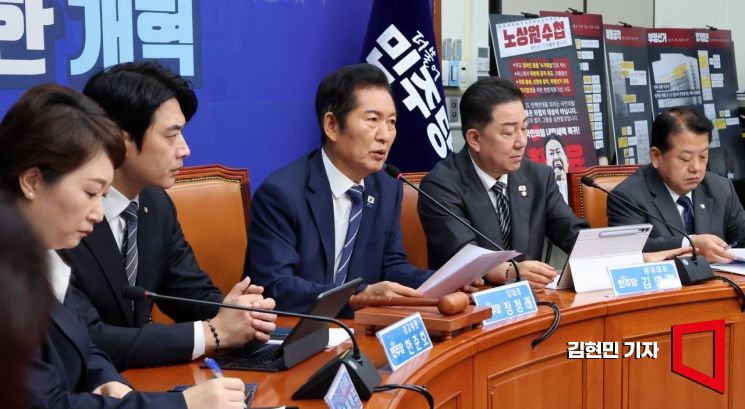 Jeong Cheongrae, leader of the Democratic Party of Korea, is speaking at the Supreme Council meeting held at the National Assembly on September 1, 2025. Photo by Kim Hyunmin
The Democratic Party of Korea plans to focus on 224 bills during this regular session. The party aims to pass an amendment to the Government Organization Act, which codifies the separation of prosecutorial investigation and prosecution, at the plenary session on September 25. The party is also pushing for media reform, introducing punitive damages for the media, and judicial reform, including increasing the number of Supreme Court justices. Jeong Cheongrae, leader of the Democratic Party of Korea, emphasized at the party’s Supreme Council meeting on this day, "As this is the first regular session under the Lee Jaemyung administration, the role of the National Assembly is more important than ever," adding, "We will fulfill the historic tasks of the three major reforms without fail."
The People Power Party is considering using a filibuster (unlimited debate) or boycotting the National Assembly schedule to block the passage of contentious bills. In addition, the party is pursuing 100 legislative tasks, including an amendment to the Commercial Act that contains provisions to ease the crime of breach of trust and strengthen management rights defense mechanisms.
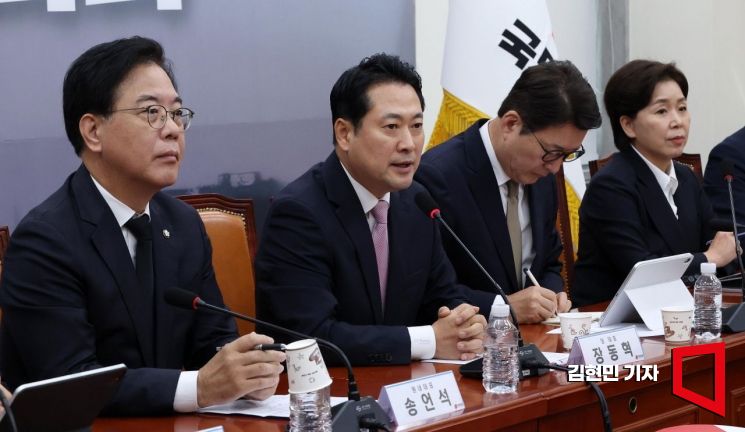 Jang Donghyuk, leader of the People Power Party, is speaking at the Supreme Council meeting held at the National Assembly on September 1, 2025. Photo by Kim Hyunmin
The handling of the government budget bill is also drawing attention. The government has approved a budget bill for next year featuring expansionary fiscal spending totaling 728 trillion won. The Democratic Party of Korea argues that expansionary fiscal policy is necessary, while the People Power Party criticizes, "It is becoming harder for businesses to operate and harder to collect taxes, but spending is soaring."
Meanwhile, regarding National Assembly Speaker Woo Wonshik’s proposal for lawmakers to wear hanbok at the opening ceremony of the regular session, the People Power Party responded, "We will wear mourning attire to protest the ruling party’s legislative overreach." Earlier, Speaker Woo accepted a suggestion from Democratic Party lawmaker Baek Hyeryeon and asked both ruling and opposition lawmakers to attend in hanbok.
Speaker Woo stated, "Hanbok is a precious cultural heritage that embodies our identity and values," and added, "On this special day marking the start of the regular session, let us express our pride in our culture and the Korean Wave." However, Song Eonseok, floor leader of the People Power Party, sent a notice to lawmakers instructing them to wear black suits, black ties, and mourning ribbons as the dress code.
© The Asia Business Daily(www.asiae.co.kr). All rights reserved.


















