2,000 Basic Research Projects to Receive 115 Billion Won in 2026
"Creating a Stable Environment Where Young Researchers Can Focus on Their Work Without Worries"
The government will restore the basic research program that was abolished in 2024. As a result, it is expected that a safety net for researchers will be provided.
The Ministry of Science and ICT announced on September 1 that its budget proposal reflected in the 2026 government budget and fund management plan has been set at a total of 23.7 trillion won. This is a 12.9% increase compared to the 2025 supplementary budget (21.0 trillion won), marking the largest budget ever. The research and development (R&D) budget is 11.8 trillion won, up 21.6% from the previous year, accounting for approximately 33.4% of the total government R&D budget.
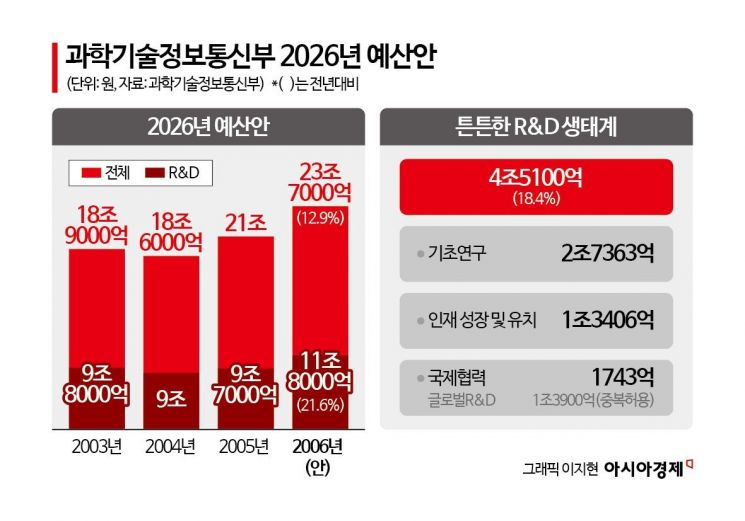
A notable point is the restoration of the basic research program that was abolished in 2024. The Ministry of Science and ICT has allocated 2.74 trillion won for the basic research program in 2026, which is about 17.2% higher than the 2.34 trillion won allocated in 2025.
Concerns have continued to be raised that the termination of the Basic Research for Life Program has increased research instability for early-career faculty or those at regional institutions with poor research environments. The restored basic research program is expected to provide a research safety net by supporting about 2,000 basic research projects with a budget of approximately 115 billion won in 2026.
Accordingly, the number of projects supported by the basic research program in 2026 will expand by about 28.5% compared to 2025, supporting a total of approximately 15,800 projects. Of these, around 7,000 will be new projects, which is an increase of about 98.2% compared to 2025.
Through the provision of this research safety net, the government aims to encourage Korean postdoctoral researchers currently overseas to return to Korea. A return track will be newly established in the "Sejong Science Fellowship," which supports young researchers, to support the return of about 130 outstanding talents to Korea. To this end, about 26 billion won will be invested in 2026 to strengthen the connection across the entire process of fellowship support-domestic, overseas, and return stages.
The name of the existing "Mid-Career Research" program will be changed to "Core Research," and the support system will be upgraded by differentiating research funding and duration according to each stage of research growth. This is in response to concerns that researchers' age and experience do not always match their research level.
Along with the expansion of individual basic research, efforts will also be made to enhance group research capabilities. In particular, support for basic research labs that promote creative convergence research among small research groups will be expanded. The national research institute program, which provides long-term, comprehensive support to nurture outstanding university-affiliated research institutes into world-class institutions, will also continue.
Koo Hyukchae, First Vice Minister of Science and ICT, stated, "The 2026 basic research budget is not only about restoring the basic research ecosystem, but also marks the starting point for a new leap forward," adding, "We will manage the allocated budget effectively to create an environment where young researchers can conduct their work stably without concerns, and to ensure that outstanding researchers can continue to grow."
© The Asia Business Daily(www.asiae.co.kr). All rights reserved.
![Clutching a Stolen Dior Bag, Saying "I Hate Being Poor but Real"... The Grotesque Con of a "Human Knockoff" [Slate]](https://cwcontent.asiae.co.kr/asiaresize/183/2026021902243444107_1771435474.jpg)
















