The Japanese stock market, which reached an all-time high last month, is expected to experience volatility in September as investors seek to realize gains.
Moon Namjoong, a researcher at Daishin Securities, stated in his report "September Japanese Stock Market: The Wait-and-See Begins" on September 1, "In September, the Japanese stock market is likely to see repeated ups and downs as investors closely monitor the U.S. Federal Reserve's monetary policy externally and the impact of tariffs imposed by U.S. President Donald Trump on domestic economic indicators."
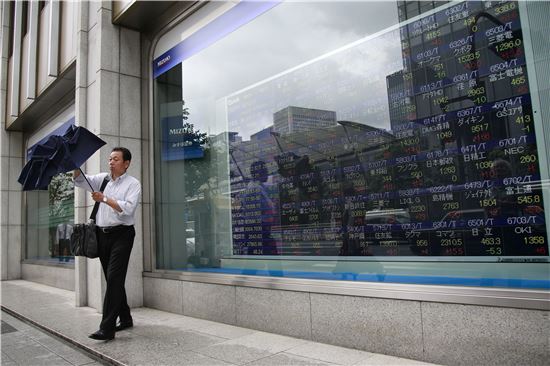 The stock ticker board located in Tokyo, Japan, displays the fluctuations of various indices such as Nikkei 225 and TOPIX. Photo by AP Yonhap News
First, regarding the Federal Reserve's monetary policy, Moon highlighted the upcoming U.S. employment report to be released on September 5. He noted that if nonfarm payrolls for August exceed the previous month's figures, it could lower market expectations for a "big cut" (a 0.5 percentage point rate cut at once) in September. He explained, "This is likely to increase demand for the yen as a safe-haven asset due to a temporary weakening of the dollar or a decline in the stock market, which would strengthen the yen and act as a downward factor for the stock market."
Furthermore, Kazuo Ueda, Governor of the Bank of Japan (BOJ), recently indicated at the Jackson Hole meeting that conditions for a rate hike are being met due to persistent wage growth pressures. Moon pointed out, "This has increased the likelihood that the BOJ could resume rate hikes as early as October," adding, "Along with the Federal Reserve's monetary policy, which is expected to resume rate cuts from September, this will further strengthen upward pressure on the yen."
He analyzed, "The main factor driving this year's stock market rally has been the BOJ's moderation of its rate hike pace. As market participants increasingly focus on the possibility of the BOJ resuming rate hikes as early as October, the Japanese stock market is unlikely to escape the cycle of downward pressure in a strong yen environment."
Domestically, Moon focused on exports as a key economic indicator reflecting the impact of U.S. tariffs. He explained, "Japan's exports in July decreased by 2.5% year-on-year, marking a larger decline than expected (-2.1%) and the fourth consecutive monthly drop." This is the largest decrease since February 2021. By country, exports to the United States fell by 10.1%. In particular, exports of automobiles and auto parts plunged by 28.4% and 17.4%, respectively.
Moon stated, "The impact of U.S. tariffs is evident in the reduced shipment volumes of automobiles and parts to the United States, and the rise in prices of Japanese exports to the U.S. in June and July has weakened the price competitiveness of Japanese products." He added, "Such weak economic indicators are dampening economic sentiment and will act as downward pressure on the stock market."
© The Asia Business Daily(www.asiae.co.kr). All rights reserved.
![Clutching a Stolen Dior Bag, Saying "I Hate Being Poor but Real"... The Grotesque Con of a "Human Knockoff" [Slate]](https://cwcontent.asiae.co.kr/asiaresize/183/2026021902243444107_1771435474.jpg)















