Heavy Rains and Heatwaves Raise Consumer Prices by 0.1%p
Growth Rate Also Lowered... Third Quarter Growth Down by 0.03%p
An analysis has found that this summer's concentrated heavy rains and heatwaves have had a negative impact on the construction, agriculture, forestry and fisheries, and food service sectors, which is expected to raise this year's consumer price index by 0.1 percentage points. It was also revealed that the economic growth rate for the third quarter would be lowered by 0.1 percentage points.
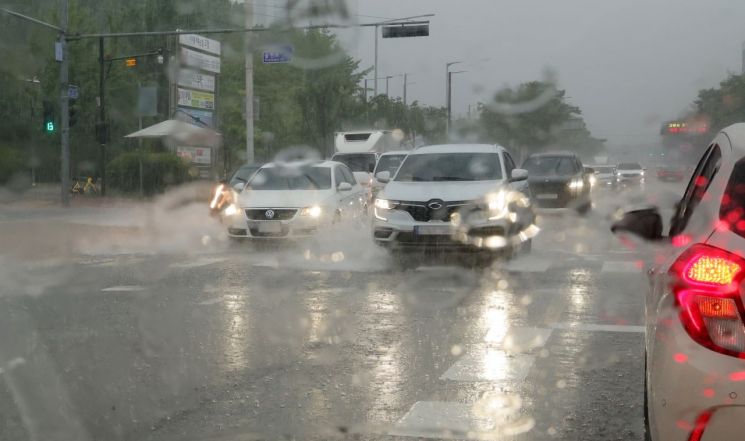
The Bank of Korea released these findings on July 31 in its report, "The Impact of Recent Heavy Rains and Heatwaves on Growth and Inflation." The report was jointly authored by Park Byunggeol and Lim Chunseong, team leaders at the Bank of Korea's Research Bureau, as well as Lee Seungho, Yang Junbin, Jang Taeyun, Kim Jihyun, Cho Insik, Kim Sanghyo, Kim Jiwon, An Seongyun, and Oh Youngsik, all researchers at the bureau.
According to the empirical analysis conducted by the research team using a local projection model, extreme weather events such as the prolonged heavy rains and heatwaves last month are estimated to raise the consumer price index by 0.3 percentage points in the third quarter of this year, and by 0.1 percentage points on an annual basis.
Heavy rain refers to precipitation of 30mm or more per hour, and a heatwave is defined as a daily maximum temperature of 33 degrees Celsius or higher. The frequency of heavy rains and heatwaves from 2020 to 2025 has increased to an annual average of 49 days and 67 days, respectively, which is 10 days and 21 days more than in the 2000s.
In particular, it was confirmed that the rise in prices of agricultural, livestock, and marine products has a negative impact on food service prices both directly and indirectly, with a time lag. The report explained that when the prices of agricultural, livestock, and marine products increase by 10 percent, food service prices tend to rise by 0.9 percent about three quarters later. The report also pointed out that the increased frequency of autumn typhoons due to climate change and the delayed Chuseok holiday this year are potential sources of instability for agricultural, livestock, and marine product prices.
Heavy rains and heatwaves have also been analyzed to contract the construction, agriculture, forestry and fisheries, and food service sectors, thereby negatively affecting the economic growth rate.
According to the report, the third quarter growth rate, when heavy rains and heatwaves are concentrated, decreased by about 0.1 percentage points compared to the 2010s. The annual growth rate was also found to decrease by 0.04 percentage points.
By industry, heavy rains cause a short-term contraction in the construction sector due to work stoppages. The agriculture, forestry and fisheries sector also suffers direct damage such as flooded farmland and livestock deaths. The analysis showed that if the period of heavy rains increases by 10 days, the annual growth rate of the agriculture, forestry and fisheries sector decreases by as much as 2.8 percentage points. The research team also confirmed a negative impact on face-to-face service industries, especially food and accommodation, and found that sales of outdoor activity-related items in the retail sector decreased.
Heatwaves have also led to slower work progress in the construction sector, reduced production of seasonal fruits and vegetables, deaths of livestock and farmed fish, and decreased productivity of laying hens and dairy cows. The negative impact on face-to-face service industries has become more apparent as prices have risen. However, in the case of heatwaves, there is also some short-term upside effect, such as increased sales of air conditioning appliances.
The problem is that such extreme weather events could occur more frequently and more severely in the future. Yang Junbin, head of the Economic Trends Team at the Bank of Korea's Research Bureau, pointed out, "If the magnitude of the shock exceeds a certain threshold that existing infrastructure can handle, the negative impact could increase nonlinearly, resulting in much more severe damage than previously predicted."
He further suggested, "Loss of life and property, damage to production facilities, and decreased productivity could all put downward pressure on potential growth rates. When building infrastructure and disaster response systems, it is crucial to proactively incorporate long-term climate change scenarios, while also finding a balanced policy mix that considers the extent to which fiscal burdens can be sustained."
© The Asia Business Daily(www.asiae.co.kr). All rights reserved.

















