An artificial intelligence (AI) technology capable of sharply restoring damaged images by analyzing temporal continuity has been developed in South Korea.
KAIST announced on August 31 that the research team led by Professor Jang Museok from the Department of Bio and Brain Engineering and the team led by Professor Ye Jongcheol from the Kim Jaechul Graduate School of AI have jointly developed, for the first time in the world, a "video diffusion-based image restoration technology" that can recover hidden images beyond moving scattering media.
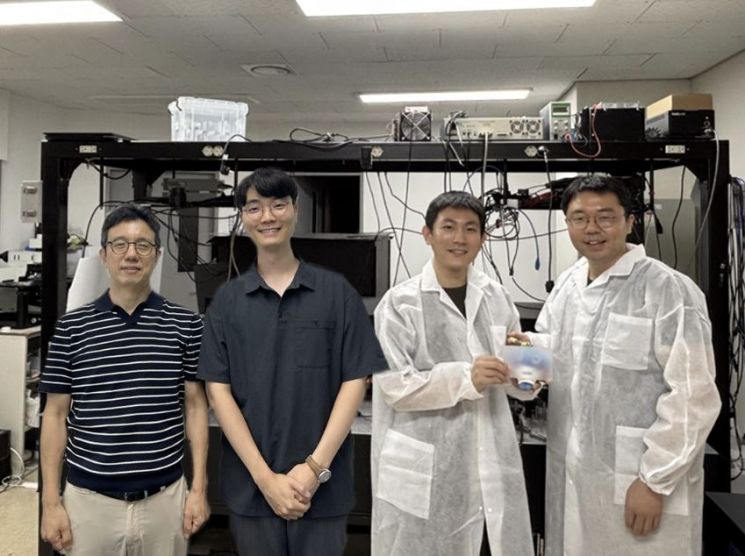 (From left) Professor Ye Jongcheol, Doctoral Candidate Kwon Taeseong, Doctoral Candidate Song Gukho, Professor Jang Museok. Provided by KAIST
Scattering media refer to materials such as fog, smoke, opaque glass, or skin tissue that randomly mix the path of light and distort visual information.
The developed technology utilizes the consistency of temporal axis information to restore blurry or damaged images using a diffusion model.
The joint research team adopted a novel restoration approach by combining an optical model with a video diffusion model to overcome the limitation of existing AI restoration technologies, which only perform well within the range of their training data.
By using this technology, it is possible to clearly restore images to their original form even in environments where light is scattered, such as when headlights appear blurry on a foggy road or when the view through a fogged-up bathroom window is distorted.
In particular, the team introduced a diffusion model that learns the temporal correlation of consecutive images, enabling stable image restoration even when the scattering environment changes over time. This resulted in superior restoration outcomes compared to existing state-of-the-art models, across various distances, thicknesses, and noise conditions.
Additionally, by introducing an optimization technique that adaptively performs haze removal, image quality enhancement (high-resolution frame generation), and blind deblurring (sharpening blurry images) without additional training, the "video diffusion-based image restoration technology" has the potential to be expanded into a universal restoration framework.
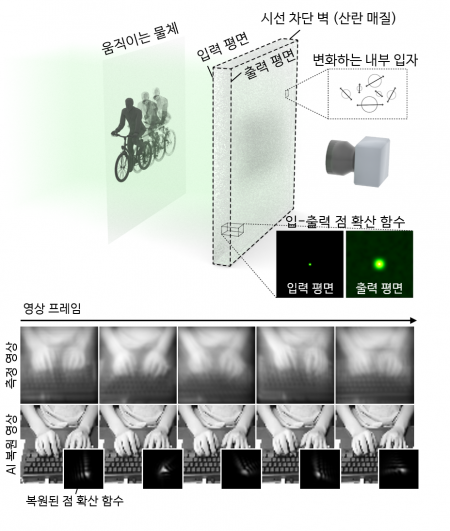
The joint research team expects that, as a universal restoration framework, this technology could be widely used in everyday life and industry, including non-invasive medical diagnostics that look inside blood and skin, rescue operations in smoke-filled fire scenes, non-line-of-sight imaging using light reflected from walls, safe driving assistance on foggy roads, and industrial inspection inside opaque glass or plastic.
Kwon Taesung, a doctoral candidate at KAIST, said, "This study has confirmed that a diffusion model trained on temporal correlations is effective in solving the optical inverse problem of restoring 'invisible data beyond moving scattering media.' In the future, we plan to expand our research scope to various optical inverse problems that require tracking the temporal changes of light, in addition to haze removal, image quality enhancement, and blind deblurring."
This research included Kwon Taesung and Song Gukho, doctoral candidates at the KAIST Department of Bio and Brain Engineering, as co-first authors. The results were recently published in the AI journal 'IEEE Transactions on Pattern Analysis and Machine Intelligence (TPAMI)'.
© The Asia Business Daily(www.asiae.co.kr). All rights reserved.
![Clutching a Stolen Dior Bag, Saying "I Hate Being Poor but Real"... The Grotesque Con of a "Human Knockoff" [Slate]](https://cwcontent.asiae.co.kr/asiaresize/183/2026021902243444107_1771435474.jpg)

















