Careless Bodyguards Provided Key Clues
to the Whereabouts of Iran’s Top Officials,
Says The New York Times
Foreign media have reported that the background behind the assassinations of Iran's senior officials and nuclear scientists during the war with Israel involved the hacking of bodyguards' mobile phones.
The New York Times (NYT) reported on August 30 (local time) under the headline "Israel Targets Iranian Leadership, Finds a Weak Link: Their Bodyguards" that a security loophole in Iran was the mobile phones of bodyguards.
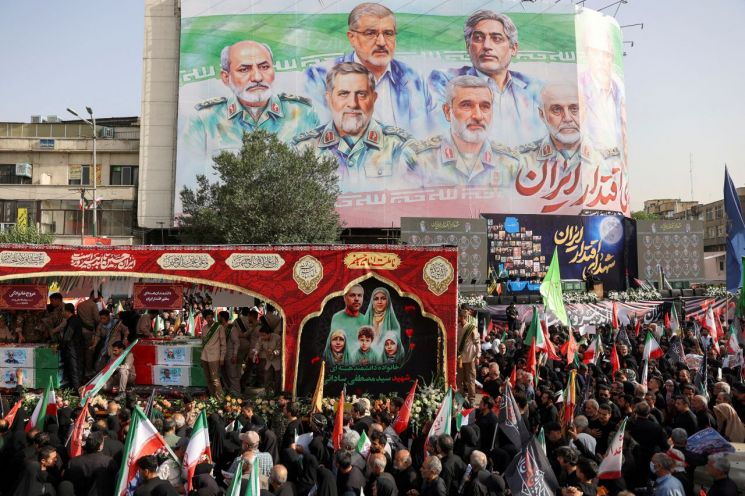
Based on interviews with 16 individuals, including senior Iranian officials, members of the Islamic Revolutionary Guard Corps (IRGC), and Israeli military and intelligence officials, the NYT reported that Israel hacked the bodyguards' mobile phones to pinpoint the exact locations of key Iranian figures and subsequently carried out assassination operations.
According to the NYT, on June 16, the fourth day of the war between Iran and Israel, President Masoud Pezeshkian and other top Iranian officials convened an emergency meeting in a deep mountain bunker west of Tehran, the capital. This came after several days of precise Israeli airstrikes had resulted in the deaths of high-ranking military commanders and nuclear scientists.
The attendees did not carry mobile phones to avoid Israeli tracking. The meeting began under tight security, but moments later, six bombs were dropped at the entrance of the bunker. While those inside the bunker were unharmed, the bodyguards waiting outside lost their lives.
Sasan Karimi, an Iranian political analyst, explained, "Although senior officials and commanders did not carry mobile phones, their bodyguards or drivers did. They did not take preventive measures seriously, and this is the main reason why most key figures were tracked."
It was also reported that the careless use of mobile phones by bodyguards, such as posting on social media for years, became a decisive clue.
From late last year until June this year, Israel formed so-called "decapitation teams" to meticulously select assassination targets. Based on Iranian nuclear documents obtained by the Mossad in 2018, the list of targeted scientists was narrowed from 400 to 100, and according to Iranian sources, 13 nuclear scientists were successfully eliminated.
At the same time, through the "Red Wedding Operation," named after a massacre scene from the popular drama "Game of Thrones," at least 30 senior military officials, including Amir Ali Hajizadeh, commander of the IRGC Aerospace Force, were assassinated in succession. Commander Hajizadeh's son said that his father was always particularly cautious about mobile phones, even with his own family. However, the lack of attention to the bodyguards' phones became a fatal weakness.
As the risk of war escalated, Iran's Supreme Leader Ayatollah Ali Khamenei strictly warned key figures not to use mobile phones or the WhatsApp messenger and ordered a significant increase in security personnel. However, this became an opportunity for Israel. An Israeli Defense Ministry official stated, "Having many bodyguards actually became a vulnerability, and we were able to exploit it."
The hacking of bodyguards' mobile phones was only part of Israel's meticulous assassination operations. It was explained that combining spies operating inside Iran with advanced technology has long been Israel's strategy. Ahmad Vahidi, the IRGC's Chief Commander, said, "The enemy (Israel) obtains most of its information through technology, satellites, and electronic data. They can locate people, gather information, identify their voices and images, and pinpoint their locations with precision satellites."
© The Asia Business Daily(www.asiae.co.kr). All rights reserved.

















