Convenience Store Industry Renews Calls for More OTC Products
No Progress Amid Pharmacists' Concerns Over Misuse
Enhancing Consumer Convenience as Key Justification
Gradual Expansion Proposed as a Solution
With Daiso leading the way, the sale of health functional foods has been spreading across offline retail channels, expanding consumer options focused on accessibility and cost-effectiveness, which has been positively received. In this context, there is a growing call to increase the number of over-the-counter essential medicines (OTC medicines) available at convenience stores, which has remained unchanged for over a decade. However, pharmacist groups have voiced strong opposition, arguing that medicines closely related to public health could be misused or abused without expert guidance, preventing further progress in discussions.
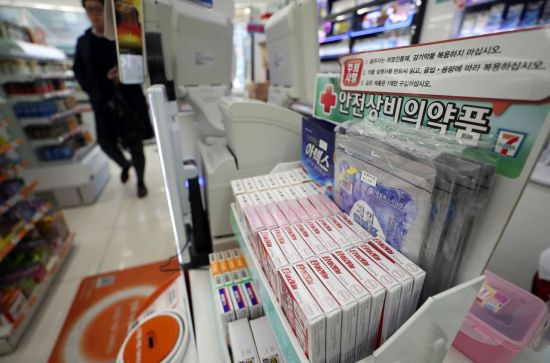 Over-the-counter medicine stocked at a convenience store. Photo by Yonhap News
According to industry sources on August 30, the convenience store industry has, for several years, prioritized the public interest of enhancing consumer convenience and has been demanding an increase in the number of OTC medicines that can be stocked and sold at convenience stores.
Under the current Pharmaceutical Affairs Act enforcement regulations, convenience stores in South Korea are permitted to sell up to 20 designated OTC medicine products. This system was introduced in 2012 by revising the Pharmaceutical Affairs Act to address the inconvenience of purchasing medicines during late-night hours and public holidays. Based on this, 13 items, including cold medicines, antipyretics, analgesics, digestive aids, and anti-inflammatory drugs, were designated. Although it was initially planned to review and update the list of designated products every three years, there has been no expansion in the past 13 years. Moreover, with the discontinuation of Tylenol 80mg and 160mg among the existing products, only 11 items are currently available.
The convenience store industry argues that even if the full quota of 20 products is not met, at least some frequently requested items with relatively low risk of side effects-such as antacids, antidiarrheals, and burn ointments-should be added. Ultimately, they claim this would increase consumer choice and convenience when purchasing OTC medicines and reduce both the time and financial losses for those with minor illnesses. Consumers who urgently need OTC medicines during late-night hours or holidays, when pharmacies are closed, could easily purchase them at one of the approximately 50,000 convenience stores nationwide. The industry has consistently conveyed these requests to both policymakers and relevant government ministries, citing these reasons.
Consumer perception of expanding OTC medicine options has also been positive. According to a 2023 survey conducted by the Consumer Public Interest Network, 62.1% of respondents said that expansion was necessary. In fact, 71.5% reported having purchased OTC medicines at convenience stores, and among those who had not, 40.6% cited the lack of desired OTC medicine options as the reason.
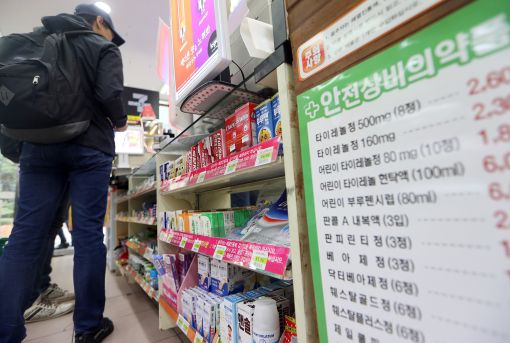 Cold medicines and other essential drugs are stocked at a convenience store in Seoul. Photo by Yonhap News
On the other hand, pharmacist groups such as the Korean Pharmaceutical Association oppose expanding the list, citing concerns that misuse and abuse could harm public health. There is also a perception that expansion would serve the profit motives of convenience stores. As a result, even though the Fair Trade Commission selected the adjustment of OTC medicine regulations as a "task for improving anti-competitive regulations" in 2019 and decided in 2023 to establish a review committee for designating OTC medicines, the committee has yet to be formed.
In response, a representative from the convenience store industry stated, "Sales of OTC medicines account for only about 0.3% of total convenience store sales, which is negligible," emphasizing, "This should be viewed from the perspective of enhancing consumer convenience as a public interest, rather than for profit." The representative added, "According to information disclosed by the Ministry of Health and Welfare, there have been no reported cases of adverse effects, which addresses concerns about lack of expertise or misuse raised by pharmacist groups. Nevertheless, if a cautious approach is necessary, we should consider gradually expanding the list starting with medicines that have a low risk of misuse."
© The Asia Business Daily(www.asiae.co.kr). All rights reserved.
















