Up 10.1% Year-on-Year, Surpassing Overall Government Budget Growth
AI, Mobility, and Culture Projects Included, Laying the Foundation for Growth
Positive Outlook for Securing Modern Art Museum, History Museum, and National Assembly Library
Kang Kijeong: "Shifting to National Assembly Response System... All-Out Effort for Additional Funding"
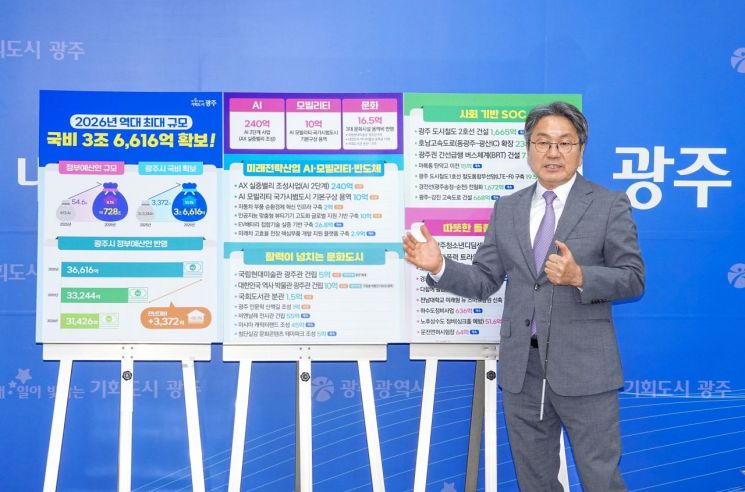 Kang Kijeong, mayor of Gwangju, is explaining the '2026 Government Budget Proposal' at the city hall press room on the 29th. Gwangju City secured a record-high national subsidy of 3.6616 trillion won. Provided by Gwangju City
Gwangju City announced on the 29th that it has secured a record-high national subsidy of 3.6616 trillion won in the 2026 government budget proposal. This achievement is the result of both the expansionary fiscal policy of the Lee Jaemyung administration and Gwangju City’s proactive efforts to secure funding.
This year’s budget represents an increase of 337.2 billion won (10.1%) compared to the previous year’s government budget. It is evaluated as not only a numerical rise but also as a new turning point for regional development. In particular, numerous future strategic projects, such as artificial intelligence (AI), mobility, and cultural infrastructure, have been included, drawing significant attention.
In the AI sector, core projects of the second phase of the AI initiative have been included in the national subsidy. Notable examples include the establishment of the AX Demonstration Valley, the basic plan for the AI Mobility National Pilot City, and the creation of an innovative infrastructure for the automotive parts circular economy. Through these projects, Gwangju is expected to emerge as the center of AI innovation in South Korea.
There is also a positive outlook for the development of a cultural city. The city has laid the groundwork to attract three major national cultural facilities: the Gwangju branch of the National Museum of Modern and Contemporary Art, the Gwangju branch of the National Museum of Korean Contemporary History, and a branch of the National Assembly Library. Various cultural projects, such as Asia Character Land and a high-tech cultural content theme park, have also been reflected in the budget.
In the area of social overhead capital (SOC), projects to improve transportation infrastructure, such as the construction of Urban Railroad Line 2, the expansion of the Honam Expressway, and the electrification of the Gyeongjeon Line, are expected to gain momentum. In addition, the city will actively invest in social care, including support for senior employment, the construction of a youth center, and the operation of the National Trauma Center for Victims of State Violence.
This year, Gwangju City achieved remarkable results by introducing a "step-by-step strategy" and a "one-team approach" to secure national funding. The city will not rest on its laurels with the government budget proposal and plans to shift to a National Assembly response system starting in September to make every effort to secure additional national funds.
The city will meticulously review its funding strategies through a national subsidy briefing and will actively persuade local National Assembly members, party leaders, and members of the Special Committee on Budget and Accounts until the government budget is finalized.
Major projects targeted for increased funding in the National Assembly include the establishment of a support center for vertical take-off and landing aircraft flight safety demonstration tests, the relocation of military bases, and the creation of a Democracy History Park. In particular, for the construction of the Gwangju-Daegu Dalbit Railway, six cities and provinces are collaborating to seek innovative national funding strategies, such as exemption from preliminary feasibility studies.
Mayor Kang Kijeong stated, "We have secured a larger national budget than last year, and many future growth engines and key regional projects, such as artificial intelligence, mobility, and culture, have been included in the government budget proposal. This achievement was made possible through the cooperation of Gwangju City officials and local National Assembly members. Once the budget proposal is submitted to the National Assembly, we will fully shift to a National Assembly response system and make every effort to secure as much national funding as possible until the final approval."
© The Asia Business Daily(www.asiae.co.kr). All rights reserved.

















