Record Budget Increase of 526 Billion Won from Last Year
Comprehensive Achievements in Railways, Energy, and More
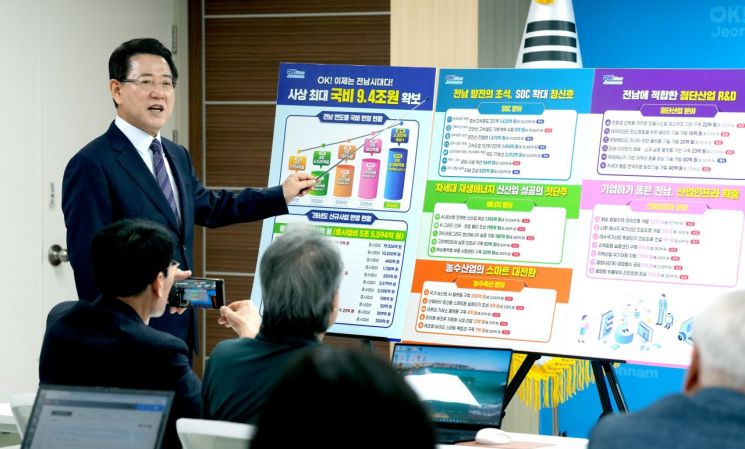 Jeollanam-do Governor Kim Youngrok held a press briefing on the 29th at the provincial government briefing room regarding the "2026 National Treasury Budget Proposal Reflected in the Government Budget" and stated, "Approximately 9.4 trillion won in national funds has been secured in the 2026 government budget, an increase of 526 billion won compared to last year." Provided by Jeonnam Province
Jeollanam-do has achieved the inclusion of 9.4188 trillion won in the 2026 government budget proposal. This is the largest amount ever, increasing by 526 billion won (6%) compared to last year, and includes a significant number of Jeollanam-do’s current priority projects as well as future growth engine initiatives.
Based on this achievement, Jeollanam-do aims to secure a final total of more than 9.7 trillion won by pushing for an additional increase of over 300 billion won during the National Assembly’s review process.
Governor Kim Youngrok stated, “We were able to achieve this meaningful result through strategies aligned with the government’s principle of national sovereignty and close cooperation with city, county, and regional National Assembly members.”
Governor Kim added, “Despite challenging fiscal conditions such as the global economic slowdown and a shortfall in tax revenue, Jeollanam-do has once again made history. Now, Jeollanam-do is confidently moving beyond the era of 9 trillion won in national funding toward the 10 trillion won era, and we are able to advance major projects without setbacks.”
He particularly emphasized, “Key projects that we have persistently advocated for, such as the second phase of the Honam High-Speed Railway and the electrification of the Gyeongjeon Line, have been included. In addition, 49 new projects amounting to 272.4 billion won (with a total project cost of 5.5594 trillion won) to secure Jeollanam-do’s next 100 years have been reflected, signaling a green light for establishing a new growth foundation.”
By sector, the secured budget for SOC (social overhead capital), which will be the cornerstone of Jeollanam-do’s development, includes: 163.2 billion won for the second phase of the Honam High-Speed Railway between Gwangju Songjeong and Mokpo; 500 million won for the basic plan for the Jeolla Line high-speed railway connecting Iksan in Jeollabuk-do and Yeosu; and 167.2 billion won for the electrification of the Gyeongjeon Line between Gwangju Songjeong and Suncheon.
For projects nearing completion, the following have been fully funded: 133.6 billion won for the Gangjin~Gwangju Expressway (first phase of the Gwangju~Wando Expressway); 8 billion won for the basic plan and design of the Gangjin~Wando Expressway (second phase of the Gwangju~Wando Expressway); 109.5 billion won for the Yeosu Hwatae~Baekya Road; and 91.7 billion won for the Shinan Aphae~Haenam Hwawon Road.
For projects entering full-scale construction, 52 billion won has been allocated for the Yeosu~Namhae Undersea Tunnel, and 9.6 billion won for facility improvements at Muan and Yeosu Airports to establish international airport-level navigation safety facilities and runways. Muan International Airport will install bird detection radar and refurbish the runway to enhance its status, while Yeosu Airport will expand the runway safety zone and longitudinal safety area, and strengthen safety facilities by installing bird detection radar.
In the next-generation renewable energy industry sector, aimed at establishing Jeollanam-do as Korea’s energy capital, the following have been included: 119.6 billion won for fostering a new AI-based distributed power grid industry to alleviate grid saturation from renewable energy generation; 19.5 billion won for the creation of the K-Grid Talent and Startup Valley to support professional training and startups among universities, research institutes, and companies, as well as demonstration of distributed energy grids; 18 billion won for microgrid distributed energy demonstration support; 5 billion won for high-power semiconductor demonstration infrastructure; and 2 billion won for establishing a test center for offshore wind power components to lead localization of offshore wind power parts.
In the agriculture, fisheries, and livestock sector: 20 billion won has been secured for the national agricultural AI platform project to enhance global competitiveness and smart transformation of agriculture; 400 million won for the implementation design of a smart farm demonstration complex for forest mushrooms and forest products; and 400 million won for equipment for the dried seaweed trading platform to standardize international transactions for dried seaweed, Jeollanam-do’s top agricultural export product.
For advanced research and development (R&D) and strategic industries that will drive Jeollanam-do’s next 100 years: 2.2 billion won for establishing production and supply infrastructure for cryogenic insulation systems for eco-friendly ships, such as liquefied hydrogen and gas; 1.6 billion won for thermal management technology development for carbon-neutral data centers and route marker battery development; 2 billion won for marine battery data hub platform technology development; 2.3 billion won for building a demonstration platform for future secondary battery materials to support small and medium-sized enterprises from development to demonstration; and 4 billion won for developing next-generation convergent immunotherapy source technology in the Hwasun vaccine special zone to combat cancer cell resistance.
To make Jeollanam-do a business-friendly region and expand industrial infrastructure: 3.2 billion won for basic planning and design of the Hwasun Abandoned Mine Area Economic Promotion Development Project to foster alternative industries in the early-closed mining area; 200 million won for the construction of an access road to the Naju Energy National Industrial Complex to improve accessibility and accelerate activation; 100 million won for the construction of an access road to the expanded Yeosu National Industrial Complex; 500 million won for the construction design of a scale-up demonstration center for one-stop support from incubation to demonstration for advanced technology-based venture startups; 200 million won for the supply of industrial water for the fourth phase of Gwangyang; 17.9 billion won for the regional industry crisis response support project to overcome the petrochemical industry crisis; 5.5 billion won for copolymer technology development; 4 billion won for CO2 pretreatment liquefied bunkering demonstration technology development; and 5.5 billion won for the development and demonstration of onboard CO2 capture technology.
For the “Global Attractive City Jeollanam-do” initiative, the following have been included: 3.5 billion won for the design of the National Maritime and Fisheries Museum, which will become Korea’s representative maritime and fisheries museum; 300 million won for establishing a base institution for nurturing talent in animation and webtoon production companies, the so-called “K-Disney” project; and 66.3 billion won for the Southern Region Wide-Area Tourism Development Project. New projects include 1 billion won for developing the Baeksu Coastal Tourism Landscape in Yeonggwang, 500 million won for expanding Damyang Dam Tourism Stay, and 400 million won for developing the Jangseong K-Temple Food Tourism attraction.
For building a disaster-safe Jeollanam-do and enhancing residents’ convenience, the following have been included to prepare thoroughly for natural disasters caused by recent climate change: 3.7 billion won for 15 natural disaster risk areas; 3.4 billion won for eight disaster-risk reservoirs; 4.2 billion won for nine flood and storm damage-prone living zones; 2.2 billion won for 18 steep slope maintenance projects; and 700 million won for the Goheung circular landfill facility maintenance.
Jeollanam-do is not content with these achievements and plans to work closely with local National Assembly members during the parliamentary review process to secure at least an additional 300 billion won, striving to achieve a total of 9.7 trillion won in national funding for 2026.
The main projects proposed for budget increases at the National Assembly, which will serve as future growth engines for Jeollanam-do, include: an additional 99.8 billion won for the second phase of the Honam High-Speed Railway between Gwangju Songjeong and Mokpo; an additional 5 billion won for the four-lane expansion of National Road No. 15 between Goheung and Bongrae; and an additional 98.8 billion won for connecting National Road No. 77 between Aphae~Hwawon and Hwatae~Baekya.
Governor Kim stated, “During the National Assembly’s review, we will make every effort, including close cooperation with lawmakers from both the ruling and opposition parties, to ensure that key projects for Jeollanam-do’s next 100 years are included, and to secure as much budget as possible until the final parliamentary approval.”
© The Asia Business Daily(www.asiae.co.kr). All rights reserved.

















