Water Quality and Landscape Improvements Planned for Pungam Lake
Residents Hope for a Cleaner, More Pleasant Park
Concerns Remain About Construction Inconvenience and Lasting Results
National Urban Park Designation Would Bring State Funding and New Status for Gwangju
"Every time I walked here, the smell was so strong that I would give up on my walk. I believe that even just having cleaner water will make a difference."
On the morning of the 29th at Pungam Lake in Seo-gu, Gwangju, a local resident recalled longstanding inconveniences and expressed hope for the renovation project.
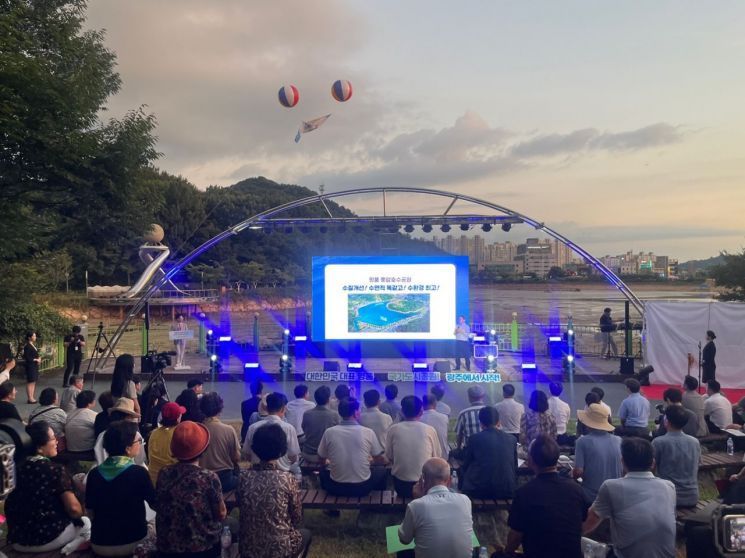 On the afternoon of the 21st, at the outdoor stage of Pungam Lake in Seo-gu, Gwangju, Mayor KiJung Kang of Gwangju spoke at the "Luxury Lake Park Development and National Urban Park Vision Proclamation Ceremony." Mayor Kang said, "Pungam Lake will be reborn as a refined space where citizens can relax in nature," adding, "We will create a luxury lake park of the highest standard in terms of water quality, facilities, and scenery." Photo by BoHyun Song
The city of Gwangju has begun procedures to have Pungam Lake in Jungang Neighborhood Park, Seo-gu, designated as South Korea's first National Urban Park. This follows the National Assembly's passage of an amendment in early August, which lowered the minimum area required for National Urban Park designation from 3 million square meters to 1 million square meters and established the Central Urban Park Committee under the Ministry of Land, Infrastructure and Transport. The Ministry plans to hold the first round of applications and designations around 2027.
On the 21st, the "Luxury Lake Park Development and National Urban Park Vision Proclamation Ceremony" was held at the Pungam Lake area. Mayor KiJung Kang, Seo-gu District Chief LeeGang Kim, members of the residents' council, and about 300 citizens attended. The declaration included four key visions: ▲A green hub in the era of climate crisis ▲A citizen-centered space ▲The succession of peace, human rights, and democracy ▲The creation of South Korea's leading luxury park.
Pungam Lake was originally built as an agricultural reservoir in 1951 and later became a place for citizens to relax as the city developed. However, recurring algae blooms and unpleasant odors during the summer have led to ongoing complaints, and the aging of facilities has also been pointed out as an issue.
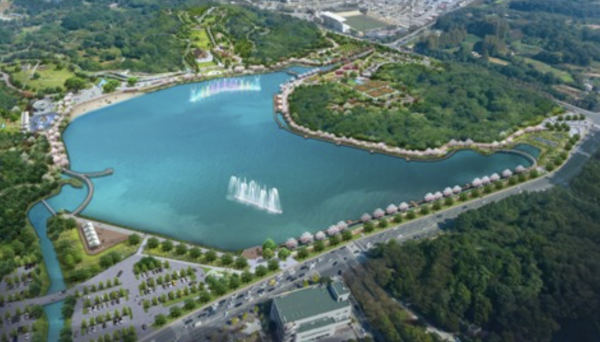
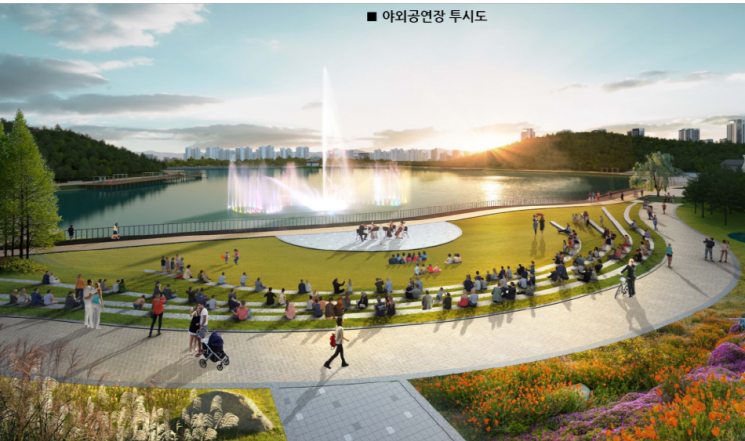
In November 2023, the city of Gwangju reached an agreement with the residents' council and established plans to improve water quality and the landscape. The average water depth will be reduced from 2.8 meters to 1.5 meters, and 1,000 tons of clean water will be supplied daily. A nature-based wetland with a capacity of 3,500 tons and a water circulation system will also be installed. The surrounding area will feature a 2-kilometer walking trail, a 2,500-pyeong rose garden, the largest musical fountain in the country, an outdoor performance hall, and a waterfront deck.
A National Urban Park is an urban park designated under the "Act on Urban Parks and Green Spaces." Although introduced in 2016, none have been designated so far due to strict requirements. With this legal amendment, parks of at least 1 million square meters can now qualify. Gwangju is eligible, having secured the entire 2.8 million square meters of Jungang Neighborhood Park.
The city of Gwangju is aiming to complete the Pungam Lake renovation project by July 2027. Until recently, the water quality at Pungam Lake was rated at Grade 4 to 5. A dedicated water quality task force is working to improve it.
Residents have expressed both anticipation and concerns about inconveniences ahead of the renovation project at Pungam Lake.
Jaeman Kim, Chairperson of the Seo-gu Residents' Autonomy Committee, said, "The biggest problems at Pungam Lake have been water quality and the resulting algae and odor issues. If this project improves the environment and the lake is designated as a National Urban Park, it would be a welcome development."
A citizen living in Kumho-dong commented, "There will be inconveniences during the more than two years of construction, but I am relieved that part of the walking trail will remain open. Still, we will have to wait and see if the water quality truly improves after the work is finished."
The city of Gwangju explained that if designated as a National Urban Park, it will become the first city to have a national-level designation in addition to Mudeungsan National Park and Mudeungsan Area National Geopark. A city official stated, "With management funding provided at the national level, we will be able to operate the park more systematically than before, when we had to rely solely on city resources."
© The Asia Business Daily(www.asiae.co.kr). All rights reserved.
![Clutching a Stolen Dior Bag, Saying "I Hate Being Poor but Real"... The Grotesque Con of a "Human Knockoff" [Slate]](https://cwcontent.asiae.co.kr/asiaresize/183/2026021902243444107_1771435474.jpg)


















