North Korea's GDP Grew 3.7% Last Year, Marking the Highest Rate Since 2016
Per Capita GNI Remains at Just One-Twenty-Ninth of South Korea's
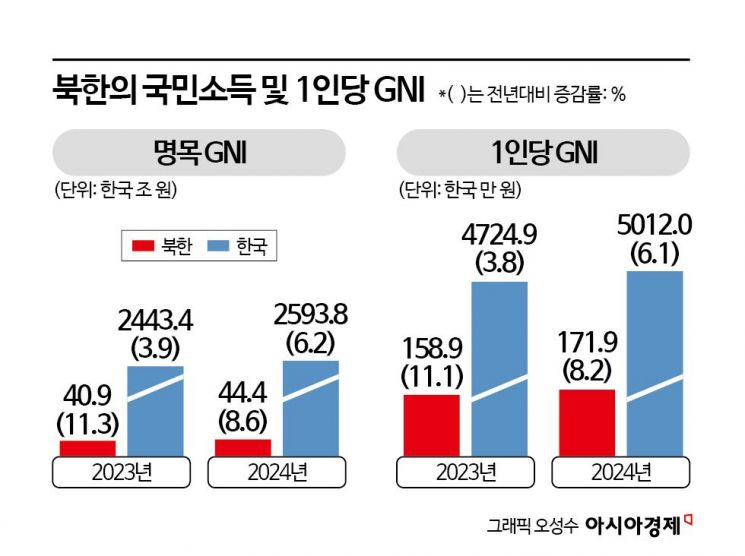
Last year, North Korea's economic growth rate reached its highest level in eight years. This was attributed to the implementation of national policy projects and the expansion of North Korea-Russia economic cooperation. However, North Korea's per capita gross national income (GNI) was 1.719 million won, which is only about one twenty-ninth of South Korea's 50.12 million won.
According to the "2024 North Korea Economic Growth Rate Estimate" released by the Bank of Korea on August 29, North Korea's real gross domestic product (GDP) grew by 3.7% compared to the previous year. This growth was driven by the strengthening of national policy projects such as the Five-Year National Economic Development Plan (2021-2025) and the Local Development 20X10 Policy (introduced in 2024), as well as the expansion of economic cooperation with Russia.
The growth rates of manufacturing, mining, and construction sectors all increased. Manufacturing expanded by 7.0% compared to the previous year, led by primary metal products, assembled metal and machinery, and chemical products, thanks to facility expansion and increased exports of weapons. This is the highest manufacturing growth rate since 7.9% in 1999. Mining grew by 8.8% as production of coal, metals, and non-metals all increased, marking the highest growth since 14.2% in 1999. Construction rose by 12.3%, mainly driven by residential buildings, the highest rate since 13.5% in 2000. In contrast, the agriculture, forestry, and fisheries sector declined. Although fisheries saw a slight increase, decreases in livestock and forestry led to an overall 1.9% drop in the sector.
The industrial structure was centered on mining and manufacturing, services, and agriculture, forestry, and fisheries. As of last year, the share of each sector in North Korea's nominal GDP was as follows: mining and manufacturing (30.5%), services (29.8%), and agriculture, forestry, and fisheries (20.9%). However, the share of these sectors has been decreasing. Compared to the previous year, the shares of services (-1.1 percentage points), agriculture, forestry, and fisheries (-1.1 percentage points), and mining and manufacturing (-0.2 percentage points) all declined. The shares of electricity, gas, and water supply (up 1.8 percentage points) and construction (up 0.6 percentage points) increased.
Last year, North Korea's nominal GNI was 44.4 trillion won, up 8.6% from the previous year. This is only about one fifty-eighth (1.7%) of South Korea's 2,593.8 trillion won. Per capita GNI was 1.719 million won, an increase of 8.2% from the previous year. This is about one twenty-ninth (3.4%) of South Korea's 50.12 million won.
Last year, North Korea's total external trade volume was 2.7 billion US dollars, a decrease of 2.6% compared to the previous year's 2.77 billion dollars. This figure is based on the sum of exports and imports of goods, excluding inter-Korean trade. There were no inter-Korean trade transactions last year, as was the case the previous year.
Exports amounted to 360 million dollars, up 10.8%, mainly due to processed feathers and wigs, optical and slack lime, and ash. Imports totaled 2.34 billion dollars, down 4.4%, mainly due to decreases in fertilizer and grain imports.
© The Asia Business Daily(www.asiae.co.kr). All rights reserved.


















