Over 3,000 Long-Range Missiles Included
$825 Million Arms Sale to Ukraine Receives Preliminary US Approval
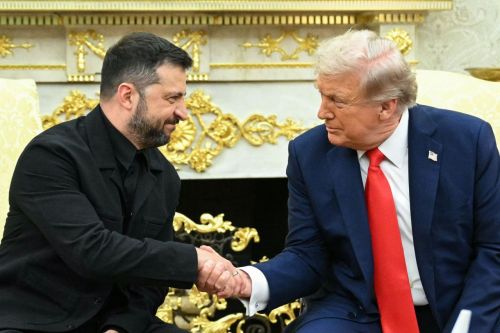 US President Donald Trump (right) and Ukrainian President Volodymyr Zelensky are seen holding a summit at the White House on the 18th (local time). Photo by AFP Yonhap News
On August 28 (local time), the US government gave preliminary approval to a plan to sell weapons to Ukraine worth a total of $825 million (approximately 1.14 trillion won), including more than 3,000 long-range missiles.
The Defense Security Cooperation Agency (DSCA), which operates under the US Department of Defense, announced that it had given preliminary approval for this Foreign Military Sale (FMS) and notified Congress of the decision. Previously, Ukrainian authorities had requested up to 3,350 Extended Range Attack Munition (ERAM) missiles, as well as 3,350 units of navigation equipment and electronic jamming devices.
ERAM is a long-range missile that can be launched from distant aircraft to precisely strike ground and maritime targets. Its modular structure allows for modifications and upgrades depending on the nature of the mission.

Ukraine plans to use funds provided by Denmark, the Netherlands, and Norway, as well as foreign military financing from the United Kingdom, for this weapons purchase. In this regard, the DSCA explained that this is an example of the United States cooperating with North Atlantic Treaty Organization (NATO) allies to expedite the provision of weapons. The DSCA also stated that this sale will enhance the security of partner nations, which serve as engines for political stability and economic development in Europe, thereby supporting the achievement of US diplomatic and security objectives.
The Wall Street Journal (WSJ), citing sources, reported that Ukraine is expected to receive these missiles within about six weeks. The newspaper also noted that the approval for the sale came after President Donald Trump held separate meetings with Russian President Vladimir Putin and Ukrainian President Volodymyr Zelensky.
Initially, President Trump was negative about providing additional support to Ukraine. However, it appears that he shifted his stance to provide further weapons to Ukraine in order to pressure Russia, which has not cooperated with US efforts to mediate a ceasefire. After the US and Russian leaders met in Anchorage, Alaska, on August 15, expectations for an end to the war increased. However, Russia subsequently refused to hold a summit with President Zelensky, citing issues with Zelensky's legitimacy and the terms of a ceasefire.
Meanwhile, the final decision on these weapons sales will be made after approval by the US Congress. Congress has the authority to block the deal during a 30-day review period.
© The Asia Business Daily(www.asiae.co.kr). All rights reserved.


















