Strawberry, Livestock, and Beekeeping Farms Affected by Heavy Rainfall
Gyeongsangnam-do will provide emergency contingency funds to strawberry seedling farms that suffered significant damage from the extreme heavy rainfall in July but are not covered by government compensation programs.
On August 28, the provincial government held a briefing at the press center, announcing, "We will provide 2.37 billion won in contingency funds to help strawberry seedling farms, which suffered severe damage from the recent heavy rainfall, return to farming as soon as possible."
 Lee Junggon, Director of Agricultural Policy Bureau of Gyeongnam Province, is announcing the plan to provide contingency funds to local farms affected by the heavy rain in July. Photo by Lee Seryung
According to Gyeongsangnam-do, the record-breaking heavy rainfall in mid-July caused widespread damage throughout the province, with the western regions, including Sancheong and Hadong, being particularly hard hit.
Among the affected, strawberry farms-one of the region's main income crops-suffered severe losses, with an estimated 27.8% of the strawberry seedling cultivation area in Sancheong and Hadong seeing their seedlings and growing medium designated for disposal.
Farmers typically need to plant autumn strawberry seedlings in September, but with greenhouses destroyed and both seedlings and growing medium submerged or washed away, they have been unable to plant on time, making it impossible to harvest from the main shipping period in November through May of the following year.
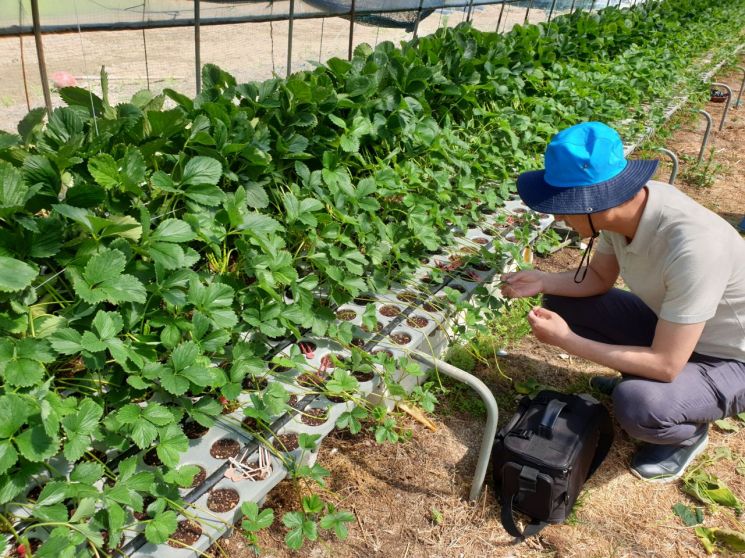 A view of inspecting strawberry seedlings in a strawberry facility greenhouse in Sancheong-gun, Gyeongnam. Provided by Sancheong-gun
However, strawberry seedlings are not included as an item in the crop disaster insurance program, so insurance coverage is not available, and they are also excluded from natural disaster recovery support.
In response, Gyeongsangnam-do will use contingency funds to supply 5.8 million strawberry seedlings and 230,000 units of growing medium, cultivated in other parts of the province, to affected farms in Sancheong and Hadong.
This support is intended to help farms, which have the willingness to continue farming but face significant losses, avoid missing the autumn planting season and continue their strawberry cultivation.
By municipality, 1.57 billion won will be provided to Sancheong-gun and 810 million won to Hadong-gun.
Additionally, the province has requested the central government to include strawberry seedlings as an item in the crop disaster insurance program, to make recovery support for seedling damage more realistic, and to increase the national funding ratio for damaged crops and facilities.
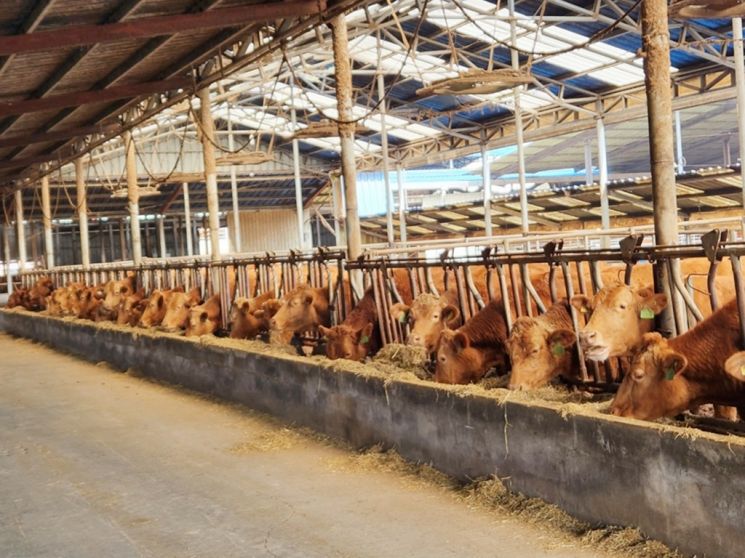
Gyeongsangnam-do will also support local farms raising Korean beef cattle, dairy cows, bees, and poultry that were affected by the heavy rainfall.
The province will allocate 970 million won in contingency funds to provide livestock supplies, such as immune boosters, supplementary feed, and silage, which are not covered by livestock disaster insurance or disaster recovery cost calculations.
Last month’s heavy rainfall resulted in the deaths of 127 Korean beef cattle, 200 pigs, 86,000 chickens, and 15,000 bee colonies in Gyeongsangnam-do, causing damages estimated at 6.4 billion won.
Furthermore, the province will offer a special agricultural and fisheries development fund loan program totaling 20 billion won to stabilize the management of farms and fisheries affected by the heavy rain.
The support will be prioritized for areas with the most severe damage, with 4.5 billion won allocated to Sancheong, 2.5 billion won to Hapcheon, 2 billion won to Uiryeong, 1.5 billion won to Jinju, and 1.5 billion won to Hadong. The final allocation will be adjusted and executed by the province.
Eligible recipients will be confirmed in early September following recommendations and review by each city and county. Once selected, they can receive loans until December 15 of this year.
Operating and facility funds will be provided at a low interest rate of 1% per annum (0.8% for young farmers and fishers). Individuals can receive up to 50 million won for operating funds and 50 million won for facility funds, while corporations can receive up to 70 million won for operating funds and 300 million won for facility funds.
Operating funds must be repaid in equal installments over three years after a one-year grace period, while facility funds must be repaid in equal installments over three years after a two-year grace period.
Additionally, Gyeongsangnam-do will grant a one-year repayment extension and interest reduction during the extension period for existing fund borrowers who are farmers, corporations, or producer organizations in special disaster areas.
Applications will be accepted until September 30 and must be submitted to the relevant NH Nonghyup city or county branch, along with a certificate verifying the damage.
Lee Junggon, Director of the Agricultural Policy Bureau, stated, "Our province will focus all of its resources on helping farms recover from the heavy rainfall and return to normal life," adding, "We will continue to closely monitor the situation on the ground and pursue institutional improvements so that every farmer can quickly recover from the disaster and return to their livelihood."
© The Asia Business Daily(www.asiae.co.kr). All rights reserved.



















